
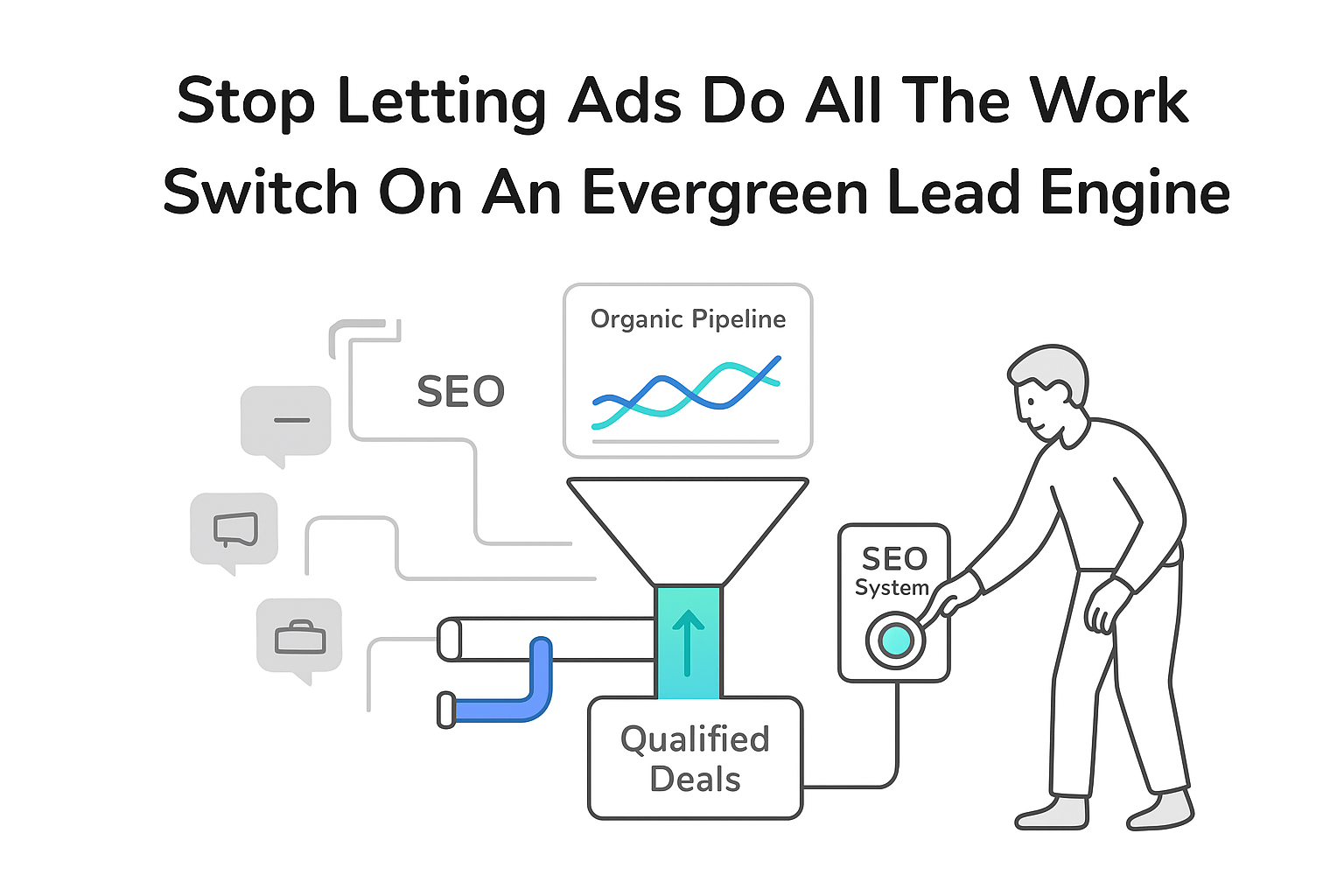
If I run a B2B service company and feel like my pipeline depends on paid ads, referrals, and luck, I’m not alone. I see a common pattern: many CEOs reach the $50K-150K monthly recurring revenue range and start to feel a ceiling. Ads get more expensive, outbound starts hitting diminishing returns, and referrals are impossible to forecast. That’s where a serious approach to B2B SEO starts to matter - not as a buzzword, but as a more reliable engine that keeps sending qualified buyers to the sales team while ad spend stays under control.
The real objective of B2B SEO for service companies
B2B SEO is only useful when it drives business outcomes. For service-based companies, the practical objective is to create a compounding pipeline from organic search - one that lowers blended customer acquisition cost over time and supports larger contracts.
Instead of chasing vanity metrics like “more traffic,” I focus on outcomes like:
- Getting in front of the right decision-makers when they search for problems I solve
- Turning that search traffic into real sales conversations (requests for proposals, demos, discovery calls)
- Keeping blended CAC lower over time than a paid-only or outbound-only approach
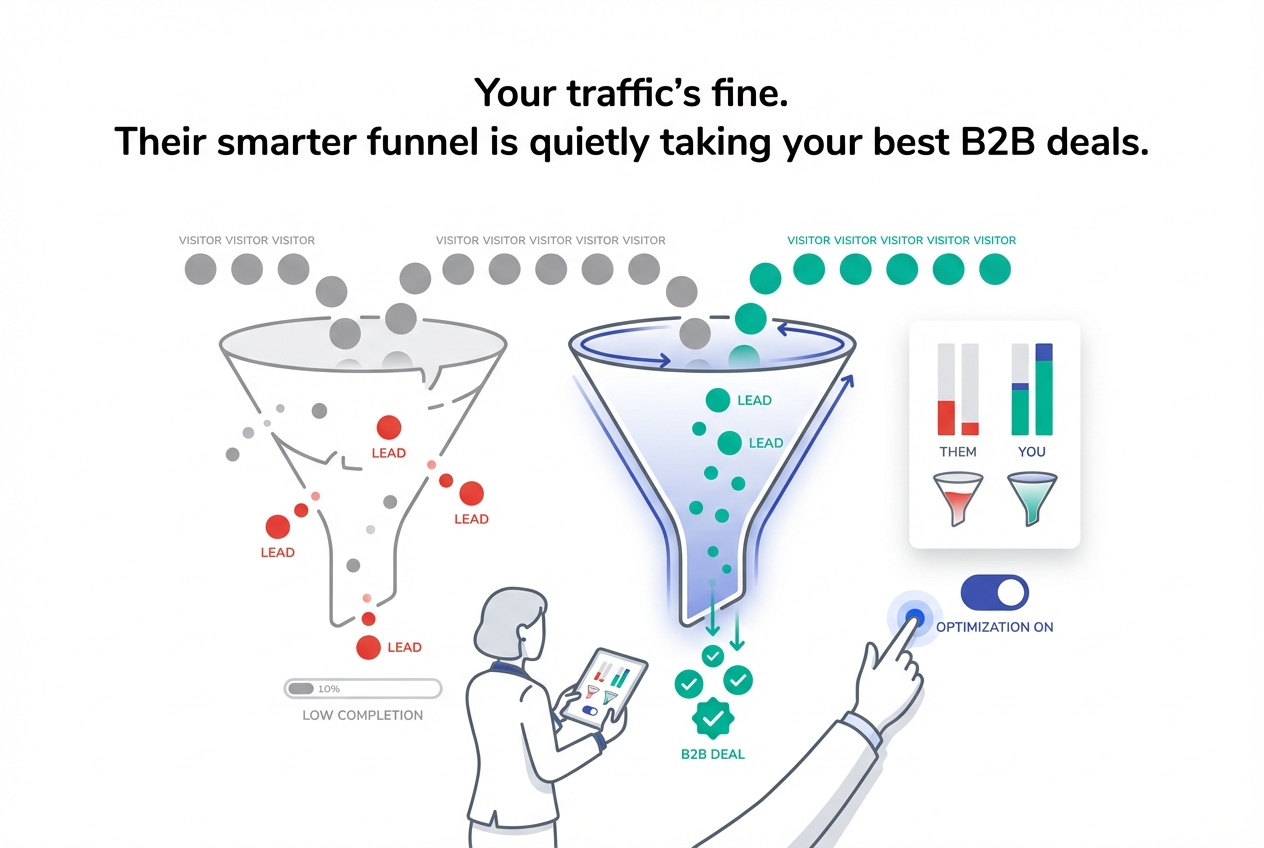
For a CEO in that $50K-150K MRR range, the “before vs after” usually isn’t about replacing every other channel. It’s about changing the source mix so paid and outbound stop carrying the entire burden. Before SEO, it’s common to see most leads coming from paid, a meaningful chunk from referrals, and a small amount of inconsistent inbound. After a focused SEO effort matures, organic can become a material share of leads month after month - which typically stabilizes CAC and reduces stress when auctions get more competitive.
If you want a tighter way to connect SEO execution to revenue outcomes, see LLM agents that standardize CRM notes into reliable fields and measuring pipeline impact of seo for practical reporting and attribution patterns.
Why SEO looks different for B2B services (and where growth gets stuck)
SEO for B2B service companies is not like SEO for low-ticket ecommerce. The offer is complex, the sales cycle is longer, multiple stakeholders are involved, and one deal can be worth six figures. That changes what “good SEO” even means.
In practice, growth challenges usually show up like this: the pipeline leans too heavily on referrals; paid channels still work but every incremental lead costs more; a louder competitor seems to be everywhere in search and starts getting pulled into RFPs earlier; and attribution gets fuzzy because buyers may say they “heard about you somewhere” after doing weeks of private research.
I like to ground this in a scenario. Imagine an IT consultancy that depends on events and outbound while a competitor ranks for queries like “cloud migration roadmap,” “Azure migration costs,” and “cloud migration partner for healthcare.” That competitor gets pulled into serious conversations earlier - not because their delivery is necessarily better, but because their visibility matches how buyers research.
The gap SEO closes is simple: it puts me in the room earlier in the buying journey, when the shortlist is being formed. If you’re seeing competitors “show up everywhere,” this is also where focused ai assisted competitive messaging analysis can help you diagnose what they’re ranking for, how they position, and where you can win.
B2B SEO strategy vs paid acquisition (and the objections I hear most)
Paid channels feel direct: spend money, get clicks. SEO feels slower. But over a 12-24 month horizon, SEO can become one of the highest-margin acquisition channels because it behaves more like an asset than an ongoing rental.
The three objections I hear most are: “I already run Google Ads,” “SEO takes too long,” and “my buyers don’t search for what I do.” Each has some truth. The mistake is treating them as conversation-stoppers instead of testing them against real buyer journeys and unit economics.
Here’s a practical comparison:
| Channel | Time to first results | CAC trend over time | Lead quality | Control and risk |
|---|---|---|---|---|
| B2B SEO strategy | Early signs in ~2-3 months; meaningful pipeline often 6-12+ months | Often drops as content compounds | Often high intent (research-driven) | Less tied to auctions; sensitive to quality and consistency |
| Paid search / social | Immediate | Often rises as auctions get crowded | Mixed (depends on targeting and offer) | High control, but fragile to cost swings |
| Outbound / SDRs | Weeks to months | Flat or rising with headcount | Depends on list quality + messaging | Effort-heavy; easy to burn lists and goodwill |
Paid is not “bad.” I often see paid work best when it complements SEO - especially for fast testing and for capturing demand on high-intent terms. The difference is sustainability: with SEO, I’m building positions that can keep producing leads without paying for every click.
A strong B2B SEO strategy also doesn’t obsess over one generic keyword. It aims to capture demand across the buying journey: early problem queries (“why is churn rising after onboarding”), solution exploration (“revenue operations consulting”), and comparison-stage searches (“RevOps agency vs in-house,” “managed SOC provider pricing”). For more on building keyword strategy from real sales conversations, see b2b saas trial intent keywords.
How I think about building a B2B lead generation engine with SEO
I treat B2B SEO as a system: it turns buyer questions into discoverable pages, and those pages into pipeline. Not through tricks - through relevance, clarity, and credibility.
The work usually breaks down into a few connected parts:
- Research: understanding the market, the ICP, and the exact language buyers use when searching
- Positioning and messaging: making sure the content doesn’t sound interchangeable with every other firm in the category
- Content assets: building pages that match real queries (service pages, comparison pages, case studies, deep guides)
- On-page clarity: structuring pages so both search engines and humans can quickly understand what they’re about (titles, headings, internal links, supporting sections)
- Authority: earning relevant mentions and links that signal trust (for example through industry publications, digital PR, collaborations, or expert contributions)
- Continuous optimization: updating what works, improving what’s close, and pruning what doesn’t earn attention or leads
Where this becomes truly “B2B” is in mapping search intent to real buying contexts. I’m not collecting keywords in isolation; I’m mapping how buyers think at different moments. What triggers the search? What do they type at 11pm when a project goes sideways? What do they search right before asking for budget? What do they compare when shortlisting vendors?
For example, in a consulting business, early queries might be “customer churn after onboarding” or “sales team missing quota reasons.” Mid-journey queries shift into framing and solution searches like “B2B sales process audit” or “customer journey mapping consulting.” Late-stage queries often include pricing, comparisons, and vendor selection language. If your site is already publishing heavily, it’s also worth avoiding self-competition across similar pages - b2b saas keyword cannibalization fixes covers the patterns that quietly cap growth.
When I line those queries up, I can almost see the buyer journey moving from problem recognition to partner selection. The SEO goal is to show up consistently along that line - so the buyer repeatedly encounters my point of view and proof before a sales conversation even starts.
Turning rankings into revenue (without getting lost in vanity metrics)
Rankings are not the finish line. Pipeline is. To keep SEO grounded, I track a simple chain that connects search activity to revenue:
- relevant organic sessions (not just any traffic)
- qualified leads attributed to organic
- sales-qualified leads and opportunities sourced from those leads
- pipeline value and closed revenue influenced or sourced by organic
When I model ROI, I treat it as a planning example - not a promise - because conversion rates, deal size, and sales cycles vary by industry. But the math itself should be straightforward. If organic brings in more qualified leads, and a predictable portion of those leads becomes opportunities and closed deals, I can estimate payback time and compare CAC to paid channels.
The key is accountability: if reporting can’t connect organic work to sales outcomes (even imperfectly), SEO starts to feel like a black box. If you want a concrete reporting approach, b2b saas search to pipeline reporting is a useful reference point.
One practical note on “assets” that earn links: downloadable resources can work well when they’re genuinely helpful. For example, a standalone resource like Download PDF is the kind of format that can attract citations because it’s easy to reference, share, and save.
A realistic SEO timeline for B2B service companies
SEO has a reputation for being slow and fuzzy. I think it’s slower than paid, yes - but it doesn’t have to be fuzzy if expectations and leading indicators are clear. Assuming an established domain and consistent execution, I typically expect:
In the first 30-60 days, the focus is on fixing technical friction, confirming measurement, defining the content strategy, and publishing initial pages. Early ranking movement often shows up first on long-tail terms.
Between roughly 60-120 days, more pages go live, impressions and clicks rise, and the first non-branded leads can start appearing - especially if the niche is focused and the content matches high-intent queries.
Around months 4-9, stronger pages begin to accumulate authority, more competitive terms become reachable, and sales teams often start hearing variations of “I found you on Google and read your article on X.”
From 9-18 months, the compounding effect becomes more obvious: older pages keep producing, new pages expand reach, and organic becomes a steady share of the overall pipeline.
What speeds this up is existing authority, a clear niche, access to subject-matter expertise, and quick implementation. What slows it down is starting from a brand-new domain, operating in extremely competitive categories, long internal approval cycles, or a weak inbound follow-up process that fails to convert interest into opportunities.
If your team feels “stuck” at a revenue plateau while costs rise, Real-time AI coaching for discovery and demo calls pairs well with SEO work because it improves the conversion layer once inbound demand starts increasing.
Keeping SEO cost-effective without cutting corners
Cost-effective SEO isn’t about doing “cheap SEO.” It’s about sequencing the right work so the business gets traction without wasting effort on low-leverage activities.
I prioritize in this order: first, fix what prevents pages from being crawled, understood, or converted (technical issues, confusing structure, missing measurement). Next, capture what the company already deserves - clear service pages and content around problems the team already solves well. Then, build authority around the highest-value topics (the ones tied to real deal flow), and expand into adjacent areas only after the initial clusters are performing.
Budgeting-wise, I think it’s more useful to compare SEO to the dynamics of paid spend than to treat it as an isolated line item. Paid often keeps costing the same (or more) to maintain volume. SEO typically costs upfront to build assets; revenue lags at first, then bends upward if the strategy is sound and the content earns trust. That widening gap between ongoing investment and compounding returns is where SEO can improve margins over time.
For teams that want a clearer operating system (planning, publishing cadence, internal links, updates), b2b saas technical seo monitoring lays out a repeatable approach.
What I look for in a specialized B2B SEO partner (or internal team)
Whether the work is done in-house, with contractors, or with an external team, specialization matters in B2B. The people executing SEO need to understand long sales cycles, multi-stakeholder decisions, and the difference between a random lead and an ICP-matched opportunity.
At a minimum, I look for four things: a strategy that prioritizes revenue potential over raw search volume; execution that reliably ships (content, on-page work, technical fixes, authority-building); reporting that ties performance to pipeline rather than only rankings; and a willingness to change course when the data says something isn’t working.
Just as important: SEO shouldn’t require constant micromanagement. If the operating rhythm is unclear - what’s being produced, what’s live, what’s being updated, and why - momentum dies quickly.
One quick reminder on authority: sometimes the fastest way to clarify “how systems connect” is to use simple models and analogies. If you’re unfamiliar with graph-style thinking (relationships, networks, paths), there’s background context more here. You don’t need it to execute SEO, but it can help when you’re mapping how buyers move from problem to shortlist.
Conclusion
B2B SEO, when done with focus and honest measurement, gives B2B service companies a way to build an always-on engine for high-intent, high-value leads. Instead of living at the mercy of rising ad costs or the next referral spike, I can build a search-driven pipeline that compounds over time.
The big shift is thinking of SEO less as “content and rankings” and more as a structured way to meet buyers where they already are: researching problems, exploring solutions, and shortlisting partners. When I map that behavior to content, track outcomes back to opportunities and revenue, and stay consistent long enough for compounding to kick in, SEO stops being a black box and starts functioning like a predictable growth channel.
If you’re rebuilding your acquisition mix and want a clearer path from search to sales, b2b saas content distribution strategy is a good next read.
Related concept, outside of SEO: Some teams also use “knowledge graph” approaches internally to connect entities, accounts, and activity across systems. If that’s relevant in your business, see Knowledge Graph as an example of how vendors describe and package that capability.



.svg)

.svg)
.svg)