
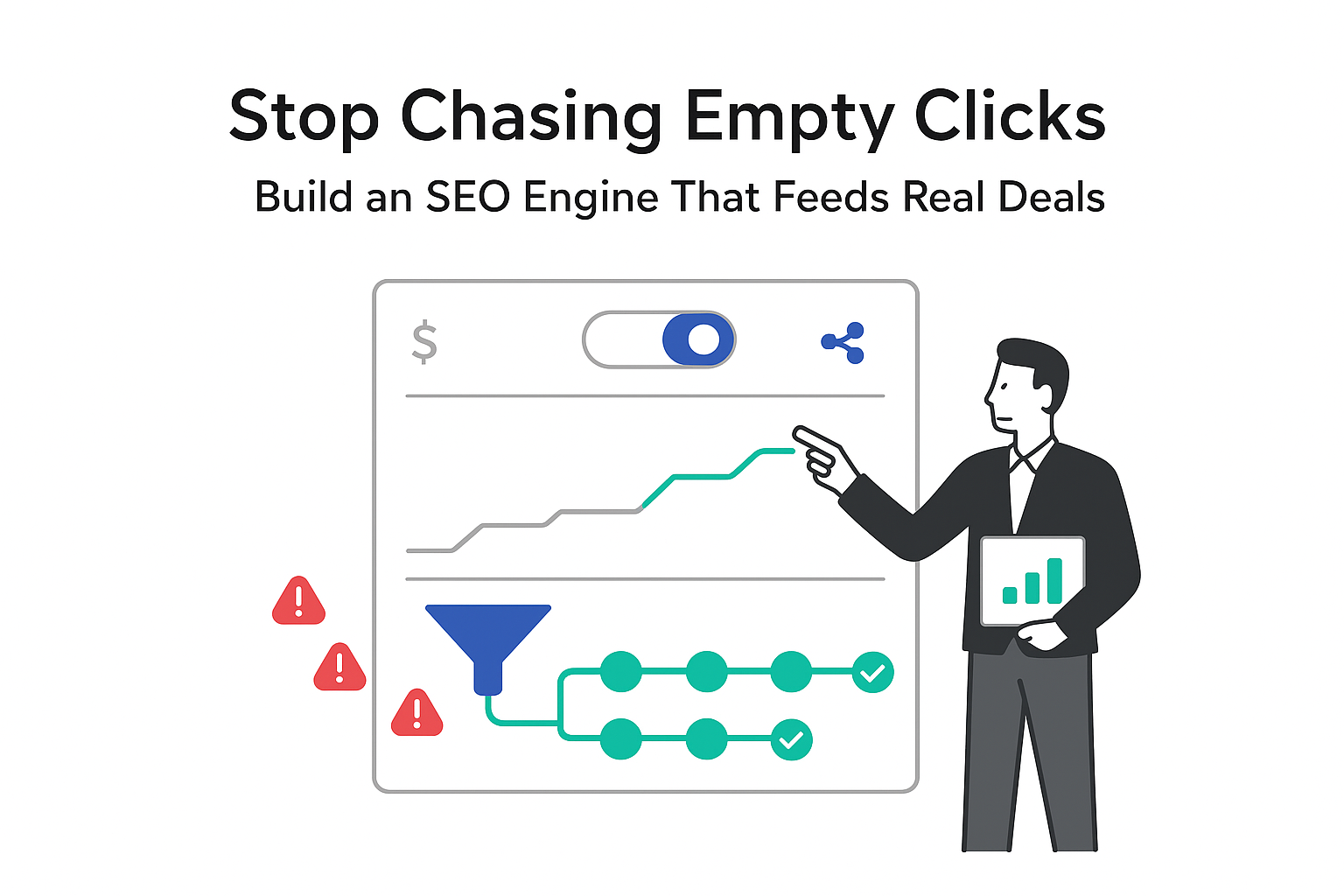
Most B2B service CEOs I talk to describe a similar pattern. Revenue climbs to a comfortable range, paid campaigns reliably bring in demand, and then growth levels off. Lead quality becomes inconsistent, sales spends too much time disqualifying, and every month the ad budget has to increase just to maintain the same pipeline.
That’s usually the moment I start looking at organic search as a second growth channel that isn’t being used properly - not as a branding exercise, but as a measurable pipeline lever.
What I expect a B2B SEO agency to deliver (pipeline, not pageviews)
A specialized B2B SEO agency shouldn’t exist to make traffic charts look better. I expect it to send more of the right buyers into the pipeline and help sales conversations start at a higher level. In practice, that means treating organic search like a performance channel tied to revenue outcomes, not just rankings.
Instead of publishing generic content or handing over a one-time audit, a serious B2B SEO approach starts with how the business actually makes money - offer structure, deal size, sales cycle length, and the ideal customer profile - and then maps search demand to each stage of that journey. (If you want a deeper breakdown of what “pipeline-first” looks like, see pipeline-first B2B SEO growth.)
When SEO is working, the outcomes I look for are straightforward:
- Lower customer acquisition cost as organic demand reduces pressure on paid spend
- More sales-qualified leads that match the ideal customer profile
- Higher close rates because content pre-qualifies (and repels bad fits) before sales gets involved
- A more stable inbound contribution to pipeline that doesn’t disappear when ads pause
If you’ve had a disappointing SEO experience before, the usual reason isn’t “SEO doesn’t work.” It’s that the work was disconnected from revenue: too much focus on volume keywords, too little focus on qualification, conversion paths, and attribution through the funnel.
What a typical B2B SEO program includes
I think of B2B SEO as an operating system: multiple components working together in a loop of strategy, implementation, optimization, and reporting. The goal isn’t “more pages.” It’s more qualified pipeline.
Most strong B2B SEO programs include the same core building blocks:
- Strategy and roadmap: market and competitor research, ICP alignment, keyword and intent mapping, and a plan tied to business goals
- Technical SEO: removing crawl and indexation friction, improving site performance, and fixing structural issues that suppress visibility and conversion
- On-page SEO and content: building and refreshing pages that answer real buyer questions and support decision-making at each stage
- Authority building: earning relevant mentions and links that increase the site’s ability to rank for competitive, high-intent queries
- Measurement and reporting: tracking quality of traffic and outcomes (leads, qualified leads, opportunities, revenue), not just “visibility”
One nuance I don’t like to see ignored: B2B SEO has to account for long sales cycles, multiple stakeholders, and the fact that a single new customer can represent meaningful lifetime value. That changes what “good” looks like. A small number of highly qualified leads can outperform a high volume of low-intent traffic.
Why technical SEO is often the fastest path to “found money”
Technical SEO is where many B2B sites quietly leak opportunity. I’ve seen businesses with strong positioning and solid content still struggle because search engines can’t efficiently discover or understand key pages - or because the site experience adds friction for buyers.
This tends to show up in predictable scenarios: older websites with years of legacy URLs and redirects, complex navigation across multiple industries or regions, mixed content types that create duplication, and templates that repeat similar blocks across large parts of the site.
From a revenue perspective, I frame technical work in plain funnel terms: if important pages aren’t being discovered, indexed, or loaded cleanly, the top of the funnel is throttled - and if pages are slow or confusing, qualified visitors won’t stay long enough to convert. Technical improvements aren’t glamorous, but they often create the conditions that make every other SEO investment work harder.
Content and on-page SEO that attract qualified B2B buyers
For B2B services, I don’t view on-page SEO as “publishing lots of blog posts.” I view it as building the right set of pages that support how buyers actually evaluate risk and make decisions.
The best keyword research isn’t just a list of terms - it’s a map of buyer intent. I like to see topics anchored in pains, constraints, and decision criteria (for example, cost, timelines, tradeoffs, and fit), because those are the searches that pull in serious prospects. A practical place to start is a high-intent keyword strategy for better pipeline.
I typically think about content in three practical layers. Problem awareness content helps a buyer name what’s happening, understand the cost of inaction, and recognize common failure modes. Solution awareness content compares approaches and clarifies when SEO makes sense relative to other channels. Vendor comparison content does the heavy lifting for sales: it addresses objections, explains what “good” looks like, and sets expectations so only the right prospects raise their hand.
This is also where weak SEO programs often fall apart: they drive traffic but don’t improve lead quality because pages are vague, calls-to-action are mismatched to intent, or proof is missing. For complex B2B services, subject-matter depth, clarity, and specificity usually beat generic “SEO copy” every time. (Related: how to turn your product demos and sales calls into an SEO engine.)
Measurement, attribution, and getting beyond vanity metrics
If I’m evaluating an SEO effort, I care about whether it can be measured through the full funnel - not perfectly (B2B attribution rarely is), but credibly. SEO reporting that stops at impressions, clicks, and average position doesn’t tell leadership what they need to know. The goal is a board-ready view of how organic contributes to pipeline and revenue.
A mature approach usually includes attribution that connects organic sessions to leads and then to qualified stages in the CRM, plus conversion-focused iteration on high-intent pages. Improving conversion rate often produces faster pipeline impact than chasing incremental traffic. In practice, that iteration benefits from structured experimentation - for example, A/B testing and (when you have enough traffic) multivariate testing on page messaging, proof blocks, and calls-to-action.


Finally, I want to see active collaboration with sales and customer-facing teams, turning real objections and repeated questions from calls into content that ranks and shortens sales cycles. That matters because B2B buyers typically need repeated exposure before they convert - often 13 touch points before a buyer actually converts - which makes consistent, high-intent organic visibility valuable even when paid is noisy.
When those pieces are in place, SEO stops being “content output” and starts behaving like a revenue channel with learnings you can act on. For a reporting structure leadership teams can actually use, see board-ready dashboards for SEO reporting.
Who benefits most from B2B SEO - and who should wait
I don’t think every business should invest heavily in B2B SEO at every stage. Fit matters, and mismatched expectations create most of the frustration in this space.
In my experience, SEO tends to work best when the business has a clear offer, a defined ICP, and a sales process that can consistently follow up and qualify inbound demand. It’s also a stronger fit when deal sizes are meaningful enough that even modest improvements in qualified lead flow create real ROI.
On the other hand, I’m cautious when a company needs immediate revenue rescue, expects SEO to double results in a couple of months, or doesn’t have anyone accountable for lead handling. In those cases, even good traffic can turn into wasted opportunity.
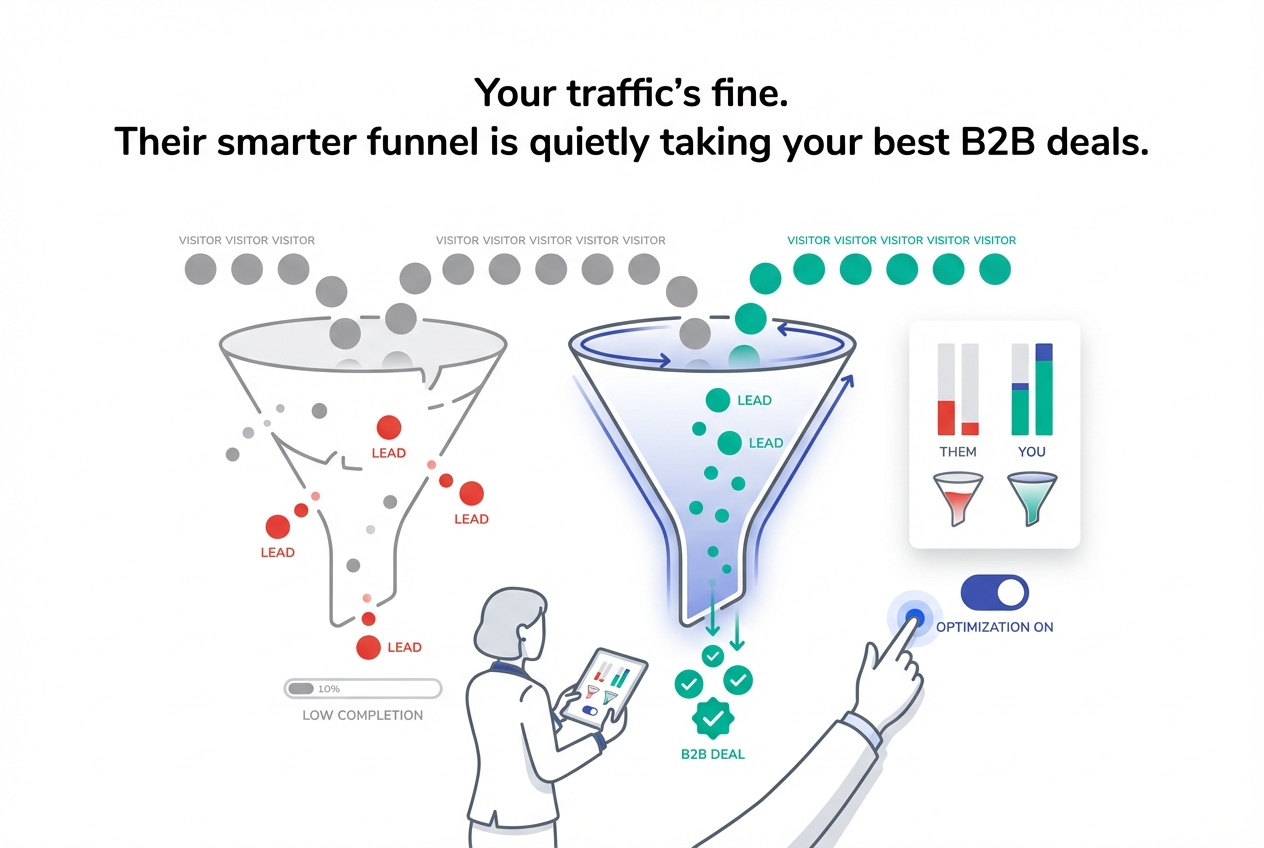
I also separate “SEO can help” from “SEO should be the priority.” If the core positioning is unclear, conversion paths are broken, or sales follow-up is inconsistent, I’d fix those foundations first so SEO doesn’t amplify a leaky funnel.
ROI modeling and realistic B2B timelines
SEO feels vague until I attach it to math. I prefer a simple model that starts with current organic traffic and moves through conversion to revenue using the company’s real funnel metrics: visitor-to-lead conversion rate, lead-to-qualified rate, close rate, and average deal value (or lifetime value when appropriate). The point isn’t to “prove” a number - it’s to make assumptions explicit so they can be adjusted as real data comes in. If you want help building that model, this breakdown of B2B SEO budget and pipeline math is a useful reference.
Here’s a simplified example using deliberately conservative assumptions to avoid overpromising:
If organic traffic grows to 9,000 sessions per month, and the site converts 1% of visitors into leads, that’s about 90 leads. If 20% become sales-qualified, that’s 18 qualified leads. If 15% of qualified leads close, that’s roughly 2-3 new customers per month. With an average initial deal value of $20,000, that’s $40,000-$60,000 in potential monthly revenue before considering retention, expansion, or longer-term compounding.
Those inputs vary wildly by category, offer complexity, and sales motion, which is exactly why I don’t like generic ROI claims. The only credible model is one built from your own funnel data.
Timelines also need to be grounded in reality:
- Months 1-3: technical cleanup, strategy, measurement setup, and initial content updates; early movement is usually seen in crawl/indexation health and lower-competition queries
- Months 3-6: more consistent impressions and clicks across targeted topics; early improvements in lead quality often show up before big traffic growth
- Months 6-12+: compounding becomes visible as higher-intent terms improve, supporting pages build authority, and the pipeline contribution stabilizes
When people ask me how long ranking takes, my answer is “it depends on competitiveness and site strength,” but I rarely see competitive, high-value non-branded terms become reliable drivers in a matter of weeks. If a business tried SEO before and it didn’t work, that history can be an advantage - provided someone honestly audits what was targeted, how quality was handled, and whether the work was ever connected to conversion and qualification.
A composite case example: turning a plateau into a steadier inbound engine
To make this less abstract, here’s a composite scenario based on patterns I’ve seen across B2B service companies.
A consulting firm selling recurring retainers reached roughly $100,000 in monthly recurring revenue. Referrals and paid campaigns drove most of the pipeline, but lead quality was inconsistent and the ad budget kept rising to maintain volume. The website had accumulated years of outdated pages and overlapping positioning, so search visibility was scattered and conversions were weaker than they looked on paper.
The SEO plan focused on three priorities: cleaning up legacy site structure and duplication, rebuilding core service pages around two clear ICPs and their decision criteria, and producing content that addressed the same objections and comparisons that repeatedly appeared in sales calls. Over time, organic traffic and lead volume increased, but the bigger win was that inbound leads became more self-educated - asking smarter questions, aligning better to fit, and moving through the sales process with fewer resets. (If you want an example of how that’s packaged into execution, see an enterprise SEO business case.)
I’m careful with “results” claims because outcomes depend on execution quality, competition, and internal follow-through. What I will say is that when SEO is treated as a go-to-market channel (not a publishing treadmill), it often reduces dependency on paid demand generation and makes pipeline quality more predictable.
How to think about pricing models without getting distracted by them
SEO pricing often feels opaque because the work spans multiple disciplines: strategy, technical execution, content, authority building, and measurement. What matters more than the label on the package is whether the scope matches the complexity of the site, the competitiveness of the market, and the speed of growth the company expects.
When I review proposals, I look for clarity on what will actually be delivered, what assumptions are being made, how success will be measured through the funnel, and what the first 90 days will focus on. I also want to see explicit boundaries - what is included, what isn’t, and what would trigger a scope change - because surprises are where most SEO relationships break down.
Ultimately, the best SEO engagement is the one that makes it easy for leadership to answer a simple question each month: Did organic search contribute to more qualified pipeline - and do we understand why?



.svg)

.svg)
.svg)