
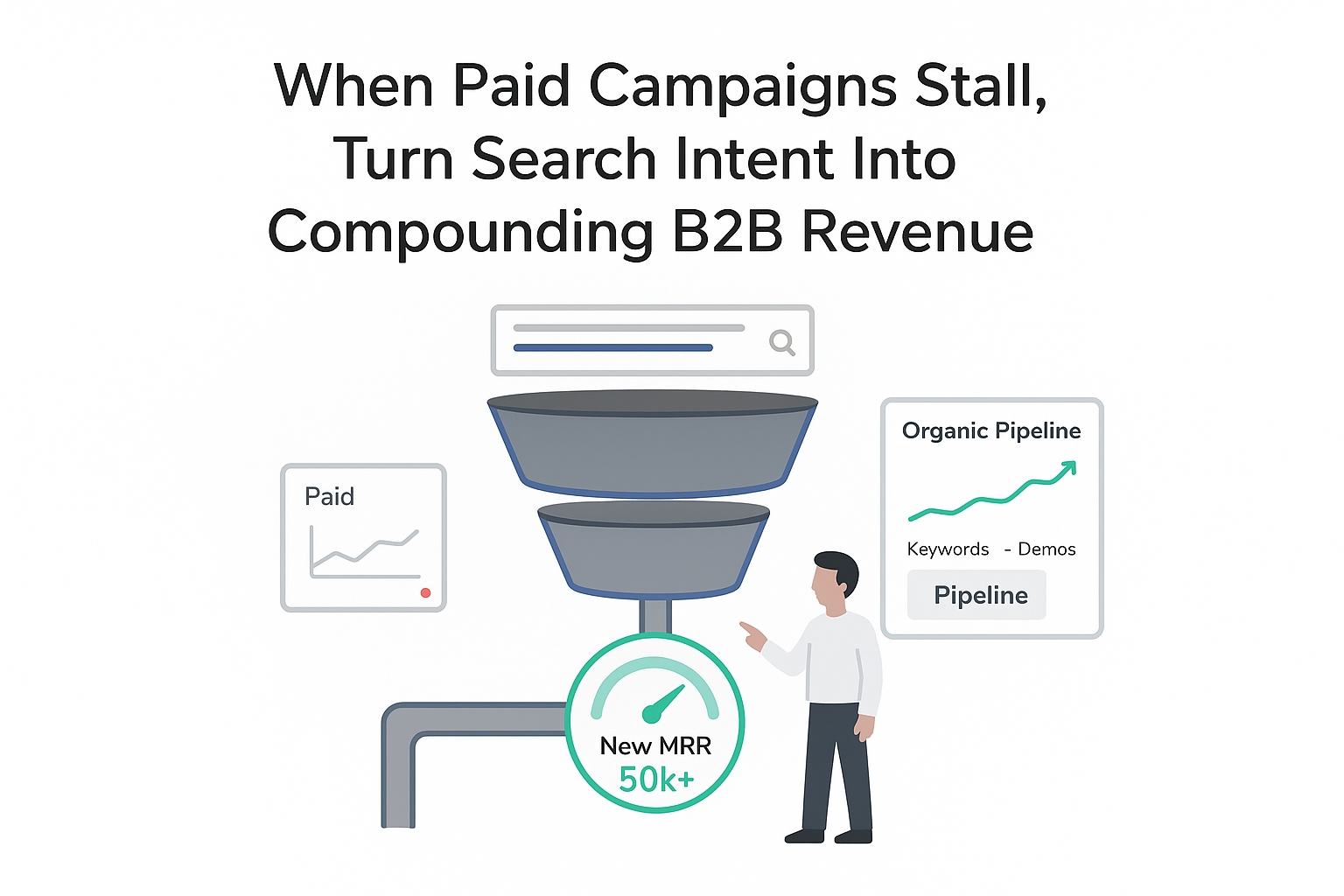
You are running a B2B service company at roughly $50k to $150k in monthly recurring revenue. Growth used to feel straightforward. Now the pipeline is lumpy, paid channels keep getting more expensive, and every new deal seems to demand more energy from you and your team than it should.
You have probably tried SEO once or twice already. Maybe someone promised hockey-stick results, sent reports full of impressions and rankings, and then could not clearly explain what changed in booked demos or closed revenue. You do not have time to micromanage keyword lists or debate minor technical fixes that never show up in pipeline.
Done right, B2B SEO turns your site into a steady source of qualified demand that can translate into revenue. In simple terms, B2B SEO is search engine optimization focused on business buyers and long sales cycles. It connects the searches your decision makers run with pages that move them toward demos, proposals, and signed contracts.

1. Start with revenue, not rankings
Most SEO plans start in the wrong place: keywords and rankings. I start with revenue.
Pick a 12-18 month window and decide how much new recurring revenue you want from organic search (separate from referrals and paid). Then I work backward from revenue into the inputs SEO can realistically influence. If you want a deeper version of this model, see b2b paid search budget allocation.
Revenue target. Suppose the average new client is worth $5k MRR. To add $50k MRR from organic, I need about 10 new clients.
Closed deals and opportunities. If the sales team closes 25% of qualified opportunities, I need about 40 qualified opportunities from organic-sourced leads.
Sales-qualified leads (SQLs) and demos. If about 50% of demos or consultations become real pipeline, I need about 80 SQLs from organic.
Leads and lead-to-SQL rate. If half of leads become SQLs, I need about 160 total organic leads (exact definitions depend on your lead scoring rules).
Required organic traffic to the right pages. If about 3% of organic sessions on core pages convert into leads, I need roughly 5,300 targeted organic sessions over that period landing on pages built to convert.
The numbers will differ in your business, but the pattern holds: revenue target first, then pipeline, then leads, then traffic. That is how I keep SEO tied to cash instead of vanity metrics.
This is also why I care less about total traffic and more about high-intent traffic. A small lift in visitors who are actually evaluating vendors beats a big spike in top-of-funnel views from people who will never buy.
2. Build a measurement loop that ties SEO to pipeline
I do not need a massive analytics team to see whether SEO is working, but I do need a clean way to answer one question:
Did organic search create pipeline and revenue?
At minimum, I make sure three things are true:
I can see which pages organic visitors land on and what actions they take (demo requests, quote requests, “contact sales,” key downloads if they are genuinely tied to pipeline).
Every inbound lead is tagged with source and landing page when it enters the CRM.
Opportunities and closed deals keep that original source attribution so organic impact does not disappear later in the sales cycle.
Once that is in place, I track performance in a way a CEO (and CFO) can actually use: trends in high-intent conversions from organic, the number of SQLs and opportunities that started with organic, and how organic-sourced deals compare on close rate and deal size versus other channels. If you need a framework for reporting beyond last-click, read Measure content’s impact beyond last-click.
On timing, I set expectations up front so SEO is treated like an asset being built, not a weekly referendum. In many B2B categories, early gains often come from improving existing pages (better messaging, clearer positioning, stronger titles and snippets), then new content begins to move rankings, and later the compounding effect shows up as more pages rank for more buying-stage queries. The exact curve depends on competition, sales cycle length, and how strong your current site is, but the principle is consistent: SEO tends to reward sustained, focused work.
If attribution and tracking are messy today, tightening the loop is usually the highest-leverage first move. In some orgs, that requires dedicated help from an Analytics & Attribution partner.
3. Choose keywords by buyer intent (not by volume)
Not every search deserves equal effort. One person wants a definition; another has a budget and a shortlist. B2B SEO works best when I deliberately choose keywords that match buying stages and map to a real path toward revenue.
Informational intent: searches that signal learning (useful for credibility, usually not immediate pipeline).
Problem-aware intent: searches about pains and symptoms (useful for shaping category demand).
Solution-aware intent: searches for a service category or approach (often the best early “money terms”).
Vendor/comparison intent: searches that evaluate tradeoffs, pricing, and risk (strong mid-to-bottom funnel).
Branded intent: searches for your company name, pricing, reviews, and legitimacy checks (high intent, and easy to get wrong if the page experience is thin).
Instead of chasing broad head terms that look impressive in a report, I prioritize solution-aware and comparison queries first, because they tend to show commercial intent and create measurable conversations faster. Then I backfill with problem-aware and informational content to widen the top of the funnel and support sales enablement. For a more detailed approach, see b2b high intent keyword strategy.
One important bias to watch: it is easy to pick keywords based on what marketers think buyers search. I ground keyword choices in the language I hear in sales calls, proposals, RFPs, and lost-deal notes. When the phrasing on the page matches the phrasing in the buyer’s head, conversion rates usually follow. (If you are brushing up on the basics, Landingi’s guide to keyword research is a solid reference for how to structure the work.)
4. Publish pages that both rank and convert
For B2B service companies, SEO performance rarely comes from random blog posting. I treat content like a system: a small set of pages designed to rank for high-intent searches and move buyers toward a next step.

Core service pages that clearly explain what I do, who it is for, and what outcomes to expect.
Industry/vertical pages that show how the service changes by context (workflows, constraints, compliance, buying committee).
Use-case pages that tie a specific pain to a specific approach and expected result.
Case studies written with real baseline to change to result, including timeframes and constraints (not just success stories).
Comparison pages that address “X vs Y,” “in-house vs outsourced,” and pricing and risk questions honestly.
From an on-page SEO standpoint, I keep it simple: a clear primary topic per page, headings that follow the buyer’s questions in order, internal links that connect related pages, and copy that speaks to decision makers (CEO, founder, COO, VP) rather than only practitioners.
On conversion, I avoid turning SEO pages into a maze. Each high-intent page should make the next step obvious (for example: request a demo, request a quote, contact sales) and reduce friction by explaining who it is for, what happens next, and what information is needed. If a page ranks but does not convert, I treat it as unfinished, because rankings alone do not pay for anything. If you want a specific blueprint for this page type, see b2b comparison page seo.
5. Improve on-page conversion with structured testing
Getting a page to rank is only half the job. The other half is turning attention into qualified pipeline.
I start with pages that already receive organic traffic and have commercial intent, typically service pages, comparison pages, and high-intent landing pages. Then I test improvements in a controlled way: one meaningful change at a time, enough time for results to stabilize (B2B traffic can be low volume), and success measured by lead quality, not just form fills.
The elements I revisit most often are: how the page positions outcomes (not features), whether proof appears early enough to matter, whether the primary CTA is clear without being aggressive, and whether the page works flawlessly on mobile. I also pressure-test forms: short forms can increase volume, but sometimes slightly longer forms improve lead quality by filtering out poor fit. The “right” answer depends on your sales capacity and deal size.
If testing is new inside your company, I keep the discipline basic: a written hypothesis, a single owner, a defined metric, and a clear decision rule for keeping or reverting changes. Without that, “optimization” becomes a series of opinions. If you want a concrete way to operationalize this, A/B testing is the simplest starting point for making decisions with evidence.
6. Prove ROI and scale what’s working
To keep leadership aligned, I use a monthly scorecard that shows both leading indicators and business outcomes. The goal is a board-ready view of what organic is doing, without hiding behind vanity metrics. If you want an example of what to include, see Board-ready dashboards: what to include and why.
What I include: a short list of priority “money” queries and the pages tied to them, high-intent conversions from organic search (demo, quote, contact actions), organic-sourced SQLs, opportunities, and closed revenue, plus supporting signals like impressions, click-through rate, and ranking movement (useful, but not the goal).
For ROI, I keep the math readable. If an SEO program costs $X per month and it produces $Y in new annual contract value in the same period (plus additional revenue from existing content continuing to perform), the ROI discussion becomes concrete. I also separate “sourced” revenue (first touch organic) from “influenced” revenue (organic touchpoints later in the journey) so I do not over-claim what SEO did.
When it is time to scale, I scale what actually produces revenue, not what produces the prettiest traffic chart. That usually means expanding around the industries, use cases, and comparison topics that generate the best combination of close rate and deal size, and making sure the supporting pages (case studies, proof, implementation details) are strong enough to convert the added demand.
7. Decide how SEO work gets owned (and keep accountability)
At some point, the real question becomes less “What is the SEO playbook?” and more “Who owns it end-to-end?”
Whether SEO is handled in-house, by contractors, or by an external team, I look for the same accountability standards: clear revenue-linked targets, a prioritized plan tied to buyer intent, consistent publishing and page improvements, and reporting that shows the full path from organic visit to lead to SQL to opportunity to revenue.
If ownership is unclear, SEO tends to drift into activity without outcomes, more articles, more audits, more dashboards, but no sustained movement in pipeline. When ownership is clear, SEO becomes a compounding channel: not magic, not instant, but predictable enough to plan around. If you want a structured way to evaluate support options and set expectations, Landingi’s PPC Definition guide is a useful reminder of how different channels get measured, and why SEO needs the same pipeline discipline.



.svg)

.svg)
.svg)