
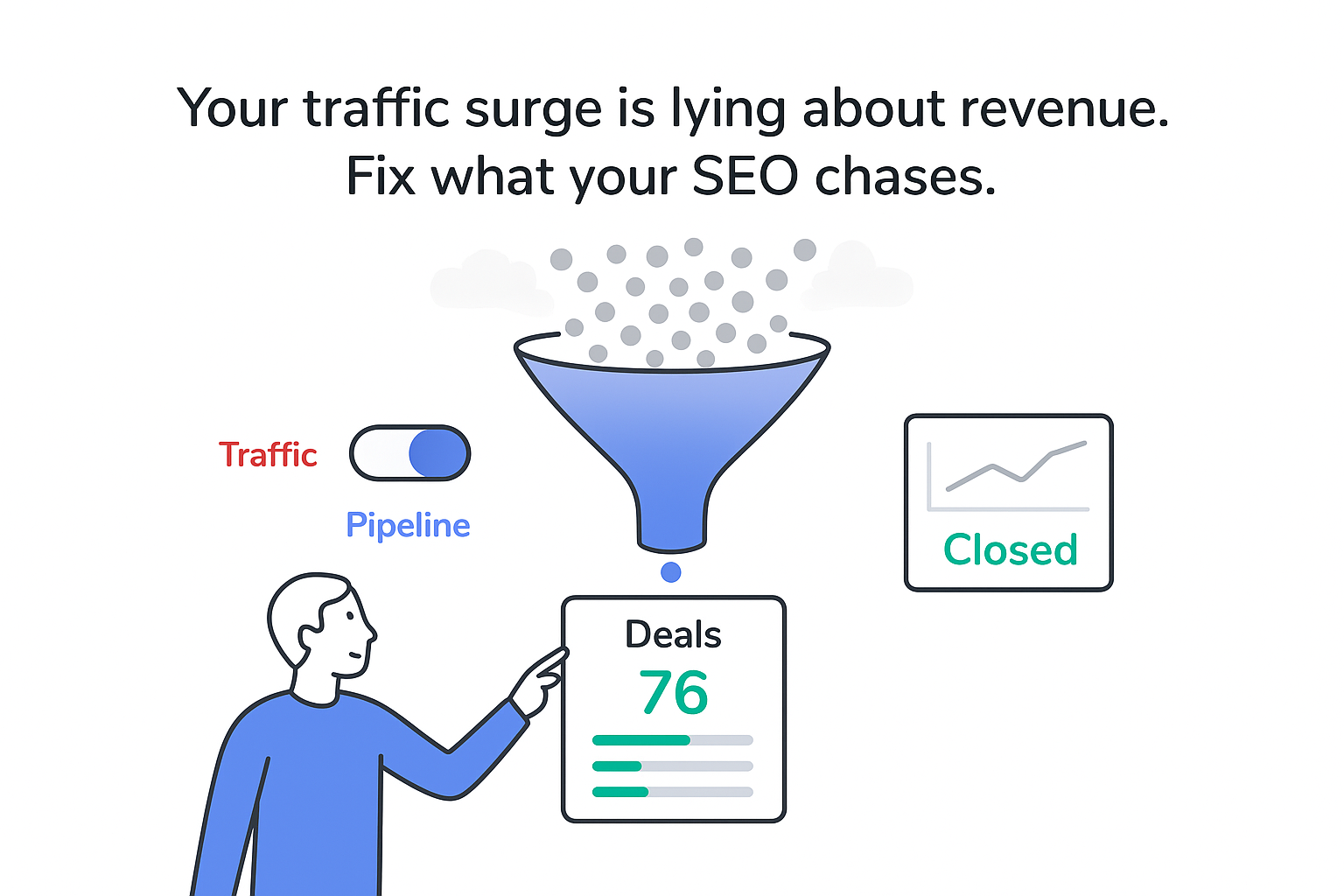
You care about pipeline, not page views. Rankings are nice, but if they do not turn into qualified conversations and closed-won deals, they are just noise. When I look at modern B2B SEO for service businesses, I treat it as an always-on revenue channel: it attracts serious buyers, supports sales conversations, and compounds over time without requiring you to scale ad spend linearly.
How B2B SEO Drives Pipeline and Revenue
I think about B2B SEO as a revenue engine, not a blogging hobby. Here is a simple scenario.
Say I am running a B2B service business at $80K MRR and I want to reach $200K MRR within 18 months without doubling paid spend or the sales team. If my average retainer is $10K/month, I need roughly 12 additional active clients - about one new right-fit client per month.
SEO can support that goal when it is built around buyer intent and conversion paths, not content volume.
A clean SEO-to-revenue funnel typically looks like this:
Right people search. Senior buyers search for specific problems and outcomes (often “service + industry” or “service + use case” queries), not generic marketing terms.
They land on a page that matches intent. The page answers what they actually meant when they searched: scope, fit, approach, proof, and next steps - without forcing them to dig.
Visitors convert into leads. A portion request a consultation, submit a form, or reach out after reading decision-support content (case studies, process pages, pricing guidance).
Sales qualifies and creates opportunities. Sales confirms fit, urgency, and budget. The right leads become opportunities.
Closed-won revenue. Some opportunities convert, and recurring revenue rises.
To keep the math grounded, I treat the following as an illustrative model (your conversion rates will vary by category, deal size, and brand strength). If today I get 300 organic visits/month from my actual ICP and that produces 6 marketing-qualified leads, 3 sales-qualified leads, and 1 new client every two months, then scaling qualified traffic changes the output meaningfully. If I grow to 1,800 right-fit visits/month while holding conversion rates steady, that same system can produce roughly 36 MQLs, 18 SQLs, and 6 new clients per quarter.
At a $10K retainer, that is $60K MRR added in a quarter - not because SEO is magic, but because the funnel is built to convert the traffic that matters.
The important takeaway: SEO touches every stage of the buying journey. It creates visibility, builds trust, answers objections, and makes it easier for buyers to self-qualify before they ever talk to sales. If you want a deeper view of how to tie this to business outcomes, see measuring pipeline impact of SEO.
The New Rules of SEO for B2B Services (and What Still Matters)
Old SEO often looked like: pick keywords, publish lots of blog posts, collect backlinks, and wait. That can still work in some markets, but for complex B2B services - with committees, long sales cycles, and high ACV - it hits a ceiling quickly.
What I see working now is simpler (and harder): SEO has to mirror how buyers research and decide.
A few “new rules” I rely on:
I build for the full funnel, not just awareness. If content never helps with comparison, risk reduction, or vendor selection, it creates attention and hands revenue to someone else.
I optimize for intent and fit, not search volume. Low-volume queries can be the highest value if they reliably attract qualified buyers.
I aim for topic authority, not random posts. Winning is about becoming the clearest answer across a connected set of questions your ICP asks.
I connect SEO to sales reality. Pages should reflect objections, procurement concerns, stakeholders, and “what happens next,” not just definitions.
I prioritize quality and specificity over output. A handful of pages that match real buying intent usually outperform dozens of generic articles.
That said, fundamentals did not disappear. They just became non-negotiable - and they matter most when they are tied to revenue outcomes.
| Keep | Evolve | Stop |
|---|---|---|
| Technical health | Move from one-off cleanups to ongoing monitoring | Letting crawl and performance issues linger |
| Clear site structure | Organize around buying journeys and services (not internal org charts) | Publishing pages that do not connect to conversion paths |
| On-page basics | Write for humans first, search engines second | Stuffing keywords into every line |
| Credible links | Earn relevance through industry visibility and partnerships | Chasing low-quality directories and junk links |
| Consistent publishing | Publish fewer, stronger pieces aligned to sales needs | Producing thin content just to hit a cadence |
| Measurement | Tie SEO to leads, pipeline, and revenue | Reporting only on impressions and average position |
Two tactical pieces that often unlock quick wins are cleaning up cannibalization (see B2B SaaS keyword cannibalization fixes) and building a link plan that supports revenue pages (see B2B link building pipeline system).
Using AI in B2B SEO Without Losing Trust
AI can speed up research, drafting, and repurposing - but it can also flatten your point of view if you rely on it too heavily. The risk in B2B services is not just “bad writing.” It is producing content that sounds plausible while failing to reflect how your buyers evaluate vendors.
When I use AI in an SEO workflow, I keep the value chain clear. AI is useful for summarizing notes, generating first drafts, and surfacing related questions buyers might ask. Human expertise is what makes content credible: real examples, nuanced tradeoffs, constraints, and a point of view that matches your delivery model. Editorial review is where trust is won: accuracy checks, clarity, and removing vague claims that cannot be supported.
On the data side, I focus less on “more tools” and more on clean inputs. Search intent signals, first-party site behavior, and CRM outcomes matter because they help prioritize what to build next and whether the work is producing qualified demand - not just visits.
A Practical B2B SEO Strategy for Service Businesses
I do not think service businesses need a massive strategy deck. What they need is a sequence of decisions that keeps SEO tied to pipeline.
I start with ICP clarity. If I am not specific about which industries, deal sizes, and buyer roles I want, the keyword set gets polluted fast and lead quality follows.
Next, I translate ICP pains into topic and keyword clusters that match stages of intent. I want coverage for problem recognition, solution exploration, vendor shortlisting, and decision support. This is where “service + industry,” comparison queries, and implementation or process questions typically show up.
Then I prioritize high-intent pages because they tend to move revenue first. In service businesses, that usually means service pages built for real objections, industry-specific pages where fit matters, comparison pages buyers use to justify decisions internally, and clear process or pricing guidance that reduces uncertainty. (If your brand demand is strong, this is also where the balance between brand vs nonbrand search strategy becomes a practical lever, not a debate.)
Only after that foundation exists do I scale supporting content - the pieces sales can actually use in deals. If a page cannot help a rep answer a common late-stage question, I treat it as a lower priority no matter how “SEO-friendly” it looks.
Finally, I bake in conversion and feedback loops early: lead routing, qualification notes, and a simple way for sales to report whether leads were genuinely in-market. Without that loop, SEO becomes a publishing exercise instead of a revenue system.
Connecting SEO to Outbound and ABM
SEO performs better when it is not isolated. Even if I am not running a formal ABM program, I can still align channels around the same pains, language, and outcomes.
Practically, that means the themes that appear in organic search should also show up in outbound messaging and sales conversations - so buyers experience one coherent story across touchpoints. When the site’s content mirrors what account executives say on calls, SEO does more than generate leads; it increases confidence and reduces friction inside buying committees.
If you are blending SEO with ABM motions, it helps to learn from teams already doing it well. A few useful references: AI-powered ABM strategies, Proper sales and marketing alignment, and Account-Based Funnel Design: Enterprise ABM Strategies for High-Value Customer Acquisition.
To keep everyone aligned, I rely on shared KPIs that sales and leadership actually care about:
SQL volume and quality from organic search
Pipeline value sourced by organic
Pipeline value influenced by organic content
Win rate and sales cycle length for organic-sourced opportunities
Average contract value for organic-sourced customers
When those metrics are visible in the same reporting environment sales already uses, SEO stops being a side report and becomes part of pipeline reviews.
Common B2B SEO Challenges (and How I Address Them)
B2B SEO rarely fails because someone did not “try hard enough.” It fails because the operating constraints are real: long sales cycles, limited search volume in niche markets, busy subject matter experts, and unclear ownership.
Long cycles are handled by balancing compounding work (topic authority, link earning, content depth) with near-term conversion leverage (improving high-intent pages, tightening messaging, clarifying fit, and removing friction from next steps). Low search volume is handled by focusing on value per lead, not raw traffic: one qualified enterprise opportunity can justify months of work.
The SME bottleneck is usually solved by making contribution lightweight and structured - short interviews, review passes, and tight briefs - so expertise shows up in content without turning every piece into a time sink.
And ownership matters more than people think. If no one is responsible for prioritization, approvals, and sales feedback, SEO becomes a queue of tasks instead of a program that learns and improves.
Measuring B2B SEO Success and ROI
If I only watch rankings, SEO looks random. If I only watch revenue, SEO looks slow. I need both leading and lagging indicators - and I need them connected.
Leading indicators tell me whether I am attracting the right audience and reducing friction: visibility on high-intent queries, engagement on service, pricing, and case study pages, and increases in qualified inquiries from organic. Lagging indicators tell me whether it is paying off: opportunities created, pipeline value, closed-won revenue, win rate, and sales cycle length.
Attribution does not have to be perfect to be useful, but it does have to be consistent. I aim for two views: sourced (organic search was the original discovery path) and influenced (organic content materially supported the deal, especially common in long, multi-touch cycles).
When the same rules are applied month to month, SEO can be compared honestly against outbound, paid, referrals, and partners. If you are building a reporting layer, see B2B SaaS search-to-pipeline reporting for a dashboard-oriented approach.
A Realistic Timeline for Results
I set expectations in stages because B2B SEO compounds.
In the first 90 days, I expect measurable operational improvements: technical cleanup, clearer tracking, stronger high-intent pages, and early movement on a focused set of terms. Around 6 months, I expect a clearer lift in qualified leads and SQLs if the strategy is aligned to intent and the site has enough authority to compete. By 12 months, I expect organic search to behave like a repeatable pipeline contributor - assuming consistent execution, credible content, and ongoing optimization.
The variance is real: mature sites in active markets can see impact sooner, while new domains, highly regulated industries, or ultra-niche categories can take longer. I would rather set honest milestones than promise a specific revenue number on a fixed date.
The Future of B2B SEO for Service-Based Companies
Search behavior is changing, but senior buyers are not going to stop researching high-stakes decisions. What is changing is how often they get answers without clicking and how quickly they can shortlist vendors based on signals of trust.
I expect three shifts to matter most. First, more “zero-click” behavior means generic informational content will capture less value. Depth, proof, and decision support will matter more than definitions.
Second, thought leadership signals will carry more weight: clear authorship, credible experience, real examples, and defensible opinions. In service businesses, the best-performing SEO content often reads like a strong sales conversation - transparent about tradeoffs and specific about outcomes.
Third, as tracking gets harder, first-party data discipline gets more important. Clean measurement, consistent lifecycle definitions, and reliable source tracking will decide which teams can improve SEO systematically versus guessing.
Handled with that mindset, B2B SEO stops being “content marketing” and becomes what it should be: a durable system that attracts qualified demand, supports sales, and steadily increases pipeline efficiency over time. For ongoing marketing strategy discussions, the Marketing School podcast is a solid supplement.



.svg)

.svg)
.svg)