
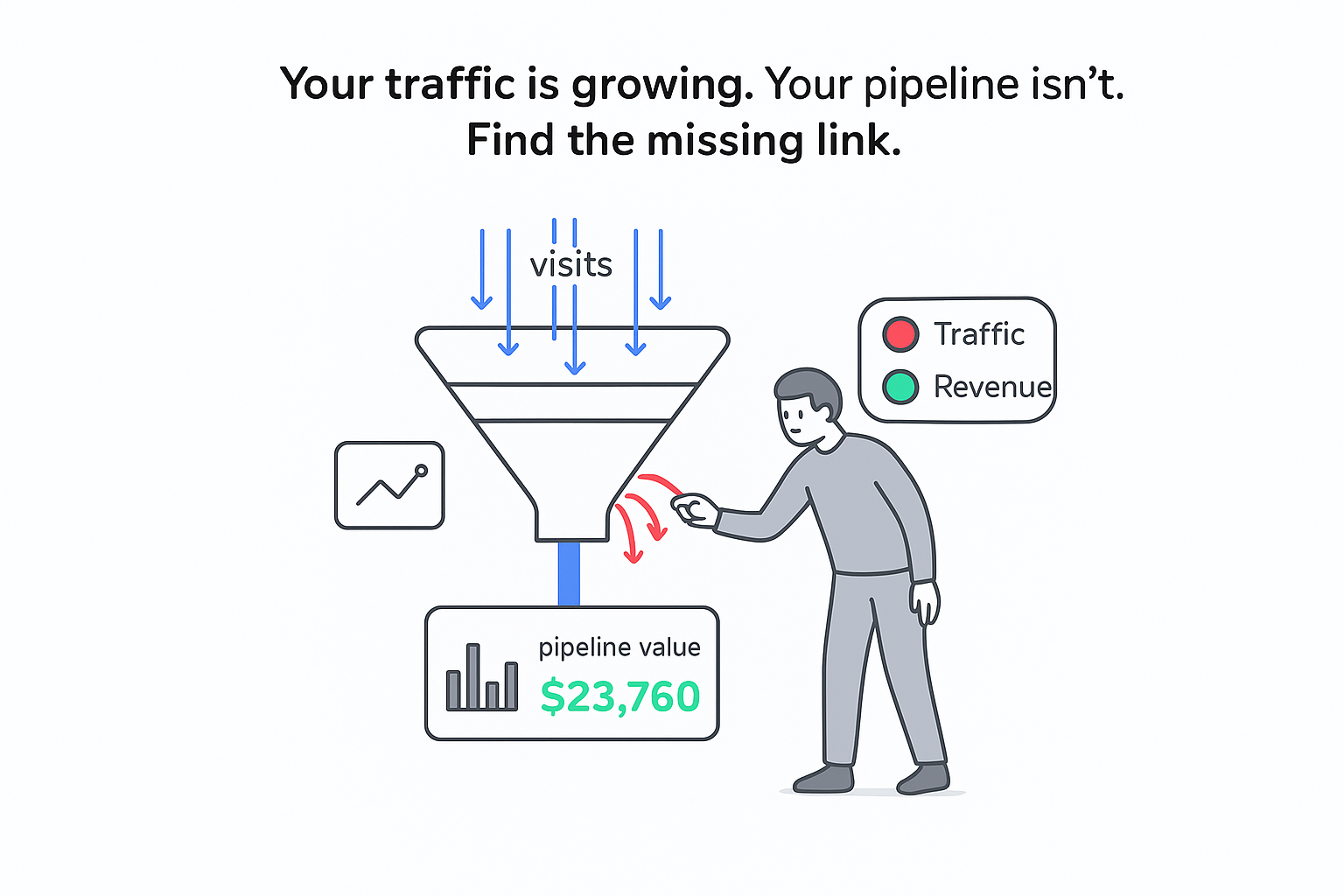
You run a B2B service company sitting somewhere between $50K and $150K in monthly recurring revenue, and the pressure is real. Paid acquisition keeps getting pricier, outbound is noisier, and every week someone asks whether SEO is “actually working” or just inflating analytics with traffic that will never buy. I’ve also seen teams cycle through vendors that promised dramatic graphs, then struggled to connect the work to pipeline and closed-won deals.
I treat SEO as a revenue channel, not a content hobby. Below, I walk through what typically breaks in B2B SEO for service companies, what a realistic ROI timeline looks like, why unified data is non-negotiable, and how to build a simple roadmap that doesn’t require constant executive babysitting.
B2B SEO for service companies: turning organic traffic into revenue
For a B2B service firm, SEO isn’t about publishing “thought leadership” for its own sake. It’s about showing up in front of the right decision-makers at the moments they’re actively researching a problem you solve, then converting that intent into qualified conversations and signed contracts.
That framing matters because a lot of SEO effort still gets judged on rankings, impressions, and sessions. Those metrics can be useful diagnostics, but they’re not outcomes. If organic traffic rises while sales stays flat, nothing meaningful changed.
When I evaluate SEO as a revenue channel, I start with three questions: which searches map to real buying intent for my services, which pages create qualified opportunities in the CRM, and where prospects drop off before they take a next step. Once those are clear, content planning stops being “what should we post this month?” and becomes “what should we publish or improve to create more qualified pipeline?” If you want a cleaner way to connect the work to outcomes, start with measuring pipeline impact of SEO instead of obsessing over top-line traffic.
What’s broken in most B2B service SEO today
Most B2B service organizations run SEO as a side project: a few blog posts, some “link building,” and a dashboard showing organic sessions trending up. Meanwhile, sales says the leads aren’t ICP, and leadership can’t tell whether SEO influenced any closed-won deals.
The patterns I see most often look like this:
- Content topics drift away from the actual services, pricing reality, and buyer objections
- Reporting focuses on rankings and traffic instead of opportunities, win rate, and revenue
- Search behavior is not connected to CRM outcomes, so “what’s working” is guesswork
- Paid search and outbound carry the revenue burden because organic isn’t built to convert
There’s also a common evidence gap in how SEO gets justified. Articles (and agencies) often quote sweeping numbers like “X% of buyers start with search.” The directional point is correct - search plays a major role early in B2B buying - but the exact percentage varies widely by industry, deal size, and urgency. What matters operationally is simpler: many buyers do substantial research before they talk to sales, and search is one of the main ways they frame the problem, compare approaches, and shortlist vendors. If I’m not present in those searches, I’m letting competitors define the criteria before my team gets a conversation. (If you need a practical approach to that competitive layer, see AI assisted competitive messaging analysis.)
The fix is not “more content.” The fix is intent alignment: building pages that match what qualified buyers actually search, and measuring success in pipeline terms.
The ROI timeline and the math that makes SEO worth it
B2B services live and die by a relatively small number of high-value deals. If I sell $60K-$200K annual contracts, I don’t need thousands of leads - I need a predictable stream of qualified ones.
That’s where SEO can work extremely well, but only with realistic expectations. SEO is not instant-response like paid search. It’s closer to building an owned acquisition asset that improves over time - assuming I keep it tied to conversion and revenue.
Pipeline math sanity check
Here’s a conservative way I like to pressure-test the opportunity using simple pipeline math:
- Average new client value: $60K ARR
- Close rate from qualified demos: 25%
- Current organic demos per quarter: 10 (mixed quality)
If focused SEO work increases that to 18 qualified demos per quarter and the close rate stays the same, that’s roughly 2 additional deals per quarter. At $60K ARR, that’s about $480K in additional ARR per year. The specific numbers will differ, but the point holds: a modest improvement in qualified demand can move revenue materially in a services business.
What a realistic timeline looks like
On timeline, I generally see B2B service SEO play out in phases. In month one, the “wins” are usually measurement clarity and removing obvious blockers. In months two to four, the most noticeable impact often comes from improving pages that already have some visibility (for example, pages stuck on page two or three for high-intent queries) and tightening conversion paths on core service pages. From months four to eight, net-new pages built around buying intent start contributing more consistently. Past that, the compounding effect becomes more visible, especially when I keep refreshing and consolidating content rather than letting it sprawl.
If I need signal quickly, I don’t rely on brand-new blog posts. I start by improving what already exists, and I treat conversion rate as a first-class SEO metric, not an afterthought.
Why unified data is non-negotiable for revenue-focused SEO
If I can’t trace the path from search to revenue, I can’t manage SEO like a growth channel. Website analytics alone can’t tell me whether a lead was a strong-fit buyer or someone doing research for a class project. And they definitely can’t tell me which pages influenced opportunities and closed-won deals.

For revenue-focused SEO, I need a clear thread from search activity to CRM outcomes: query (or at least landing page and intent) → visit → lead → opportunity → closed-won. Without that, I’m stuck optimizing for proxies.
This is where basic revenue operations thinking helps: align definitions, align handoffs, and align reporting so marketing and sales are looking at the same truth. In more mature teams, this often evolves into a unified revenue view where each channel can be evaluated on its contribution to pipeline and closed-won outcomes, not just activity. (This direction is also consistent with Forrester's research on revenue orchestration platforms.)
A “good enough” unified setup usually includes:
- Consistent source attribution on every inbound lead (including organic vs paid, and clean campaign tagging where relevant)
- Forms and phone calls captured as CRM records with the correct source data
- A way to connect opportunities and revenue back to the pages that initiated or assisted the journey
- A simple reporting view that highlights which topics and pages generate qualified opportunities, not just traffic
Once that backbone exists, more advanced analysis becomes worth doing. I can identify pages that attract the wrong audience, spot topics that repeatedly lead to qualified pipeline, and prioritize updates based on revenue impact rather than editorial preference. If your CRM data is messy, you may also benefit from workflows like LLM agents that standardize CRM notes into reliable fields to improve reporting without adding manual busywork.
This also reduces internal friction. When marketing and sales are using the same definitions and pipeline view, debates about “lead quality” become diagnosable: I can see which pages and intents are producing poor-fit leads and adjust targeting, messaging, or conversion paths.
Fixing the fragmented funnel: SEO across the full buying journey
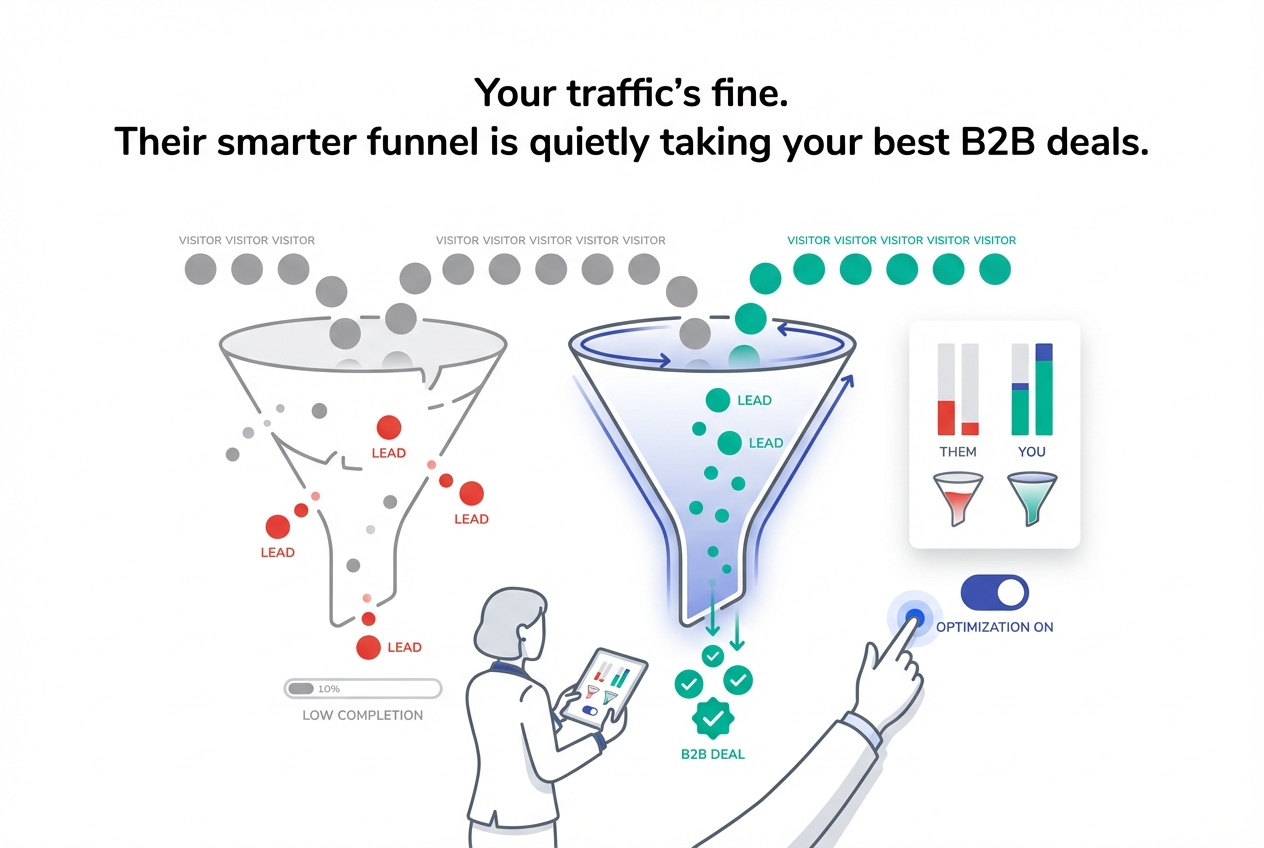
A major reason B2B SEO underperforms is that it gets trapped at the top of the funnel as generic education. Meanwhile, paid search, outbound, events, and sales collateral all run on separate tracks, with inconsistent messaging and disconnected reporting.
When channels are fragmented, a prospect might see one promise in an ad, another on the website, and a third on a sales call. Marketing reports “engagement,” sales reports “low quality,” and leadership gets stuck mediating.
I get better results when I treat SEO as support for the entire buying journey, not just discovery. Practically, I want pages that map to how buyers progress: early research that defines the problem in the buyer’s language; mid-stage content that explains causes, risks, and what “good” looks like; and decision-stage pages that address vendor selection, tradeoffs, implementation expectations, and ROI justification. This is also why SEO and paid strategy should share intent logic - especially when you’re dealing with committees instead of solo buyers (see B2B search ads for buying committees).
In practice, this often includes comparison-style pages (in-house vs outsourced, role vs consultant, approach A vs approach B), pricing guidance (even if it’s ranges and drivers rather than fixed numbers), and content that mirrors the objections I hear in sales calls.
When SEO content supports real decision-making, it stops producing “interesting visitors” and starts producing prospects who arrive already educated, already aligned on the problem, and more ready to discuss scope.
What a high-performing B2B service SEO program actually includes
The strongest B2B service SEO programs I’ve seen share the same foundation: they’re built around ICP and intent, they remove technical friction, and they run with tight feedback loops between marketing and sales.
Technically, I’m aiming for a site that is easy to crawl, fast enough to hold attention, and structured so search engines (and humans) can understand what matters. Slow pages, confusing navigation, duplicate or competing pages, and unclear service positioning all create drag. That drag shows up as weaker rankings and lower conversion rates, especially on the pages that should produce demos. If you need a structured way to keep this under control, use an enterprise technical SEO roadmap style approach instead of ad hoc fixes.
On the content side, I don’t treat “blog content” and “money pages” as separate universes. Service pages, case studies, comparison pages, and decision-stage explainers usually do more revenue work than generic how-to posts. If I do publish educational content, I make sure it earns its place by connecting to a clear next step and supporting a service line.
Operationally, the missing ingredient is often coordination. SEO improves faster when it’s fed by real customer language. I like pulling from sales calls, proposals, discovery notes, and post-sale lessons. Those inputs produce content that sounds like the buyer, addresses real objections, and aligns with what sales actually sells.
If my team can’t name which organic pages generated opportunities last quarter, that’s not a “reporting issue.” It’s a sign the program is not being managed as a revenue system yet. A strong starting point is building B2B SaaS search to pipeline reporting that ties landing pages to opportunity creation.
The pillars of a revenue-ready B2B SEO strategy (without the fluff)
When I simplify revenue-focused SEO for services, it comes down to four connected pillars.
First: ICP and intent-driven targeting. Broad terms invite broad traffic. Narrow, specific queries - industry, role, pain point, urgency, and solution expectations - tend to bring the prospects I actually want.
Second: conversion-oriented pages. The job isn’t to educate forever; it’s to help a qualified buyer make a decision. That means clear positioning, proof, process clarity, and a next step that matches the buyer’s commitment level. Not every visitor is ready to “book a call,” but every high-intent page should guide the visitor toward a logical action.
Third: technical trust and user experience. Trust isn’t only testimonials and logos. It’s also how the site behaves: speed, readability, mobile usability, and forms that don’t feel invasive or clumsy. Friction quietly kills conversions, and conversion rate is part of SEO performance whether or not it shows up in ranking reports.
Fourth: measurement and ongoing optimization. Competitors update their pages, search behavior shifts, and service lines evolve. If I’m not updating, consolidating, and improving, results decay. A useful measurement cadence answers revenue questions first: which topics and pages created qualified opportunities, where visitors drop off before converting, and which content appears repeatedly in successful deals.
A practical implementation roadmap I can run without chaos
I get the best outcomes when SEO work moves through clear phases instead of trying to do everything at once.
Phase 1: Diagnose what’s real. I start with a technical review, a content and intent review, and - most importantly - a measurement review. If attribution and CRM linkage are broken, I won’t be able to prove what’s working, and the program will drift back to vanity metrics.
Phase 2: Win with existing assets. Next, I prioritize quick wins on existing pages: pages that already rank but underperform, service pages with unclear positioning, and high-traffic content that attracts the wrong audience or fails to guide visitors to a meaningful next step. This is where early momentum often comes from, because I’m improving what already has some visibility.
Phase 3: Fill revenue gaps with intent pages. Then I build net-new pages around buying intent. Instead of publishing randomly, I build clusters that map to core services, ICP segments, and decision-stage questions. I keep internal linking and navigation tight so the site reinforces expertise around specific themes rather than feeling like a pile of disconnected articles.
Phase 4: Run the optimization loop. Finally, I move into a steady cycle: refresh what’s working, consolidate what’s cannibalizing, and keep tightening conversion paths on pages that consistently bring qualified visitors. If you suspect overlapping pages are diluting results, prioritize B2B SaaS keyword cannibalization fixes early - it’s one of the fastest ways to reduce wasted effort and improve clarity for both search engines and buyers.
This is where SEO becomes predictable - less about occasional spikes and more about reliable contribution to pipeline.
A readiness check for your B2B service SEO
When SEO is working as a revenue channel, it feels measurable and calm. When it isn’t, it feels like activity without clarity.
To take stock, I use a simple check:
- I look at the past quarter and identify how many closed-won deals started (or were meaningfully influenced) by organic search - not just how many leads arrived.
- I list a small set of high-intent keywords tied to my core services and verify whether I’m visible where qualified buyers actually search.
- I confirm whether my reporting can trace a path from landing page to opportunity and revenue without manual guesswork.
If those are hard to answer, the upside is usually less about “doing more SEO” and more about rebuilding it around intent, conversion, and unified data. Once that’s in place, SEO stops being a debate about traffic and becomes another accountable growth channel alongside paid and outbound. If you want a practical way to keep that accountability visible, build a lightweight B2B SaaS feature adoption keywords and revenue dashboard that the whole team can reference weekly.



.svg)

.svg)
.svg)