
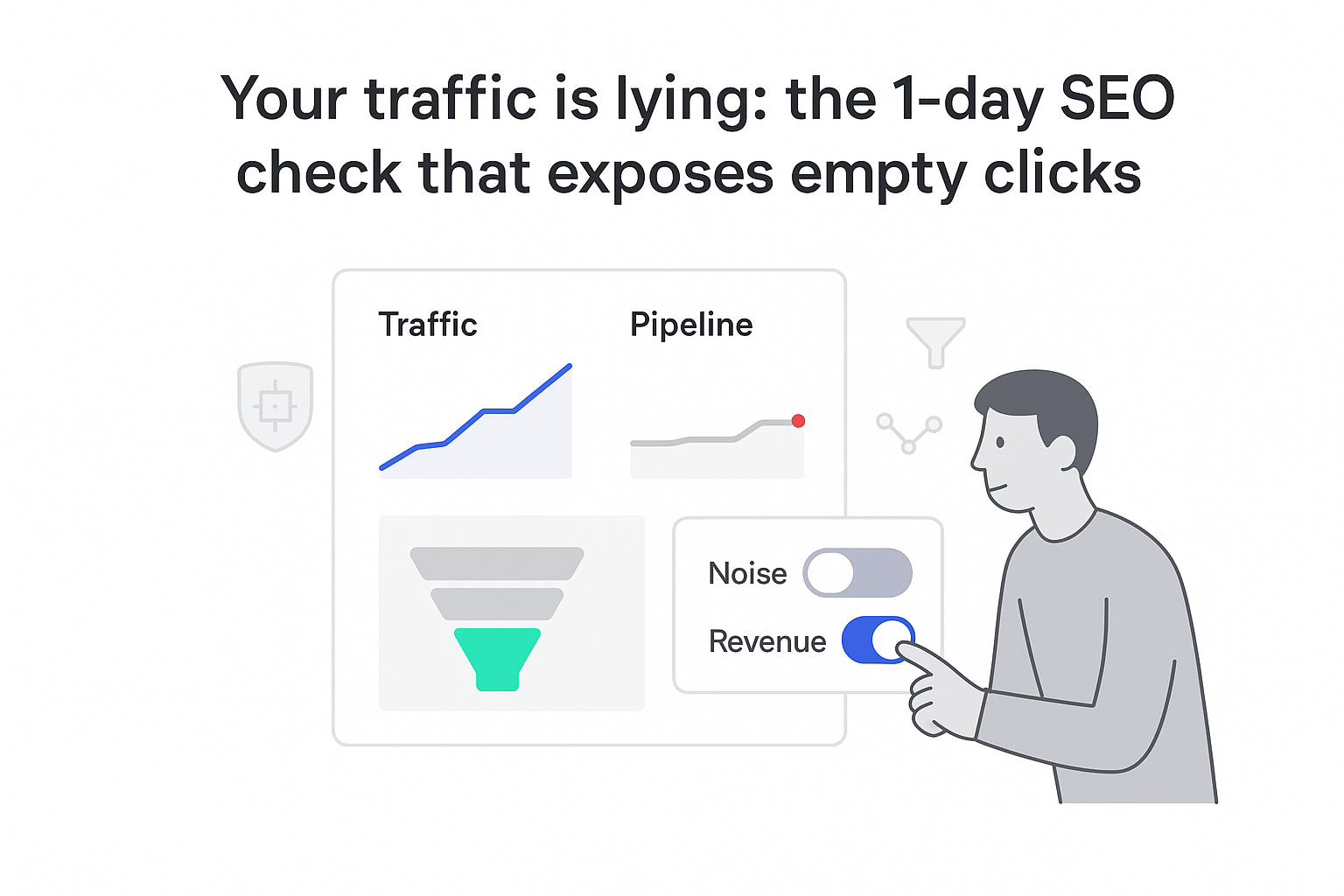
SEO is supposed to bring qualified leads while I sleep. For a lot of B2B service founders, it does the opposite: I sign a retainer, approve a content calendar, watch traffic climb in a dashboard - and the sales board stays flat. Sometimes it’s worse, because now I’m also spending time chasing updates from someone who can explain impressions but can’t explain pipeline.
I wrote this for CEOs and founders of B2B service companies around $50K-$150K MRR who want SEO that contributes to revenue, not just activity.
Why B2B service SEO so often turns into noise
When I look at underperforming SEO programs in service businesses, the pattern is usually the same: the plan is built to “win SEO,” not to win deals.
A typical nine-month run can easily produce dozens of posts, more ranking keywords, and a longer monthly report. What it often doesn’t produce is a noticeable increase in qualified opportunities from organic. Sometimes “organic search” shows up as a small touch in attribution, but not in a way I’d confidently connect to the spend and effort.
That isn’t always incompetence. It’s usually a mismatch between how SEO gets planned and how B2B services get bought.
The traffic trap (and why it’s worse in B2B than B2C)
Many SEO plans still start with search volume and keyword difficulty. That approach can work in B2C or ecommerce where buying cycles are short and conversion paths are direct. In B2B services, deals are often five to six figures, sales cycles run 60-180 days, and decisions involve multiple stakeholders. In that environment, ranking for broad definitions (“what is X?”) can pull in students, job seekers, vendors, and casual researchers - people who inflate sessions and rarely become pipeline.
Content that ignores buying committees and sales friction
Another common failure mode is “blog factory” production: outsourced writing that never touches real customer language. No sales call listening, no win/loss notes, no review of why deals stall, and no understanding of what a buying committee needs to feel safe choosing a vendor.
The result can be perfectly readable content that still doesn’t speak to what moves enterprise-ish decisions: perceived risk, implementation complexity, internal approvals, switching costs, and the “what happens if this fails?” questions buyers are often too polite to ask directly.
No revenue owner - and why AI search punishes shallow content
When reporting centers on sessions, impressions, and average position, I’m seeing a program with no clear owner for business outcomes. Without accountability for pipeline, the default is to call SEO “a long game,” keep publishing, and hope it eventually turns.
AI-driven search raises the bar here. With AI Overviews and answer-first interfaces, generic content written to match keywords (instead of answering specific, experience-backed questions) gets summarized away. Visibility increasingly goes to sources that look credible, consistent, and specific - not just “optimized.”
The outcome-driven B2B SEO framework I use to judge any plan
For B2B services, I don’t think SEO should be treated as “content output.” I treat it as a pipeline channel with a budget that has to earn its place next to outbound and paid. If you want a deeper companion to this approach, see pipeline-first B2B SEO growth.
When I evaluate a strategy, I look for five fundamentals:
1) Start from revenue math, not keyword volume. I want to know how much qualified pipeline organic is expected to create over 12-24 months, and what CAC/payback boundaries I’m willing to accept compared to other channels. If average deal size is $25K and I need $600K in additional annual pipeline, that’s about 24 additional qualified opportunities per year - meaning the plan should plausibly create 2-3 additional qualified opportunities per month after ramp. (Related: B2B SEO budget and pipeline math.)
2) Define the ICP by behavior and constraints, not demographics. “B2B services” is too broad. I look for clarity on who actually buys, what triggers the search, what blocks the deal (security, compliance, implementation, timing, politics), and what makes an account a bad fit even if they convert.
3) Do real Voice-of-Customer research before creating a content backlog. Keywords are how problems show up in search; they’re not the problems themselves. I expect the strategy to be informed by sales calls, customer interviews, win/loss notes, and the language buyers use when they’re trying to reduce risk or justify a decision internally. If you need a practical method here, use frameworks that help you gather unstructured data that reflects real customer conversations.
4) Map content to the full buying journey (not just top-of-funnel). Strong B2B service SEO usually includes problem-aware content, solution comparisons, “how the work actually happens” explanations, and objection-handling pieces that sales can use in live deals. I’m looking for connected paths, not isolated articles. This is where a B2B topic cluster strategy helps you build momentum without publishing fluff.
5) Build feedback loops with Sales and RevOps. Rankings matter, but the best signal is whether sales conversations improve and whether the CRM shows organic pages influencing real opportunities. I want a process where topics come from objections and use cases, and where performance is measured in qualified conversations and pipeline movement - not only in traffic.
Here’s the practical difference I’m trying to see:
| Old SEO approach | Outcome-driven B2B service SEO approach |
|---|---|
| Starts from search volume | Starts from pipeline targets and buyer problems |
| Publishes disconnected posts | Builds a connected journey from problem to decision |
| Reports sessions and rankings | Reports influence on opportunities and revenue |
| Treats AI search as “just another channel” | Builds credibility and specificity AI systems can’t ignore |
| Minimal sales involvement | Regular sales/RevOps feedback loop |
What I expect from an SEO partner in the AI era
When I assess a partner (or an internal hire), I’m not looking for a prettier roadmap. I’m looking for capabilities that match how B2B buyers research today and how AI-mediated search surfaces sources.
Sales-cycle fluency. I expect them to ask about ACV, typical stakeholders, buying stages, qualification criteria, where deals stall, and what buyers fear most. If the first conversation is mostly about “how many posts per month,” I assume they’re planning for output, not outcomes.
Credible market learning (not guesses). I want to see a plan for gathering and using Voice-of-Customer inputs: call recordings, discovery notes, win/loss, customer success themes, and the phrasing buyers use when they’re anxious about change, risk, or credibility.
Technical competence without turning it into an endless project. Indexing, internal linking, page speed, and clean site architecture still matter - especially when I’m trying to get important pages crawled, understood, and surfaced consistently. I don’t need perfection; I do need someone who can identify and remove blockers efficiently.
Content operations that protect accuracy and insight. AI can accelerate drafting, but it doesn’t replace judgment. I look for an editorial process where subject matter experts influence outlines and reviews, claims are checkable, and the content reflects real constraints and tradeoffs (the things serious buyers care about). If you want a tactical playbook for this, see The Secret to B2B SEO: Build Authoritative Content with Your SMEs.
Pipeline-tied measurement. I want reporting that connects content to form fills, demo requests, self-reported attribution, and opportunity journeys. Rankings can be a leading indicator; they aren’t the outcome. If your tracking is messy, a GA4 measurement framework like Strategic Analytics Framework for GA4 can help you get cleaner answers.
A clear view of AI visibility. I expect attention to where and how the brand appears in AI Overviews, snippets, and answer-style results. More importantly, I want them to know how they’ll adjust when AI results shift - because they will. In practice, that often means making claims verifiable and adding clear citations that AI systems can trust.
How I screen proposals without getting lost in jargon
Picking a partner gets much easier when I’m explicit about stage and success.
First, I clarify the basics internally: current revenue level (MRR/ARR), average contract value, sales cycle length, and how pipeline is currently sourced (outbound, paid, referrals, existing organic). That context matters because B2B SEO isn’t one-size-fits-all; a founder-led motion behaves differently than a mature SDR + RevOps engine.
Then I define success in revenue terms. Instead of “more traffic,” I write targets like “$300K in additional qualified organic pipeline in 12 months” or “organic contributes 20% of closed revenue within 18 months.” Even if the numbers are estimates, they force clarity.
For budget expectations, agency pricing ranges are market-dependent and highly variable. In practice, many B2B service companies end up in a band that feels like mid-four to low-five figures per month once strategy, content production, and technical work are included. I don’t anchor on a percentage of revenue as a rule; I anchor on whether the plan can plausibly return multiples in qualified pipeline over a realistic timeline.
These are the red flags I personally won’t ignore:
- Long contracts without clear 90-day milestones (and without transparent exit terms if the basics aren’t delivered)
- Content volume as the primary strategy (especially when the plan can’t explain how content will be used in sales conversations)
- Reluctance to discuss ACV, sales cycle, and qualification (because it usually signals they’re optimizing for traffic)
- Reporting that stops at rankings and sessions with no plan to connect to opportunities
On involvement: I expect to be hands-on early - positioning, ICP clarity, proof points, “how we actually deliver,” and what counts as a qualified lead. After that, my ideal role becomes a structured monthly or quarterly review focused on pipeline movement, learnings, and adjustments. If a program requires daily founder micromanagement to function, the system is broken.
If your reports aren’t decision-ready, this is exactly what board-ready SEO reporting should fix: less vanity, more accountability.
A one-day internal SEO review I do before hiring anyone
I don’t need a 60-page audit to get clarity. A focused internal review is usually enough to spot whether the problem is strategy, execution, measurement, or conversion paths.
1) Quantify current organic impact. In CRM and analytics, I check how many qualified opportunities in the last 6-12 months had organic as a meaningful touch, not just a stray first visit.
2) Identify the pages that already influence revenue. I list the handful of pages that show up most in lead and opportunity journeys (often service pages, pricing/packaging pages, and a small number of specific articles).
3) Audit message-fit: ICP-specific vs. generic. I scan content and ask: does this speak to my actual buyer’s constraints, risks, and decision criteria - or could it be for anyone?
4) Split brand vs. non-brand visibility. If organic is mostly brand-driven, SEO may be functioning more like “reputation confirmation” than demand creation. That’s not bad - but I need to acknowledge it and plan accordingly.
5) Check AI and SERP presence on core queries. I run a set of problem and solution searches and see who gets summarized, cited, or featured - and what those sources have that my site doesn’t.
6) Surface obvious technical blockers. I look for indexing issues, broken links, slow templates, and messy internal linking to priority pages.
This is also where I answer a common objection: if most leads come from referrals or outbound, I still care about SEO because many referred and outbound-sourced prospects research me before replying or signing. If my site doesn’t answer their “risk and implementation” questions, I’m quietly leaking conversion rate - even if I’m not relying on organic for first-touch demand.
Modeling SEO ROI and timelines without magical thinking
SEO feels fuzzy when I can’t tie it to a simple model. I keep it grounded with a basic equation:
(Incremental qualified organic opportunities × close rate × average deal size) ÷ monthly SEO investment
If, after ramp, organic adds 10 qualified opportunities per month, close rate is 25%, and average first-year value is $25K, that’s 10 × 0.25 × 25,000 = $62,500 in potential new revenue per month. I then compare that against the fully loaded monthly cost (strategy + content + technical work). If you want to pressure-test the math quickly, use a simple SEO ROI calculator and adjust assumptions until they match your reality.
On timelines, I set expectations like this for B2B services:
- Months 0-3: foundations and fast wins (fixing blockers, tightening positioning on key pages, improving internal linking and conversion paths). Early signals usually show up as better lead quality and clearer intent from existing traffic.
- Months 4-6: meaningful movement on priority queries, stronger presence in SERP features/AI summaries for specific topics, and the first consistent lift in qualified inbound.
- Months 6-12: compounding effect - content clusters deepen, sales enablement pieces get used in deals, and pipeline influence becomes visible and repeatable.
Finally, I keep the B2B-vs-B2C difference explicit: in B2B services, the goal is rarely to win the broadest “definition” keywords. The goal is to become the most credible source for the specific problems, scenarios, and decision tradeoffs that real buying committees research before they spend $50K, $250K, or more.
If I can’t see a plan to earn that kind of trust - human trust and machine trust - I assume I’m buying noise.



.svg)

.svg)
.svg)