
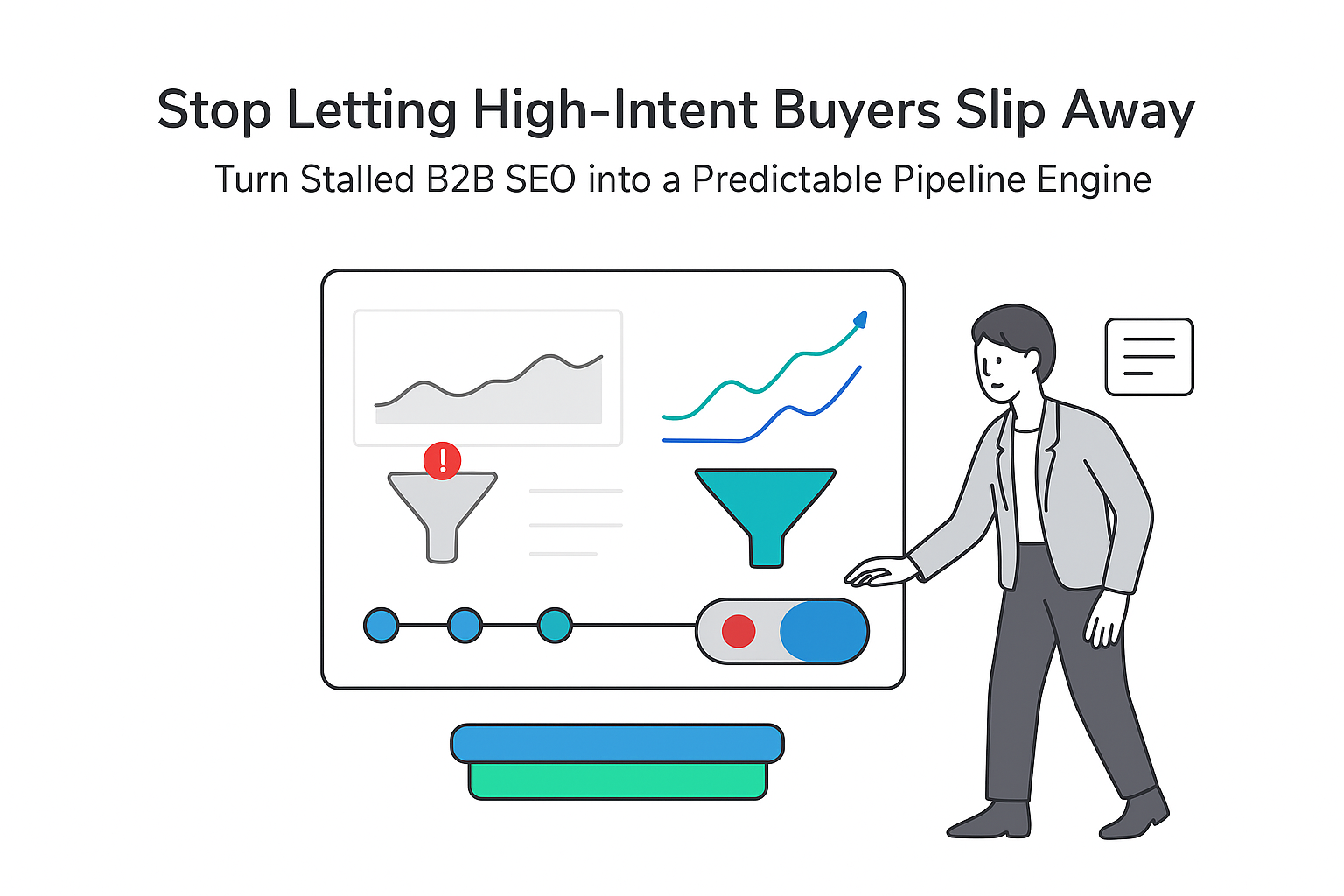
Most B2B service companies I talk to hit the same wall. Paid acquisition gets more expensive, referrals come in waves, and outbound starts to feel like pushing a boulder uphill. At the same time, buyers are actively searching for exactly what you do - yet your site is sitting on page three, or not showing up at all. That’s where serious B2B SEO for service-based companies earns its place: not as a side project, but as a growth channel you can build and trust.
What B2B SEO for Service-Based Companies Is (and Isn’t)
B2B SEO for service-based companies is the process of turning search demand into qualified sales conversations for your services.
In practice, that means shaping your website and content so that when your ideal buyer searches for their problem, their industry, or your category of service, you show up with a page that matches intent, answers questions, and makes it easy to take the next step.
I’m writing this for CEOs and founders of B2B service firms - agencies, consultancies, IT providers, and professional services - typically in the $50k to $150k/month range, who want to grow without letting customer acquisition cost spiral.
How B2B SEO differs from generic or B2C SEO:
- You sell to buying committees, not impulse buyers, so content has to support multiple roles and objections. (Related: B2B search ads for buying committees.)
- Keywords carry intent, not just traffic - a “small” keyword can be worth more than a high-volume term if it maps to high-value deals.
- Success is measured in pipeline and revenue contribution, not raw sessions. Visibility is a lever, not the end goal. (See: measuring pipeline impact of SEO.)
When it’s done well, SEO becomes a compounding asset: it can reduce blended CAC over time, create a more predictable inbound pipeline, and keep you from having to “restart” demand every month the way ads often do.
Why B2B Service Companies Rely on SEO to Scale
“We tried SEO. We published some blogs. Nothing moved. So we went back to ads and referrals.”
I also hear variations like “Our buyers don’t Google vendors,” or “SEO is too slow,” or “Outbound works fine.” There’s truth in all of that. Referrals are great, outbound can work, and SEO does take longer to ramp than paid. The catch is what happens once you’re already growing and want to keep CAC sane: without an owned inbound channel, growth stays chained to either headcount (outbound) or spend (paid).
Here are five reasons I treat SEO as a scaling requirement for many B2B service companies:
- It captures buyers who are already searching. People absolutely search for service partners, including niche and high-intent queries (for example, “[service] for [industry]” or “[service] pricing” or “[service] consultant”). If you’re not visible, you’re effectively handing demand to competitors.
- It can improve deal quality, not just lead volume. Unlike many paid campaigns, SEO lets you focus on terms that match your ICP, pain level, and budget. I’ve seen cases where traffic didn’t explode, but a handful of high-intent pages created a meaningful share of new pipeline within 6–12 months (results vary by market and competition).
- It supports longer sales cycles without adding meetings. B2B service deals involve risk checks, internal justification, and “why you vs. them” comparisons. Search-led content lets you answer recurring objections once - clearly and consistently - so your sales team doesn’t have to repeat the same explanations in call after call.
- It lowers CAC over the medium term. Paid can behave like rent: stop paying and the leads stop. SEO behaves more like building equity. Early months can feel like investment, but as core pages rank and credibility signals accumulate, the cost per incremental lead typically declines.
- It de-risks the business. A predictable inbound engine makes you less dependent on a single salesperson, a single platform, or a single acquisition tactic. If you ever plan to raise capital, sell, or simply protect margins, that resiliency matters.
I don’t see this as “SEO vs. outbound vs. paid.” I see it as portfolio thinking - SEO becomes the owned channel that makes the mix healthier over time. If you’re aligning SEO with a broader channel plan, this internal piece on B2B paid search budget allocation can help you pressure-test the numbers.
How I Think About B2B SEO as a Growth System
A lot of teams treat SEO like a set of disconnected activities: publish a few posts, fix a few technical issues, get a few links, then hope something moves. When results look fuzzy, they stop.
I find it more useful to treat SEO like a system. The loop is simple: you publish pages tied to real buyer intent, those pages earn visibility, visibility turns into qualified visits, visits turn into conversations, conversations turn into clients and proof, and that proof strengthens your perceived authority - making the next round of pages easier to rank.
The part that determines whether the system works is fit. SEO needs to align with your ICP language, your delivery model, your pricing reality, and the objections your sales team hears every week. If prospects keep asking, “How is this different from a freelancer?” or “Why does this cost what it costs?” I want those questions answered on the site in a way that’s easy to find from search - and consistent with what your team says in calls. (Related: SEO keyword strategy from B2B sales calls.)
I also plan content across awareness levels: early-stage problem recognition, mid-stage solution evaluation, and late-stage provider comparison. The goal isn’t “more traffic.” The goal is winning the searches that move opportunities and revenue. This is where product-channel fit matters - SEO is powerful when it matches how your market actually buys.
Pillar 1: Website Foundation (So Rankings Can Convert)
I think of the website as the engine. If the engine is clunky, content becomes expensive fuel that doesn’t produce pipeline.
For B2B service SEO, the foundation usually comes down to four practical elements.
First, positioning and ICP-focused messaging need to be obvious on the homepage and service pages. In a few seconds, a buyer should understand who you help, what outcome you drive, and why you’re credible - without needing to decode internal jargon.
Second, site structure should be predictable. Most strong B2B service sites make it easy to navigate between core services, relevant industries (where applicable), proof (case studies), and educational resources. The point is to help both buyers and search engines understand how everything relates.
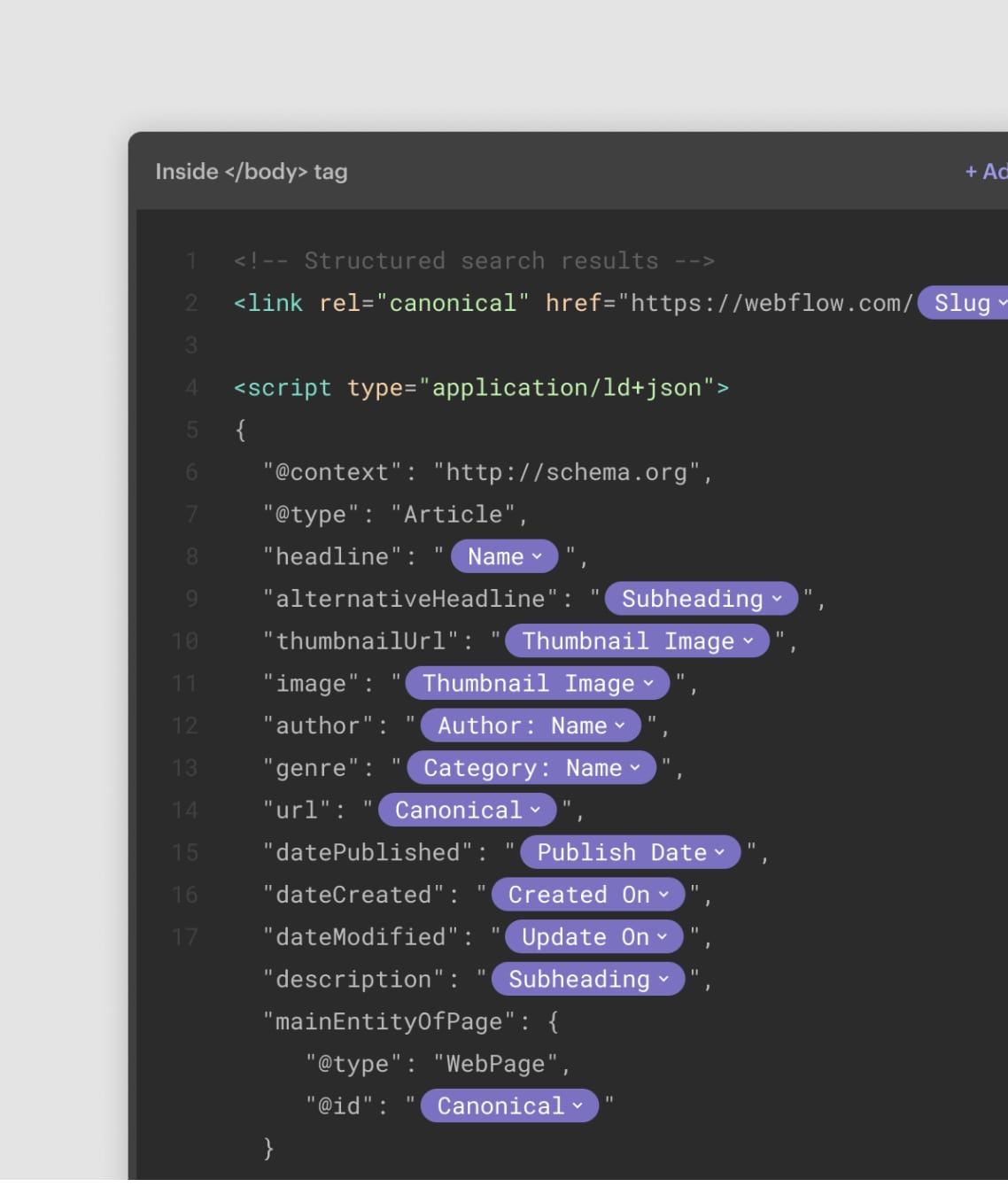
Third, technical health has to be “boringly solid”: pages can be crawled and indexed cleanly, the site is fast on mobile and desktop, and basic security and structured metadata are in place where they genuinely help. If you need an end-to-end reference point, use this internal enterprise technical SEO roadmap as a checklist, then go deeper on fundamentals like sitemaps using Google’s official guide.
Finally, measurement needs to exist from day one. If you can’t tie organic visits to meaningful actions (forms, calls, consultation requests) and then tie those to your sales process, you’re guessing - even if rankings look good. If you want a practical approach, start with a revenue-focused SEO metrics dashboard.
Pillar 2: Content That Maps to Revenue (Not Random Blogging)
For B2B service companies, random blogging usually underperforms because it’s disconnected from purchase intent. What I want instead is a content approach that supports the entire journey: category understanding, vendor evaluation, and decision confidence.
In practice, that typically includes a mix of (1) high-intent service pages and industry-specific pages, (2) educational articles that address problems your ICP is actively trying to solve, (3) comparison-style content that covers realistic alternatives (including in-house vs. external), and (4) proof content that makes outcomes tangible with specifics you’re allowed to share.
The highest leverage content often comes directly from sales conversations: pricing questions, implementation concerns, risk and security objections, stakeholder objections (“my CFO will ask…”, “legal will ask…”), and the real reasons deals stall. When that content is published thoughtfully and connected to your core service pages with strong internal linking, it doesn’t just attract visitors - it reduces friction in the sales process. If you’ve ever had multiple pages competing for the same query, fix that early with these keyword cannibalization fixes.
I’ll also add a constraint I trust: if a page wouldn’t help a real buyer make a decision, I don’t expect it to help SEO in the ways that matter.
One overlooked detail: if you use screenshots, diagrams, or process visuals, write descriptive ALT tags so both accessibility and search context improve.
Pillar 3: Authority and Backlinks (Trust Signals You Actually Want)
Even strong content can struggle in competitive niches if the site lacks authority signals. Backlinks - other credible websites linking to you - still function as a proxy for trust.
I stay conservative here. In B2B services, the best links tend to come from real-world credibility: industry publications referencing your insights, partners mentioning joint work, event or podcast appearances that include a legitimate site mention, associations or directories that are genuinely relevant, and original data or research that others cite.
What I avoid is anything that looks like it exists only to manufacture links. If the referring site wouldn’t be useful to your actual buyer, that’s a warning sign - not a win. Authority-building is slow by design, but it’s also one of the reasons SEO compounds. For a process-focused approach, see this internal guide to B2B link building as a pipeline system.
Pillar 4: Measurement and Optimization (So SEO Shows Up in the P&L)
Without measurement discipline, SEO teams drift toward vanity metrics: more posts, more impressions, more “visibility,” but no clear business impact.
Early signals (roughly 30–90 days): clean indexation, impressions for target themes, and rankings moving from “not present” into the wider results set. I treat this as validation that the foundation and targeting aren’t fundamentally broken.
Mid signals (roughly 3–9 months): qualified organic sessions to service and decision pages, conversion rate from organic visits to meaningful actions, and - most importantly - sales acceptance (are these leads actually viable?). If you want benchmark context on what “good” can look like, check it out here.
Late signals (6–12 months and beyond): opportunities created, closed revenue influenced or sourced, and CAC by channel compared to paid and outbound.
I don’t believe a CEO should live in analytics. But you should be able to review a simple monthly summary and a deeper quarterly readout that supports decisions: what to expand, what to consolidate, what to refresh, and what to stop doing. If you want to future-proof reporting as search evolves, this internal piece on AI-assisted search term analysis for B2B is a useful companion.
A Practical B2B SEO Roadmap (Timeline and What to Expect)
I like framing the roadmap in stages so you can sanity-check whether effort and outcomes are aligned.
- Diagnose and plan (first 30–60 days). Establish your baseline, clarify ICP and positioning, map search intent to priority pages, and identify the few technical or structural issues that would block progress.
- Build the foundation (months 2–3). Fix the highest-impact technical issues, tighten navigation and messaging, and ensure your core service pages are genuinely decision-ready and measurable end-to-end.
- Establish a publishing rhythm (months 3–9). Ship content consistently around high-intent themes, link it logically to service pages, and prioritize topics that mirror sales objections and late-stage evaluation.
- Build authority and optimize (months 6–12). Refresh content that’s close to page one, improve conversion performance on high-intent pages, and earn credibility signals through legitimate mentions and partnerships.
- Scale and defend (month 12+). Expand into additional verticals only where you have real delivery strength, keep money pages current with proof and positioning, and adapt to changes in the search landscape without abandoning fundamentals.
The main expectation I set is this: SEO can feel slow early, then surprisingly sticky once it starts working. The compounding effect is real - but only if you build around buyer intent and business outcomes, not content volume.
What Sustainable B2B SEO Growth Looks Like After a Year
When I zoom out, I see two trajectories.
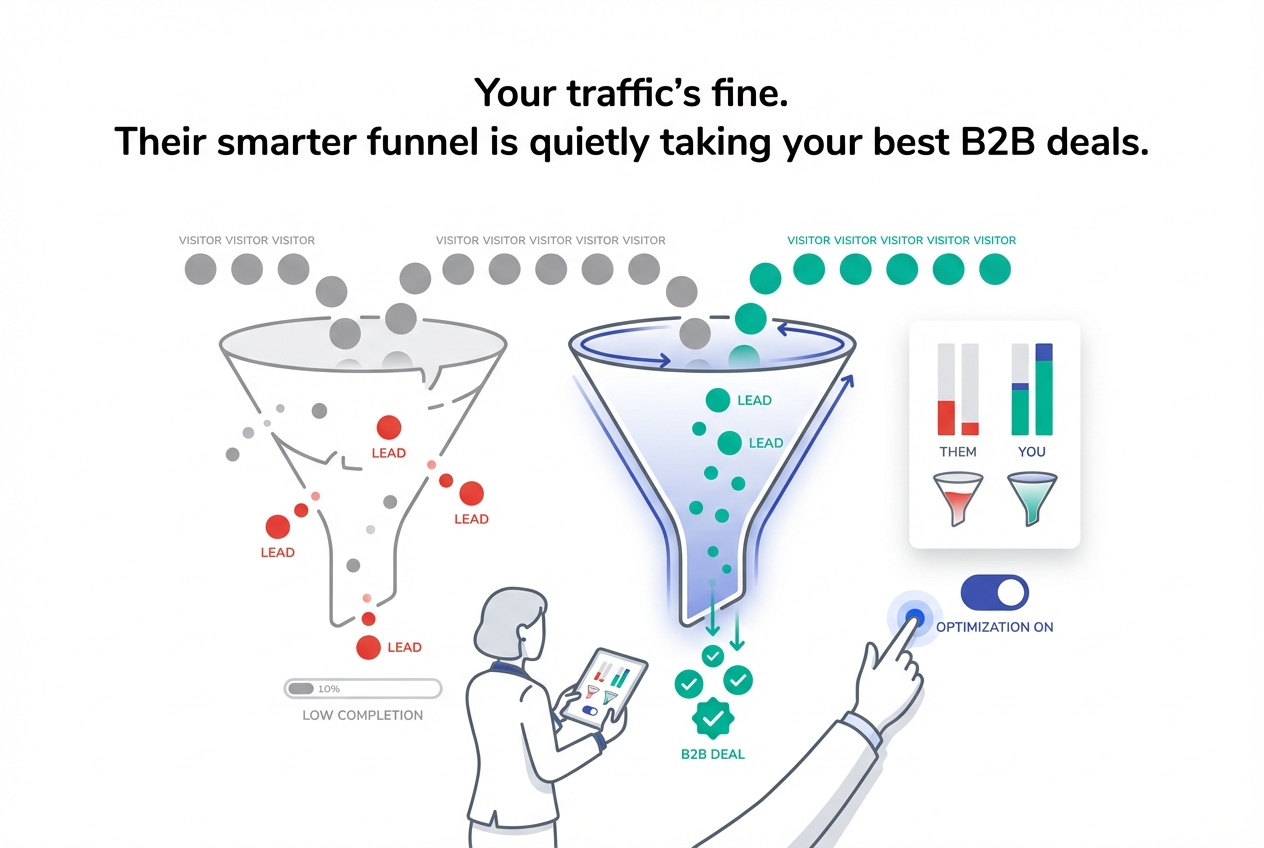
In the first, growth stays dependent on ads, outbound, and the founder’s network. It can work, but CAC pressure and operational stress tend to rise as you scale, and pipeline becomes fragile when a channel shifts.
In the second, paid and outbound still matter - but SEO becomes a stable baseline. The right service and industry pages consistently pull their weight, objection-handling content reduces sales friction, and organic leads show up as a measurable slice of pipeline. Not 100% of growth - and it doesn’t need to be - but enough that the business feels less exposed and more efficient.
That’s the real promise of B2B SEO for service-based companies: not “more traffic,” but a durable inbound engine you own.



.svg)

.svg)
.svg)