
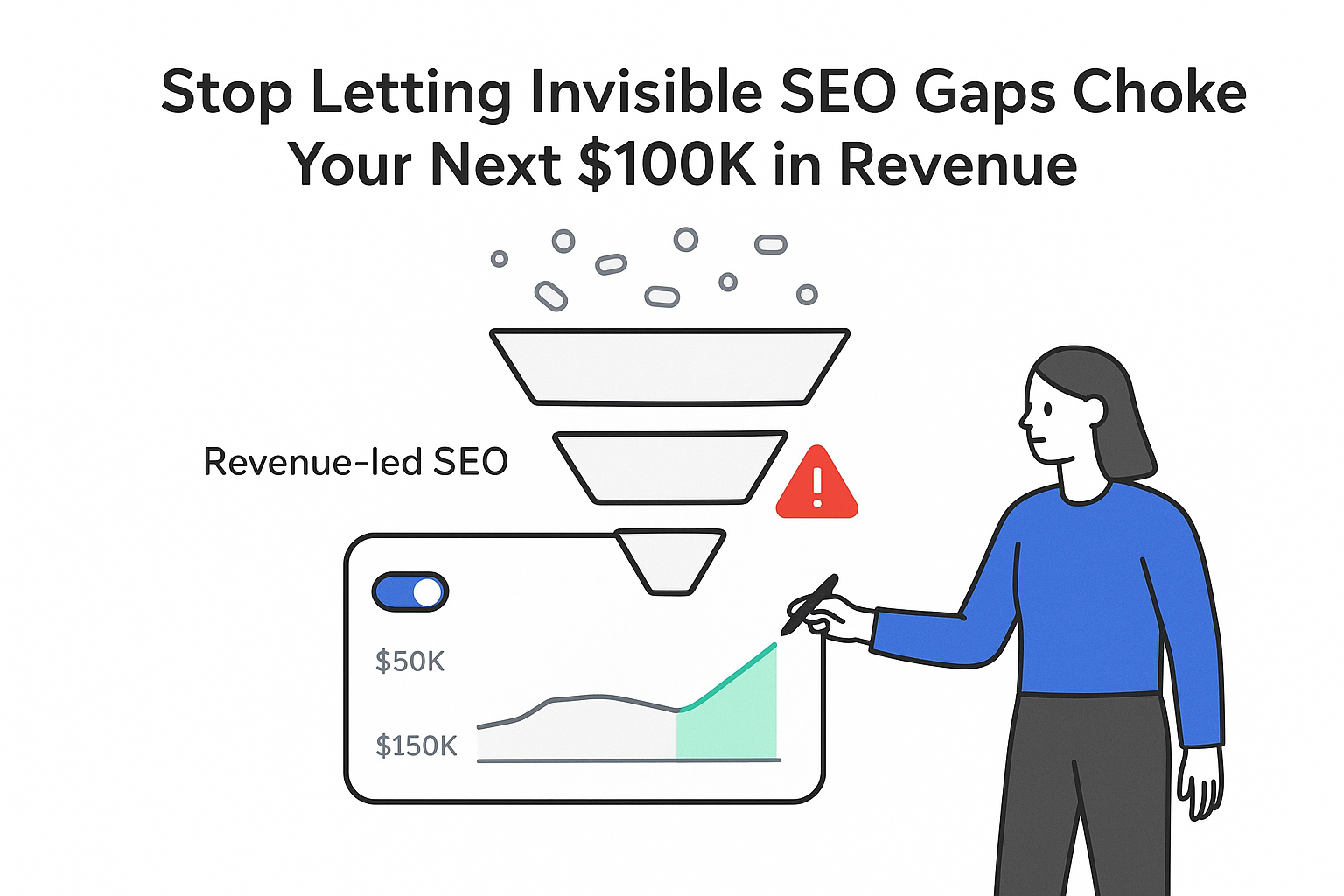
Paid channels used to feel simple: pour budget into Google Ads or LinkedIn, watch qualified demos appear. Now click costs climb, conversions feel jittery, and I often see B2B service firms plateau around $50K-$150K per month. It’s not a crisis, but the pressure shows up in thinning margins and slower growth. Some of that is just market competition, and some of it is attention decay - what many teams describe as “fatigue” in paid environments (see this recent article in Advertising Week).
I also hear the same claim from CEOs in this range: “We don’t really rely on search. Our best deals come from referrals and outbound.” That can be true operationally, yet those same buyers still search, compare, and sanity-check you before they reply to an email or accept a call. If you’re hard to find (or easy to dismiss) in that moment, you’re handing credibility to someone else.
That’s where a revenue-focused approach to SEO starts to matter for B2B services: not “more blog views,” but more pipeline-relevant visibility at the moments buyers are trying to reduce risk. (If you want the short version of how I think about this end-to-end, see revenue-driven B2B SEO for service firms.)
How B2B service SEO is different (and where it actually shows up)
I’ll say this plainly: SEO for B2B service companies behaves differently than SEO for B2C ecommerce or product-led SaaS. Sales cycles are longer, stakeholders are multiple, services are nuanced, and search volumes can look small even when deal sizes are large.
That mix misleads teams into thinking “SEO won’t move the needle” because they see only a few hundred searches per month for a high-fit term. In services, one deal can repay months of marketing spend - so the right question isn’t “how big is the keyword volume,” it’s “how close is the searcher to a buying decision, and how valuable is the win.”
Here’s the typical journey I map content to:
Awareness      →      Consideration      →      Shortlist      →      Vendor Selection
(problem)             (solutions)               (who to call)         (final choice)

SEO touchpoints:
   - Problem guides, thought leadership
   - Solution pages, comparison content
   - High-intent service / industry pages, case studies
   - Brand searches, reviews, pricing & ROI content
What I watch for is where search shows up as confirmation, not just discovery. Even referral-driven deals often include: (1) a quick Google scan, (2) a skim of a few pages, (3) a credibility check through case studies, comparisons, or pricing/ROI framing. If your site doesn’t help them make that decision, it quietly increases friction for sales.
This is also why “brand vs nonbrand” matters more than most teams realize. Many deals that start elsewhere still close faster when organic supports credibility and reassurance (related: brand vs nonbrand search strategy).
A revenue-led SEO framework (what I optimize for)
A lot of things get labeled “B2B SEO strategy,” but not every strategy connects to revenue. In practice, I see companies default into one of three one-dimensional motions: only blogging, only link building, or only technical cleanup. Each can help, but none is sufficient on its own to produce reliable pipeline for a service firm.
A revenue-led approach is more balanced. I anchor it on four pillars:
- Intent-led topic and keyword strategy tied to your services, industries, and deal types
- High-intent pages that answer buyer questions and convert
- Authority building that earns trust (including links and third-party mentions)
- Measurement that connects organic activity to leads, opportunities, and revenue - not just rankings
Most plateaus happen because pillar #1 and #2 are weak: teams publish content that earns attention but not conversations, or they have “service pages” that are too generic to rank and too vague to convert. If you’re diagnosing a plateau, that’s usually the first place to look.
Intent and keyword research that maps to real deals
In B2B services, I don’t start with keyword volume. I start with the buyer and the sales cycle, then translate that into search intent.
The most useful inputs are internal: notes from sales calls, lost-deal reasons, proposal questions, and the specific language prospects use when they describe risk, urgency, and “why now.” From there, I map those themes to buying stages (problem-aware, solution-aware, vendor-aware) and prioritize topics that are closest to revenue. (If you want a practical process for turning sales conversations into search priorities, see trial intent keywords and pricing intent keywords.)
Vanity queries vs revenue queries
A key filter I use is separating vanity queries from revenue queries:
Vanity query: “what is SOC 2” can be high volume, but it often attracts students, DIY readers, or early researchers who will never buy.
Revenue query: “SOC 2 audit services for fintech companies” is often lower volume, but far more likely to be a qualified opportunity because the search already contains service intent plus context.
Once I’ve built a candidate list, I validate it against reality: past closed-won deals, highest-converting industries, and the objections that repeatedly stall pipeline. If a topic doesn’t match how deals are won, I treat it as optional - even if it looks “good” in an SEO report.
Building high-intent pages that turn research into leads
Traffic is interesting; pipeline is the point. For most B2B service firms, the pages that carry revenue intent aren’t deep blog posts - they’re a specific set of pages designed to match shortlist and vendor-selection behavior.
These are the page types I prioritize first:
- Core service pages (clear scope, outcomes, proof, and next steps)
- Industry/vertical pages (the same service framed for a specific regulated niche or business model)
- Use-case/problem pages (a defined scenario with measurable outcomes)
- Comparisons and alternatives (in-house vs partner, approach A vs approach B, or “alternatives” to common options)
- Pricing and ROI framing (not necessarily a rate card, but enough context to reduce uncertainty)
Where most pages fail is that they’re written like brochures. I rewrite them to behave like sales enablement: specific outcomes, credible constraints (“who it’s for / not for”), proof near the top, and language that matches the buyer’s risk concerns.
A simple example of what changes in practice: a generic “IT consulting services” page tends to rank poorly and convert poorly because it’s non-committal - no industry focus, no concrete deliverables, no proof, and no reason to believe you’re the safer choice. When I split that into one or two highly specific pages (service + industry), traffic can stay flat or even drop slightly, but lead quality rises because the page qualifies the visitor and reduces ambiguity. That’s the trade I want in B2B services: fewer clicks, more sales-relevant clicks.
To make those pages actually discoverable, I also treat internal linking like a revenue system, not a “nice-to-have.” A clear structure prevents pages from competing with each other and helps buyers self-navigate. (If you’re seeing overlapping topics or weird ranking volatility, this is often the culprit: keyword cannibalization fixes.)
A practical 90-day implementation plan (and what results look like)
A common CEO concern is that SEO becomes a vague, never-ending project. I avoid that by treating the first 90 days like a structured launch: clear deliverables, measurable leading indicators, and a visible link between work completed and pipeline impact.
A realistic timeline in B2B is that leading indicators show up first, and consistent revenue impact follows later:
Days 0–30  | Baseline + fixes: technical issues, tracking, ICP & intent map, page plan
Days 31–60 | Build + publish: first high-intent pages, supporting content, internal linking
Days 61–90 | Improve + expand: optimize what’s live, strengthen proof, earn mentions, refine conversion paths
Within 60-90 days, what I expect to see is not “SEO magically closed deals,” but tangible movement: key pages indexed, early ranking improvements, clearer branded and problem-specific searches, and the first qualified inquiries that can be tied back to organic visits. Consistent lead flow typically takes 4-12 months, depending on competition, existing authority, how quickly content ships, and how fast your team can approve changes.
This is also where internal speed matters. Slow approvals and limited development capacity can delay results more than any algorithm update. If you want SEO to compound, keep decision-making tight and publishing cadence predictable.
Optimization after the first 90 days: authority, UX, and channel alignment
Once the initial engine is running, I shift focus from “launch” to “compounding.” The work becomes less about creating random new pages and more about strengthening what already converts, then expanding outward from proven themes.
At this stage, I focus on three areas. First, site structure and topical depth: a clear hub-and-spoke model around each core service so both buyers and search engines understand you’re not dabbling - you’re specialized. Second, on-site UX and conversion clarity: fast pages, low-friction forms, obvious navigation to service and industry pages, and proof where skepticism naturally peaks. Third, authority building: relevant third-party mentions and links that match your niche (quality over volume).
This is also where SEO can support account-based motions. If you target a tight list of industries or account types, industry pages and comparison content become useful warm assets for outbound, partnerships, and sales follow-up - especially in long cycles where buyers keep revisiting your site to reduce perceived risk.
When conversion-path changes are on the table, I’m a fan of bringing a testing mindset to the page experience (forms, proof placement, CTA clarity, and page sequencing). A/B testing can be a practical way to reduce guesswork, as this Forbes piece notes - it helps brands hone in on the type of content that delivers personalized experiences.
Attribution in long B2B cycles (how I give SEO fair credit)
B2B journeys rarely follow a clean “search → form fill → close” path. More often, it looks like: an early search leads to a guide, then a LinkedIn touch, then an outbound email reply, then a few stakeholder checks, then months later a deal closes.
That’s why I avoid judging SEO purely on last-click attribution. Instead, I look for “organic involved” signals across the journey: assisted conversions, repeat visits to high-intent pages, growth in branded search, and opportunity records that include an organic touch at any point. The goal isn’t to inflate SEO’s role - it’s to avoid undercounting it in a multi-touch buying process. (For a deeper look at reporting and revenue connection, see measuring pipeline impact of SEO.)
ROI modeling and budgeting for B2B service SEO
A finance lens helps keep SEO grounded. I model SEO ROI the same way I model any growth channel: inputs, conversion rates, time-to-impact, and risk.
I start with a baseline for organic: sessions, lead rate, sales-qualified rate, close rate, average deal size, and average sales cycle length. Then I model improvements that are plausible for a service firm that adds high-intent pages and improves conversion paths.
Here’s a simple example model (numbers just to show the math):
Baseline: 2,000 organic visits/month at 1.5% visit-to-lead yields 30 leads. If 40% become SQLs (12) and you close 25% (3 deals) at a $25,000 average deal size, that’s about $75,000/month attributed revenue.
If a year of focused work doubles traffic and improves conversion quality: 4,000 organic visits/month at 2% visit-to-lead yields 80 leads. If 45% become SQLs (36) and you close 25% (9 deals) at a $25,000 average deal size, that’s about $225,000/month.
I also pressure-test the edge cases. If your total addressable market is extremely small and your buyers truly do not search for solutions (rare, but possible), SEO won’t be the primary growth lever. And if you need results in 30 days due to runway constraints, SEO is typically a parallel investment, not the emergency fix.
On budgeting, I don’t believe in a universal “right” number. I look at the cost of acquiring one customer today (often via paid) and ask what mix of content, technical work, and authority building would realistically reduce that over 6-12 months. Lower budgets usually mean fewer experiments and slower learning; higher budgets can accelerate publishing and iteration - but only if the business can approve, ship, and follow through. If you want a numbers-first way to frame this, see B2B paid search budget allocation.
One more note: if paid performance is deteriorating due to saturation or fatigue dynamics, it’s useful to treat SEO as a stabilizer, not just a growth bet. A helpful reference point is that 76% of consumers cite ad fatigue as their biggest engagement hurdle - which is exactly why compounding, intent-led organic visibility can be such a margin protector for service firms.
Key takeaways
- I treat B2B service SEO as a pipeline asset, not a traffic project: fewer keywords, higher intent, clearer conversion paths.
- The highest leverage usually comes from upgrading (or creating) the pages buyers use to shortlist and de-risk a decision - service, industry, comparison, and ROI framing pages.
- A structured 90-day plan should produce visible leading indicators and the first qualified inquiries; meaningful pipeline impact typically compounds over 4-12 months.
- SEO works best when it supports the rest of go-to-market: credibility for referrals, assets for outbound, and insights that improve messaging across channels.
- ROI and attribution should reflect long sales cycles, using assisted influence and “organic-involved” views - not just last-click.



.svg)

.svg)
.svg)