
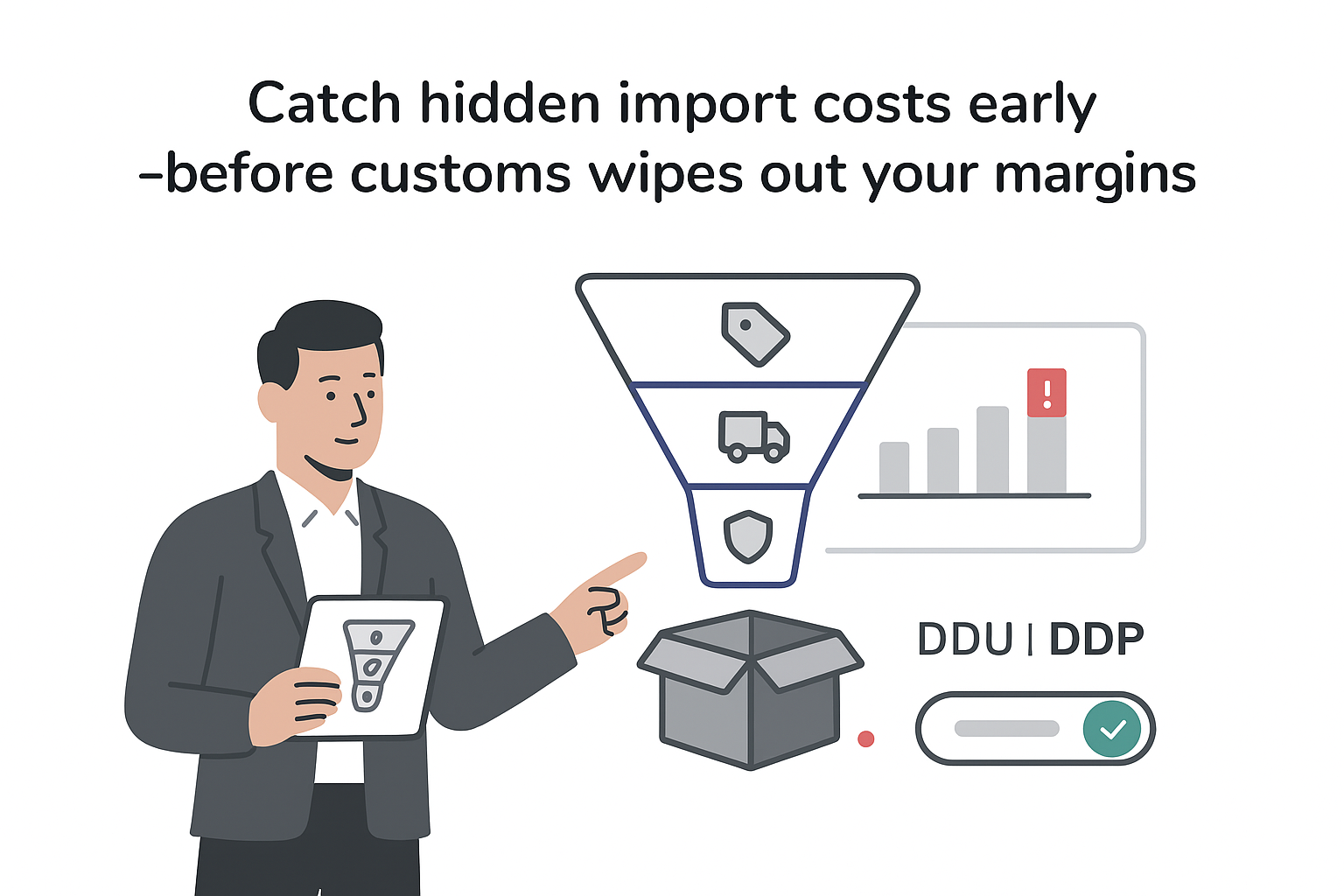
Expanding into new markets sounds exciting until the first shipment gets stuck at customs, your client calls, and your margin disappears in a fog of extra charges. That moment is when import rules stop being back office admin and start feeling very real for a CEO.
In this guide I keep the technical pieces, but the focus is simple: how you predict the real cost, protect your margins, and keep shipments moving without needing a customs law degree.
Guide to import duties and taxes for international expansion
If you are sending goods across borders, import duties and taxes sit right in the middle of your pricing model, your delivery promises, and your cash flow. Ignore them, and you get sudden charges, grumpy clients, delayed projects, and partners pointing fingers at each other.
In this section I set the stage. I walk through landed cost, how customs duties, import tariffs, and international shipping taxes work, how HS code classification affects everything, and how choices like DDU vs DDP shape your customer experience. I also highlight public tariff databases and duty and tax estimators so you can predict costs with more confidence. Once you understand these costs, it becomes much easier to run price testing without damaging brand perception instead of guessing.
You may already have freight forwarders and carriers who handle customs for you. That helps, but you still carry the financial risk. Knowing the basics lets you ask sharper questions, read quotes properly, and say yes or no to opportunities based on numbers, not guesses.
Calculating your total landed cost and customs fees
When a CEO asks, “What does this market expansion really cost per shipment?” they are asking about landed cost, not just the supplier invoice. Customs fees are one of the quieter line items in that number, but they sit beside bigger pieces that all add up.
In plain language, your landed cost usually looks like this:
- Product cost
- Freight (air, ocean, courier, truck)
- Insurance
- Import duties
- Taxes (VAT, GST, etc.)
- Customs fees and brokerage charges
- Other surcharges and handling fees
Here is a simple example for a B2B shipment of equipment to a new market:
| Item | Amount (USD) |
|---|---|
| Product cost | 10,000.00 |
| Freight | 1,000.00 |
| Insurance | 100.00 |
| Customs value (product + freight + insurance) | 11,100.00 |
| Import duty (5% of customs value) | 555.00 |
| Import tax (10% of customs value + duty) | 1,165.50 |
| Customs brokerage and customs fees | 150.00 |
| Other surcharges | 75.00 |
| Total landed cost | 13,045.50 |
On paper, you bought goods for 10,000 dollars. In reality, that shipment cost over 13,000 dollars before your team even touched it in the destination country.
If your target gross margin was, say, 30 percent and you priced only on the 10,000 dollar product cost, you just gave away several points of margin without noticing. That might be acceptable on a one off pilot, but as volumes grow it quietly turns into a profit problem. The same pattern appears when seasonal discounts are planned without a clear view of landed cost, which is why many teams pair this analysis with seasonal campaign planning that protects margins.
Estimating landed cost up front lets you price quotes accurately, decide which markets and Incoterms make sense, and set clear expectations inside your sales team. It also makes it easier to set quarterly marketing goals that map to P&L, because you see the real profitability of each lane or market. It also stops the blame game when customs sends a surprising invoice.
How customs duties are calculated on shipments
Customs duties look like a single number on a report, but several inputs sit behind it. Once you understand those, the math becomes less mysterious.
Key inputs customs authorities use
Customs authorities usually look at:
- HS code classification
- Customs value
- Country of origin
- Any applicable trade agreement
- Duty type
- Quantity, weight, or units
Each of these can change the duty bill significantly, especially HS code, customs value, and origin.
Ad valorem vs specific duties
For an ad valorem duty, the calculation is:
Duty amount = duty rate × customs value
Customs value is often based on the transaction value of the goods, then adjusted to include freight and insurance up to the border. Some regions handle this slightly differently, but a typical pattern is product cost plus transport and insurance.
For a specific duty, the formula changes:
Duty amount = rate per unit × quantity or weight
For example, 50 dollars per metric ton or 0.10 dollars per item. Some products even face mixed systems that combine ad valorem and specific elements.
Common mistakes include declaring only the ex works product price and ignoring freight and insurance when the rules say they must be included, assuming a zero or reduced rate from a trade agreement without holding correct proof of origin, and using a wrong HS code that looks close enough but triggers a higher duty rate later during an audit.
Penalties range from back duties and interest to shipment holds and increased inspection rates. Even if a broker handles the filing, the importer of record usually owns the liability. That is often you or your client, depending on how the deal is structured.
What are import tariffs on goods?
People use the words import tariffs, customs duties, and taxes almost as if they are the same thing. They are related, but not identical.
Import tariffs are government charges on imported goods that apply based on the HS code, the customs value, and the country of origin. Many countries use them to raise revenue or protect local industries. In daily trade language, tariffs and customs duties often mean the same thing.
Taxes such as VAT or GST are different. They are usually consumption taxes charged on top of the customs value and duties. VAT and GST are often recoverable for registered businesses, while tariffs typically are not.
Tariff levels can vary widely by product category. Industrial machinery might have a modest rate, while consumer goods or sensitive products face higher tariffs. You can also run into special rates such as anti dumping or safeguard duties, which target specific products from specific countries when local industries complain about unfair competition.
Sorting this out early helps you decide which product lines make sense for a market and which ones you should handle through local sourcing instead.
Understanding international shipping taxes for B2B orders
International shipping taxes usually refer to VAT, GST, or similar consumption taxes applied when goods enter a country.
In many regions, import VAT is calculated on the customs value plus customs duties and some fees. That means tax is often charged not only on the goods themselves, but also on transport, insurance, and the duty amount.
It helps to separate three concepts: import VAT or GST at the border, domestic VAT or sales tax on local sales, and whether the buyer can recover input tax.
For B2B transactions, VAT registered buyers can normally reclaim import VAT on their returns. That makes VAT a timing and cash flow problem for them rather than a permanent cost. For B2C shipments or non registered buyers, that VAT is a real cost that pushes up the final price.
In the EU, import VAT is due when goods clear customs, but some countries allow deferred accounting where tax is recorded but not paid in cash at the border.
In the UK, post Brexit, non UK sellers need to think carefully about VAT registration thresholds and who is the importer of record. Handling this wrong can cause parcels to sit in depots while buyers argue about extra charges.
In Canada or Australia, GST rules around imports, registration, and low value thresholds shape how you price to local clients and who is responsible for collecting and remitting tax.
For service based B2B companies that ship hardware, training kits, or equipment as part of a contract, import taxes may feel like a side note until you realize that the tax treatment changes whether you or your client should be the importer and how you phrase your proposals.
Classifying products with the correct HS code
If there is one technical concept to pay real attention to, it is the HS code. The Harmonized System is a global classification language for products. It controls which import duties and taxes apply, whether a free trade agreement can reduce them, and how customs systems treat your shipment. For a concise overview of how the system works, see this guide to the Harmonized System (HS) code.
An HS code usually starts with six digits that are harmonized internationally. Countries then extend it with extra digits for more local detail. For example, at the six digit level one code might cover portable digital automatic data processing machines, and a longer national version such as 8471.30.01 could describe a very specific type of that equipment in a local schedule.
To find the right HS code, I typically see companies start with official tariff schedules, searching by keyword and working through the chapter notes to understand definitions and exclusions. They then cross check with any classification tools or databases their customs authority provides, look at past binding rulings for similar products, and, for tricky or high value items, take advice from customs brokers or trade specialists.
Misclassification can feel harmless in the short term, especially if a lower duty rate sneaks through. The real risk appears later when customs compares product descriptions, trade flows, and HS data.
If they decide your code was wrong, you might face back duties for several years of imports, fines, and closer checks on future shipments. For B2B service contracts tied to strict delivery schedules, those delays hurt more than the payments. The reputational cost with a key client can be higher than the customs bill.
Finding current tariff rates and duty information
Once you have an HS code, the next question is: what are the current tariff rates? Paper lists and old spreadsheets age quickly, so it helps to work from official sources.
Here are some widely used reference resources:
| Resource | Region / Focus | What it is good for |
|---|---|---|
| USITC Harmonized Tariff Schedule | United States | HTS codes, duty rates, legal notes, rulings |
| EU TARIC database | European Union | Tariff rates, measures, restrictions, VAT clues |
| UK Integrated Online Tariff | United Kingdom | Tariff rates, VAT rates, trade measures |
| Canada Tariff Finder / CBSA tools | Canada | Duty rates, HS codes, trade agreement rates |
| National customs portals in Asia Pacific | Markets such as Australia, Japan | Local duty and tax rules, HS lookups |
| World Customs Organization and WTO tools | Global reference | High level schedules and trade agreement details |
In practice, it helps to start your search by HS code, then confirm with a keyword check and the chapter notes. You also need to watch for multiple columns of rates, such as MFN, preferential, or special duties, because the rate you actually pay depends on origin and documentation.
Tariff rates can change due to trade disputes, new agreements, or periodic reviews. Relying on a three year old spreadsheet may feel efficient until a customs bill proves otherwise. Many B2B firms keep a simple internal log of their key HS codes and refresh the rates for those codes at set intervals.
DDU vs DDP: choosing how customers pay duties and taxes
The DDU vs DDP question decides who feels the pain of import duties and taxes day to day: you or your customer. The terminology has shifted in recent Incoterms, with DAP replacing DDU in many contracts, but the idea has not changed.
DDU / DAP means Delivered Duty Unpaid. You ship the goods, but the buyer pays duties, taxes, and customs fees at the border.
DDP means Delivered Duty Paid. You take responsibility for paying those charges and usually roll them into your price.
Here is a simple comparison for B2B sellers:
| Aspect | DDU / DAP | DDP |
|---|---|---|
| Who pays duties and taxes | Buyer | Seller |
| Cash flow impact | Buyer pays on arrival | Seller pays up front, recovers in pricing |
| Customer experience | Risk of surprise bills and delays | Cleaner delivery, fewer payment interruptions |
| Control over process | Less control after shipment leaves | More control, but more admin and compliance |
| When it fits | Large buyers with customs teams, low touch sales | High value orders, strategic accounts, complex markets |
From a CEO perspective, DDU can feel attractive because you avoid handling foreign tax and duty payments. The catch is that a surprised buyer who gets a big customs invoice often blames the seller, not the customs office. That can mean refused deliveries, slow payments, and damaged trust. Aligning your approach with clear security and trust signals that increase checkout confidence makes cross border buying feel less risky for your customers.
DDP brings those charges into your cost structure. You gain control over the numbers and can quote landed pricing that is easier for your sales team and your clients to understand. The trade off is higher working capital demand and a stronger need for accurate landed cost calculations.
Whatever you choose, contracts, quotes, and even simple email proposals should state clearly who is importer of record (the party legally responsible for the import declaration and duties) and who pays which part of the customs bill.
Regional variations in customs duty rules
Customs duty rules share common principles, yet each region brings its own quirks. A model that works smoothly for the US and Canada might cause problems when copied straight into the EU, the UK, or Asia Pacific markets.
De minimis thresholds
The US has a relatively high de minimis threshold for low value shipments, meaning small parcels can enter with simplified duty and tax treatment. Other markets keep thresholds much lower, so even modest shipments trigger full customs procedures and costs. This difference matters if your strategy relies on frequent low value shipments.
Rules of origin and trade agreements
Shipping goods from the US to Mexico or from the EU to specific partner countries can reduce or remove customs duties if the product meets origin rules and you hold proper proof. Missing a certificate, misunderstanding substantial transformation rules, or misjudging the origin composition can flip a shipment from zero duty to a full standard rate, and customs can reassess several years of history.
Special territories and zones
Some regions include free trade zones or territories with separate rules. Special economic zones, bonded warehouses, or territories with distinct customs treatment can change when and how duties and taxes are charged. That matters if you ship equipment to a project site located inside a special zone, because the timing of duty payment can shift and paperwork requirements can multiply.
The pattern is simple: do not assume copy paste rules. Before launching in a new market, many companies run a small policy check with local customs advisors or their broker network. This early work saves long email chains with finance when the first unexpected duty invoice lands.
Using an online duty and tax calculator and expert support
An online duty and tax calculator can make early decisions faster. Various carriers, customs authorities, and trade portals publish estimators that approximate import duties, taxes, and some fees once you enter the destination, HS code, value, and Incoterms.
These estimates are particularly useful in early pricing models, when sales teams want a quick sense of landed cost before sending a quote, or when you are comparing the relative attractiveness of different markets.
However, they have limits. Many calculators use standard duty rates and may miss trade agreement reductions, do not fully reflect special measures such as anti dumping duties or safeguards, assume standard customs values and ignore special valuation rules, and can lag legal changes if they are not updated often.
That is why many B2B companies combine a calculator with expert review. A common pattern looks like this: finance or operations runs estimates with a duty and tax calculator for the main product list and target markets, then a customs broker or specialist validates the top revenue items and high risk categories. Industry associations such as the National Customs Brokers and Freight Forwarders Association can help you find qualified brokers if you do not already have partners in place.
Over time, this mix of structured estimation and expert review turns import duties and taxes from a vague extra cost into a defined input in your pricing models. Your sales team stops guessing, your clients see fewer surprises, and you can talk about new markets with real numbers rather than optimistic assumptions.



.svg)

.svg)
.svg)