

Being fully booked feels like a good problem to have, right up until the pipeline runs dry. Many CEOs I speak with ask the same thing at that point: should you pause SEO when things are busy and delivery capacity is maxed out? For B2B service companies, my short answer is no. If you pause SEO when you are fully booked, you are not saving money. You are shifting that cost into a future revenue gap, right when current retainers or projects roll off.
SEO is slow to start and slow to stop. The search activity you fuel now often turns into sales conversations three, six, or even twelve months later. When you stop, the impact is delayed, which makes the problem harder to connect to the original decision. Competitors in product businesses talk about inventory and sold-out SKUs. In services, your "inventory" is your team and delivery capacity. Once that capacity frees up, you either have qualified leads waiting or you have an empty pipeline and an expensive scramble.
Why pausing SEO when you're fully booked backfires
I prefer to answer the core question head-on. If you pause SEO, you are choosing short-term comfort over future growth. The contracts and retainers that keep you fully booked today all have an end date. Your buyers also have long decision cycles, internal politics, and budget processes that drag out timelines.
Here is a simple way to see the cause and effect:
- Months 0 to 3: You invest in SEO, publish content, and improve key pages. Search traffic starts to rise, but sales impact is small.
- Months 3 to 6: Rankings improve, more high-intent visitors arrive, and inbound inquiries increase.
- Months 6 to 12: Those conversations move through your sales cycle and turn into revenue.
Now imagine you pause SEO at month 4 because you are fully booked. You keep enjoying strong revenue for a while, since the pipeline you built is still closing. Then, around months 8 to 12, the effect shows up. New inquiry volume drops, deals thin out, and your team suddenly has more time than work.
To fix it, you spin SEO and other demand channels back up. But the delay repeats. You may face three to six painful months with underused delivery capacity, or feel forced to lean hard on paid ads at poor unit economics.
That is why treating SEO like a tap you can turn on and off rarely works for B2B services. The timelines simply do not match the reality of long sales cycles and project-based revenue.
Maintain brand visibility during capacity constraints
In product businesses, the advice during stock shortages is often "maintain your brand awareness". For a B2B service business, that becomes very SEO specific. Your brand visibility lives inside search results, your content, and the trust that comes from seeing your name again and again during a long research process.
When SEO activity stops, three things usually happen at once. First, rankings for high-intent terms start to slide as fresher or more authoritative pages replace yours. Second, branded search results become messy, with outdated messaging and third-party listings taking over the first page. Third, thought leadership content ages, which makes you look out of date to new buyers who are still in research mode.
There are certain queries you simply cannot afford to abandon, even when capacity is tight, for example:
[your brand] consulting, [your brand] reviews, B2B [your niche] agency, or [your core service] for [your main industry]. You want these searches to land on current, clear, confident pages, not a forgotten blog post from three years ago.
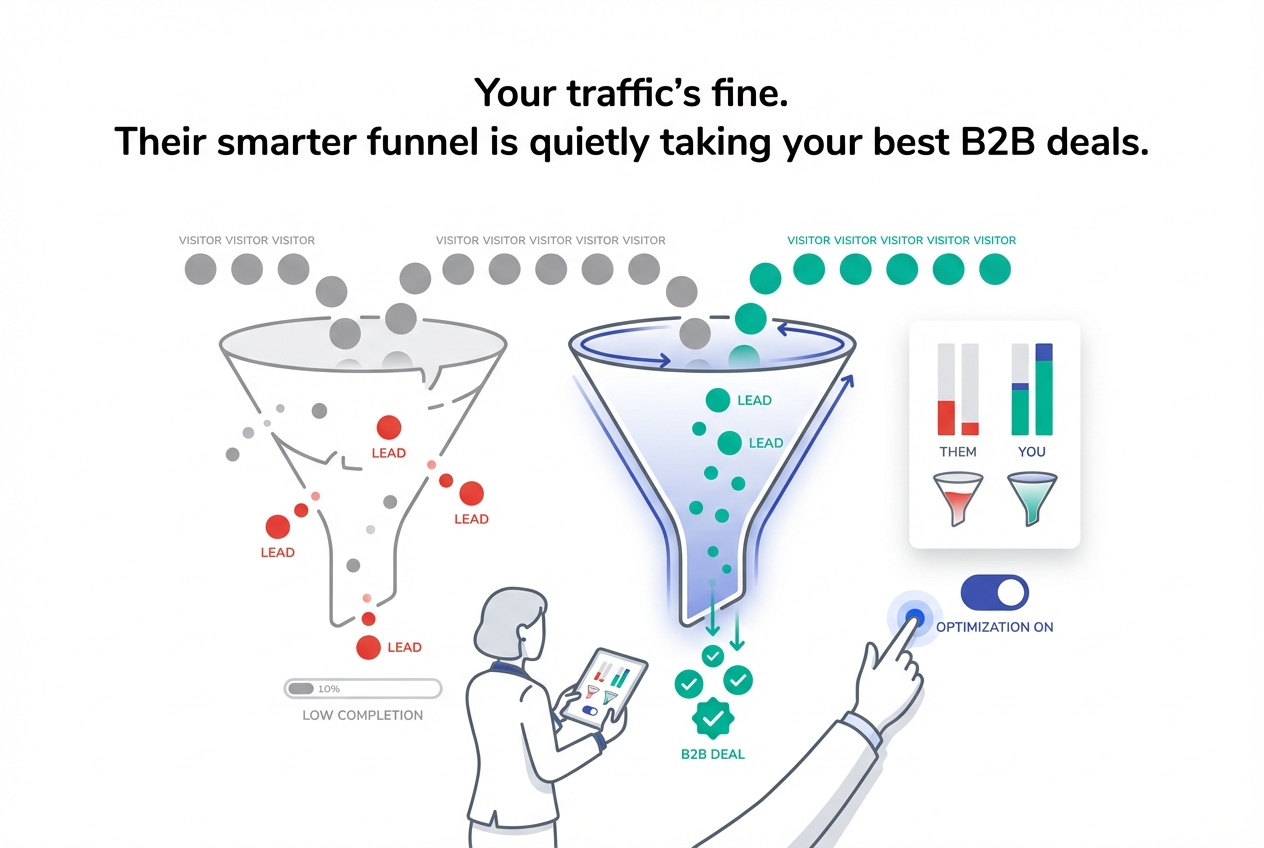
Picture a simple line graph. One line shows a company that keeps publishing and maintaining SEO when they are fully booked. Organic impressions stay steady, then slowly climb. Another line shows a company that paused SEO. Their impressions hold for a bit, then slide down over several months. When both companies free up capacity, one can fill their teams from organic demand. The other needs emergency campaigns and discounts to win back attention.
One mid-size consulting firm stayed visible during a fully booked stretch of nine months. They were not trying to flood sales with more leads. They focused on defending rankings and keeping branded searches clean. During that period, they still logged a consistent stream of qualified inbound inquiries, which allowed them to raise prices on new work instead of rushing for any deal that came through.
Use capacity-aware SEO to prioritize your most profitable services
Retail marketers talk about "inventory-aware" campaigns that only promote products actually in stock. B2B service leaders can use the same logic, with a twist. I call it capacity-aware SEO.
The idea is simple. Instead of pushing every service equally, you match your SEO focus with where you have real delivery capacity and which services bring higher margins or more strategic clients.
A basic framework looks like this. First, list your core services and mark current capacity for each as high, medium, or low. Second, add a quick profitability score for each service, considering margin, upsell potential, and how strategic the work is. Third, combine those two views to decide where SEO energy should go.
You might end up with a simple matrix in your planning documents:
- High capacity / High margin: Top SEO priority right now.
- Low capacity / High margin: Maintain SEO, but add clear waitlist messaging.
- High capacity / Lower margin: Use SEO to fill gaps, but do not crowd out premium work.
- Low capacity / Lower margin: Protect key rankings, but do not push hard.
Next, connect this to real data from your CRM and operations tools. Which service lines close fastest? Which have the biggest lifetime value? Which teams have room to grow in the next quarter? That information should guide your choice of target keywords for each service, the topics you cover in new content, and the internal links that nudge visitors toward services you most want to sell.
Capacity-aware SEO keeps your visibility growing without overloading a maxed-out team. You still build authority, but you guide demand toward the parts of the business that can handle it and that actually move your profit needle.
Keep prospects informed with transparent waitlist messaging
When inventory is short in retail, smart brands keep customers informed and manage expectations. The same principle works for services when your calendar is full.
Instead of quietly pausing SEO and hoping people stop finding you, use honest, transparent messaging across your site and search presence. You still capture demand, but you are clear about what happens next.
On the hero sections of key service pages, you can set expectations directly. For example:
Currently booking new projects for Q3. Join the priority list to reserve a spot.
Fully committed for the next six weeks. Tell me about your project and I will confirm the next open slot.
Meta descriptions can echo that clarity. For example:
[Brand] provides [service] for B2B companies. Now booking new engagements for September. See how the team works and request a spot on the priority list.
Anyone scanning search results immediately understands both what you do and when you are available.
Buttons and form labels can continue the story: "Join the waitlist", "Reserve next available slot", or "Get on the priority list" all signal demand without overpromising speed. Confirmation emails then close the loop:
Thanks for reaching out. Our team is fully booked until mid-August. You are now on the priority list. We will review your details and share next steps within two business days.
This kind of messaging does three useful things at once. It protects trust, because people respect clear information more than silence or surprise delays. It filters for higher-intent leads who are willing to wait for the right partner. And it keeps your pipeline warm without forcing you to rush hiring or burn out your current team.
Instead of treating capacity as a problem to hide, you turn it into proof that your service is in demand.
Prepare your SEO to capture demand as capacity opens
While your team is flat out, your marketing work should quietly make life easier for the moment when capacity opens up again. Think of it as getting the store ready before shoppers arrive.
Keep technical SEO healthy. Run regular checks for crawl errors, broken internal links, slow templates, or mobile issues. Standard SEO and analytics tools make this manageable. You do not need big changes, just a clean, fast, reliable site.
Refresh key pages, do not rewrite everything. Update social proof, pricing ranges, case studies, and next-availability statements on your main service pages at least once a quarter. These small changes send fresh signals to search engines and reassure human visitors that what they are reading reflects your current reality.
Schedule content in advance. When your subject matter experts have a lighter stretch, batch a few strong thought leadership pieces and schedule them for the coming months. That way your blog or resources section stays active even when delivery is hectic.
Use marketing automation and lead scoring carefully. Connect your forms to a simple nurture sequence so people who join your waitlist receive genuinely useful content every couple of weeks. Basic lead scoring can highlight prospects who engage a lot, so sales know who to speak with first once there is room.
Switch waitlist messages to talk-to-sales at the right moment. As operations confirm new capacity, update forms, buttons, and page copy from "reserve next slot" to "speak with the team this month". Because you kept SEO steady, there is already a pool of educated, engaged prospects ready to talk.
If you sketched this as a flowchart, it would look like this: operations share capacity updates, marketing adjusts SEO messaging and content focus, automation warms up leads identified by SEO, then sales step in once capacity is open. You avoid boom-and-bust cycles for both your calendar and your stress levels.
B2B SEO case study: service company that scaled with ongoing SEO
To make this feel less abstract, consider a scenario many B2B service leaders will recognize.
A 40-person IT services firm had hit about 1.2 million dollars in monthly revenue. They were booked solid for three to four months. The CEO was tempted to pause SEO and content to save around fifteen thousand dollars per month and "stop flooding sales with leads we cannot handle".
Their history with agencies was not great. Past partners had focused on vanity metrics and were nowhere to be found when results slowed down, so the concern about wasted spend was real.
Instead of cutting, leadership decided to keep SEO active but change how it worked. They shifted focus to higher-margin advisory services, added clear waitlist and "next availability" messaging on every key page, concentrated on defending branded and high-intent rankings instead of chasing every possible keyword, and used SEO content to educate and warm up ideal clients while those clients waited to start.
Over the next twelve months, the numbers told a clear story. Organic traffic to high-intent pages rose by more than half. Sales-qualified leads from organic grew by more than a third, even with explicit waitlist messaging. Average deal size increased by almost a third as more leads came in for premium services. Reliance on paid search spend dropped noticeably, as organic demand carried more of the load. Revenue dips between project cycles smoothed out, because there were always warm leads ready to start when a team freed up.
Reporting focused on pipeline and revenue, not just rankings. Every month, leadership could see how search terms and content tied back to booked work. That transparency, plus a tight link between SEO activity and delivery capacity, helped rebuild trust in SEO as a core growth channel rather than a black box.
Key SEO strategies that worked
Several specific tactics drove those results. All of them apply broadly to B2B service companies with long sales cycles.
- Reworking core service pages for high-intent queries. The firm refreshed copy, structure, and internal links on its main service pages, focusing on precise phrases like "cloud migration services for manufacturers" instead of vague, top-of-funnel terms. They added stronger proof, such as short case blurbs and simple process visuals. That change alone drove a significant rise in qualified form submissions from organic visitors.
- Publishing evergreen thought leadership around buying questions. Rather than chasing news, they built a library of guides such as "How to budget for a cloud migration project" or "What to ask before changing IT service providers". These pieces were written for decision-makers, not just technical staff. Over time they became a steady source of organic leads, with visitors who read two or more articles converting to pipeline at a much higher rate. For a deeper breakdown of how these assets compound, see how evergreen pages compound ROI for B2B services.
- Earning links from niche industry publications. The firm contributed guest articles and expert quotes to respected sites in their target verticals. This supported authority for core keywords and sent direct referral traffic from exactly the right audiences, without resorting to generic link-building schemes that did not reflect how B2B buyers actually behave.
- Improving on-site paths and forms. Analytics showed visitors bouncing between blog posts and service pages without taking action. By simplifying navigation, reducing form fields, and adding "next availability" notes near contact forms, the firm increased organic lead conversion rates substantially. Prospects knew what would happen next and when.
- Using transparent availability to filter and qualify leads. Instead of hiding their backlog, they mentioned average start times everywhere that mattered. Many casual shoppers dropped off, which was fine. Those who stayed were more serious and more willing to engage in structured scoping work. Close rates on organic leads rose notably, even as volume grew.
None of these moves were flashy. The power came from consistency, clear goals, and a deliberate link between SEO activity and real-world delivery capacity.
Next steps: align your SEO strategy with your capacity goals
If you take one thing from all this, let it be this: I would not pause SEO just because you are fully booked. It is almost always better to shape SEO around your capacity and your most profitable services than to slam on the brakes.
There are three areas worth focusing on right away:
- Compare your current rankings and organic traffic by service line with real capacity and margin. Decide which services you want search to support most over the next two to three quarters.
- Review messaging on your core pages and forms. Add clear next-availability or waitlist language where needed, so you can keep capturing demand without creating false expectations.
- Define a small set of SEO metrics that tie to revenue, such as organic sales-qualified leads, pipeline value influenced by search, and average contract value from organic sources.
From there, you can decide whether to run SEO with an in-house team, external specialists, or a mix of both, and how to choose a marketing agency and contract that fit your goals. In my experience, what matters most is that whoever owns SEO is comfortable talking about profit, not just traffic, and can connect their work directly to pipeline and capacity.
As you shape your approach, it helps to think about SEO alongside topics like ROI, realistic timelines for organic growth, and how search supports B2B lead generation across a full buying cycle. Treated this way, SEO becomes a steady growth engine that keeps serving you long after the current wave of projects is complete.



.svg)

.svg)
.svg)