
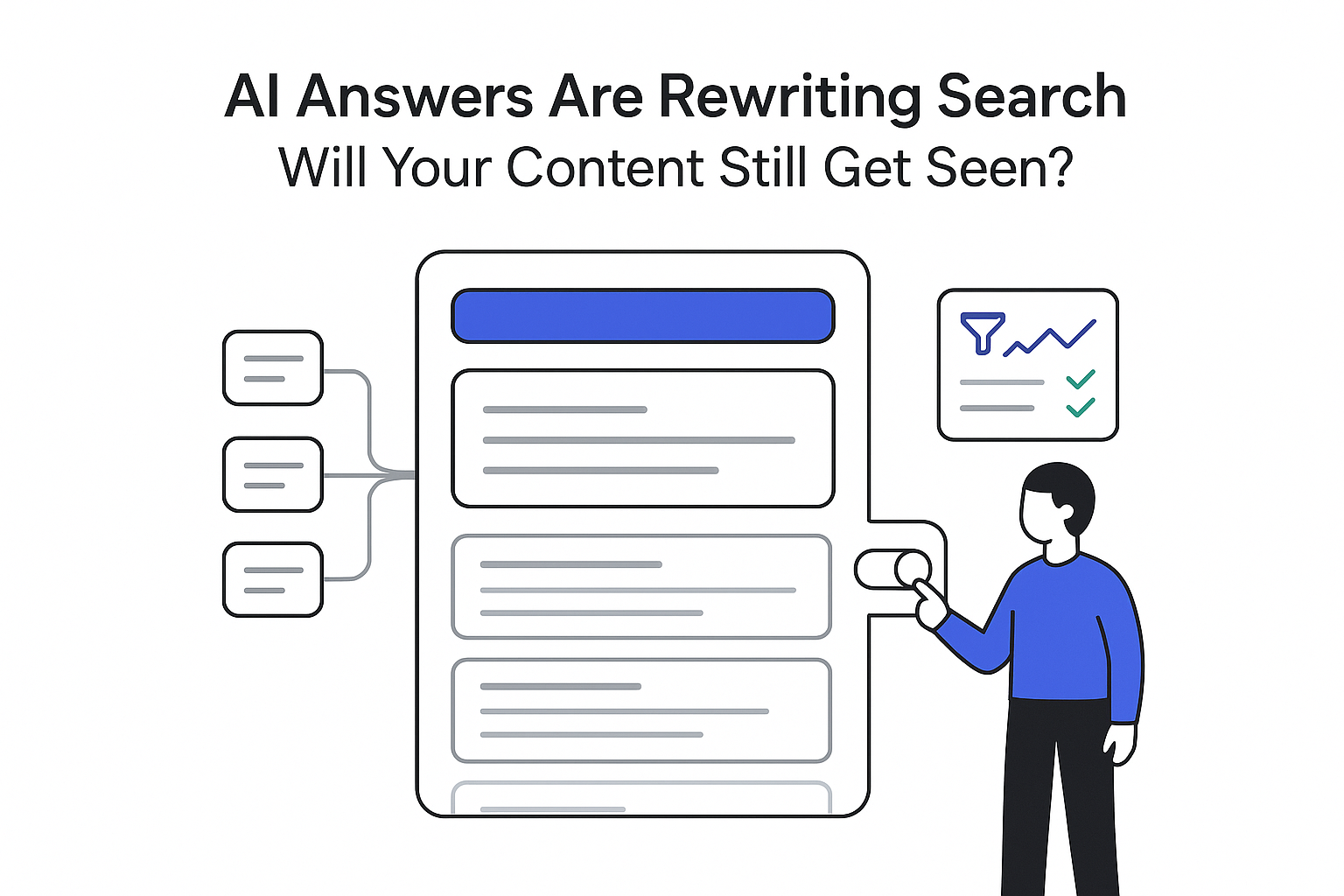
Answer Engine Optimization in AI Search and What It Reprices for SEO
How Perplexity-style AI search and answer engine optimization (AEO) change visibility, traffic, and measurement for marketers
AI-first answer engines are moving from summarizing search results to replacing them. The core thesis: Perplexity's sub-document, personalized AI search changes what "ranking" means and shifts optimization from whole pages to fragments and user context, reshaping how marketers gain visibility, traffic, and attribution.
Key Takeaways
- Answer engines erode the idea of "one SERP for everyone": with personalization and memory, the same query can surface different sources per user, so rank tracking loses value and traffic-based metrics become the primary control panel.
- Sub-document indexing pushes optimization down to paragraph and sentence level: engines retrieve thousands of snippets, not 10 URLs, so information-dense, well-structured sections matter more than page-level tricks.
- Classic SEO remains the eligibility filter: link-based authority (PageRank-style) and crawlable, indexable content still decide whether your material even enters the snippet pool, so domain and link strategy still matter.
- Context window saturation is now a core quality lever: engines try to fill roughly 130K tokens with relevant snippets to reduce hallucinations [S1]. As models improve, more informational queries will be answered in place, likely reducing click-through for basic research queries.
- Early AEO work is most valuable for brands in high-research categories (complex purchases, technical content). Those are the areas where answer engines are most likely to be used and where appearing as a cited source or recommended brand can shift consideration.
Situation Snapshot
Perplexity's Jesse Dwyer has outlined how their AI search stack works and how it differs from both classic search and "GEO" (generative engine optimization) approaches that sit on top of traditional indexes [S1].

Key factual points from the interview [S1]:
-
Personalization:
- Perplexity and ChatGPT can load "personal memory" into the model context, so two users with the same query can receive different answers and underlying sources.
-
Index structure:
- Traditional search indexes and ranks entire documents (pages).
- GEO-style AI search (for example, GPT + Bing) runs a normal web search, pulls the top 10-50 URLs, and has the model summarize them.
- Perplexity's AI-first approach indexes "sub-documents" (snippets) of roughly 5-7 tokens (2-4 words) each, represented as vectors.
-
Retrieval:
- For a query, Perplexity retrieves about 130K tokens of "most relevant" snippets (around 26K snippets at about 5 tokens per snippet), matching the LLM's context window limit.
- The system aims to fill that context with relevant data to minimize hallucinations.
-
Ranking factors:
- Perplexity relies on a PageRank-style link system for base authority and relevance signals.
-
Differentiation:
- Perplexity claims its edge lies between index and snippets: modulating compute, reformulating queries, and using proprietary models to improve snippet selection.
These mechanics align broadly with retrieval-augmented generation patterns across the industry, but the interview is explicit about fragment-level indexing and its central role in AEO [S1].
Breakdown & Mechanics
The core question: how does sub-document AI search change the mechanics of visibility compared with classic SEO?
From one global SERP to personalized answer contexts
Classic model:
- Query -> ranking system -> nearly the same top 10 results for most users (with limited geo or personalization) -> user chooses links.
AI answer model described by Dwyer:
- Query + user memory/context -> index of snippets -> selection of around 26K of the most relevant snippets (about 130K tokens) -> LLM generates a single synthesized answer with source citations [S1].
Cause-effect chain:
- User profile, previous chats, and saved memory bias which snippets look "most relevant".
- That produces a changing set of sources per user.
- There is no stable "rank 1-10" for a given keyword.
Impact: classic notions like "we rank #3 for X" stop mapping cleanly to what users see. Visibility becomes:
- "How often are we one of the sources quoted or cited for questions in this topic cluster, for this kind of user?"
Whole-document vs sub-document indexing
Whole-document (GEO-style):
- Index unit: full pages.
- Retrieval: top 10-50 URLs, based on conventional ranking signals.
- AI role: summarizer of already-ranked web pages.
- Optimization target: page authority, keyword focus, and classic on-page SEO.
Sub-document (Perplexity-style AEO):
- Index unit: short fragments (snippets) from pages, encoded as vectors [S1].
- Retrieval: tens of thousands of snippets from many pages until the context window is full.
- AI role: composer that reasons almost entirely on retrieved fragments, not entire pages.
- Optimization target: clear, self-contained informational fragments that encode topic meaning in small spans of text.
Practical consequence: instead of asking "How do I move this URL from position 8 to position 3?", the better question becomes "Does this paragraph express the concept so clearly that it will be retrieved as a top snippet?"
Context window saturation and hallucination risk
Perplexity's stated goal is to saturate the model context with relevant snippets so there is little room for the model to improvise [S1].
Mechanics:
- Each LLM has a maximum context size (for example, around 130K tokens).
- The retrieval system keeps pulling high-relevance snippets until that limit is reached.
- If most of that context is accurate, on-topic material, hallucinations should drop because the model is effectively constrained to quoting and connecting existing content.
Marketing implication:
- As retrieval and context use improve:
- Reliability of AI answers goes up.
- User trust and repeated usage likely increase.
- More informational queries may be satisfied without a click to source sites.
Result: the value of being cited in the answer (brand impression, authority, potential referrals) rises while the volume of organic sessions from some query types may decline.
Where optimization still looks like "SEO"
Despite the shift, several foundations stay familiar:
- Index eligibility: pages still need to be crawlable, indexable, and not blocked.
- Authority: Perplexity uses a PageRank-style scoring system [S1], so links and domain reputation still act as core filters.
- Topical focus: if a site is not recognized as relevant for a topic cluster, its snippets are less likely to enter the context window.
AEO does not replace SEO; it sits on top of SEO signals but redefines how those signals are consumed and combined.
Impact Assessment
From a marketing perspective, the key levers show up in organic visibility, paid media planning, content strategy, and analytics.
Organic search and answer engine optimization
Direction of change:
- Visibility: less binary (top 10 vs nothing) and more probabilistic (how often your snippets make the cut for a given query type).
- Traffic:
- For simple, factual queries, expect a gradual shift from click-throughs to zero-click answers as engines mature.
- For complex decisions or local/commercial intent, there is still strong incentive for AI engines to link out.
Winners:
- Sites with strong link authority that also have tightly structured, high-density content:
- Clear headings per question.
- Short paragraphs where each one expresses a discrete idea.
- Repetition of key entities and relationships in natural language to support snippet-level indexing.
- Brands with recognizable names that users already search for or engage with; personalization will favor previously trusted sources.
Losers:
- Thin, ad-heavy content that existed mainly to capture long-tail queries; AI summaries can replace many of these pages.
- Sites relying purely on rank chasing for a handful of generic keywords; deeper personalization erodes that advantage.
Concrete actions:
- Rewrite key pages so that each paragraph can stand alone and convey a complete micro-answer.
- Organize content around question-form headings (H2/H3) that map to natural-language queries.
- Maintain or grow link authority through referrals, PR, and partnerships; that authority still gates snippet inclusion.
Paid search and PPC in an AI-first environment
Perplexity today is not a major PPC channel, but the mechanics described hint at future ad patterns.
Likely medium-term effects (speculation):
- On Google:
- As Google increases AI overviews, some high-funnel queries that currently generate cheap clicks may become answer-only, reducing impressions and clicks.
- Bids may rise on remaining high-intent queries where AI still pushes users to visit sites (for example, pricing or local service selection).
- On AI answer engines:
- Expect ad units embedded within AI answers:
- Sponsored citations among sources.
- "Recommended providers" sections that sit beside or within the generated text.
- Auctions may consider:
- Topic relevance at snippet and domain level.
- Historical answer inclusion for that topic.
- Performance metrics similar to Quality Score.
- Expect ad units embedded within AI answers:
Practical watchpoints:
- Track shifts in impression share and click volumes for informational vs commercial queries over the next 12-24 months.
- Monitor announcements from Perplexity, OpenAI, Google, and others around sponsored content within AI answers to anticipate new inventory.
Content strategy and brand visibility in answer engines
AEO changes what "thought leadership" and "helpful content" mean in practice.
Key shifts:
- Fragment-level quality: well-written introductions and conclusions still matter, but mid-page sections that express specific facts, comparisons, and how-to steps in plain language are more likely sources for snippets.
- Entity clarity: use consistent names for your brand, products, locations, and key concepts; this helps engines connect your snippets across the index.
- Brand reinforcement: because personalization uses user memory, repeated exposure matters. If a user has visited or clicked you in the past, engines may be more inclined to favor your snippets.
Actions:
- Audit cornerstone content for "answer-ready" sections with clear questions and self-contained responses.
- Include brand mentions within explanatory text in a natural way, so that when a snippet is quoted, your brand can appear in or near the cited fragment.
Analytics, measurement, and operations
Traditional SEO reporting - rankings, average position - will degrade in usefulness as AI answers and personalization spread.
Expected shifts:
- From rank-based KPIs to:
- Organic traffic volumes by topic cluster.
- Brand search trends.
- Referral traffic from AI engines (where identifiable).
- New measurement needs:
- Tracking when your site is cited as a source in AI answers (currently manual or via third-party tools; ecosystem still immature).
- Monitoring categories where impressions fall but conversions stay flat, suggesting queries are being answered before the click.
Practical steps:
- Place more weight on topic-level and brand-level metrics instead of single-keyword rankings.
- Watch referral patterns for new or unusual referrers that may indicate AI engines (for example, special query parameters or referrer URLs from Perplexity).
Scenarios & Probabilities
These scenarios combine current evidence with reasoned speculation. Labels reflect rough likelihood over the next 2-4 years.
-
Base case - Hybrid search with rising AI answers (Likely)
Major engines continue surfacing both classic results and AI answers. Informational queries in many verticals see heavy AI summarization, while transactional queries retain strong traditional SERPs. AEO becomes a layer on top of SEO: authoritative, structured content gains share in AI answers, but link-driven SEO remains necessary.
-
Upside for early AEO adopters - Fragment-first dominance (Possible)
Sub-document architectures like Perplexity's spread quickly, and other players deepen similar approaches. Brands that already structure content for snippet retrieval and maintain strong authority see outsized representation in AI answers and brand mentions. For some sectors, appearing in AI answers becomes as influential for consideration as ranking in the top 3 Google results once was.
-
Downside - Slow adoption and regulatory drag (Edge)
Privacy rules restrict extensive personal memory use, weakening personalization. High-profile hallucination incidents or copyright disputes slow deployment of aggressive AI answers. In this world, classic SEO remains the dominant channel and AEO optimization yields smaller returns outside a few high-tech or early-adopter user segments.
Risks, Unknowns, Limitations
Several open questions and constraints could change how these dynamics play out.
-
Data gaps:
- We lack large-scale, independent data on:
- How often Perplexity and similar engines cite specific domains.
- The click-through rate from AI answers to source pages across verticals.
- We lack large-scale, independent data on:
-
Black-box retrieval:
- Details of snippet scoring, personalization weighting, and compute modulation are proprietary [S1], so assumptions about their exact impact are educated guesses, not measured facts.
-
Adoption curve uncertainty:
- The pace at which mainstream users shift informational queries to AI answer engines is unclear and sensitive to UX, pricing, and trust.
-
Measurement constraints:
- Current analytics tooling does not reliably expose when a visit came after the user saw your brand in an AI-generated answer.
-
Falsification conditions:
- If future data shows that:
- AI answer usage stagnates or declines.
- Engines keep sending a similar share of traffic to top results as today.
- Personalization remains shallow in practice.
- If future data shows that:
Validation: this analysis states a clear thesis, explains the mechanics of Perplexity-style AI search, quantifies context-window dynamics where possible, contrasts short- vs long-term impacts, segments implications by channel, and outlines scenario-based expectations with labeled speculation. Recommendations focus on concrete shifts (fragment-level content, authority, measurement changes) grounded in the described system behavior.
Sources
- [S1]: Search Engine Journal / Roger Montti, 2026, article - "Perplexity AI Interview Explains How AI Search Works" (interview with Jesse Dwyer of Perplexity AI).





.svg)

.svg)
.svg)