
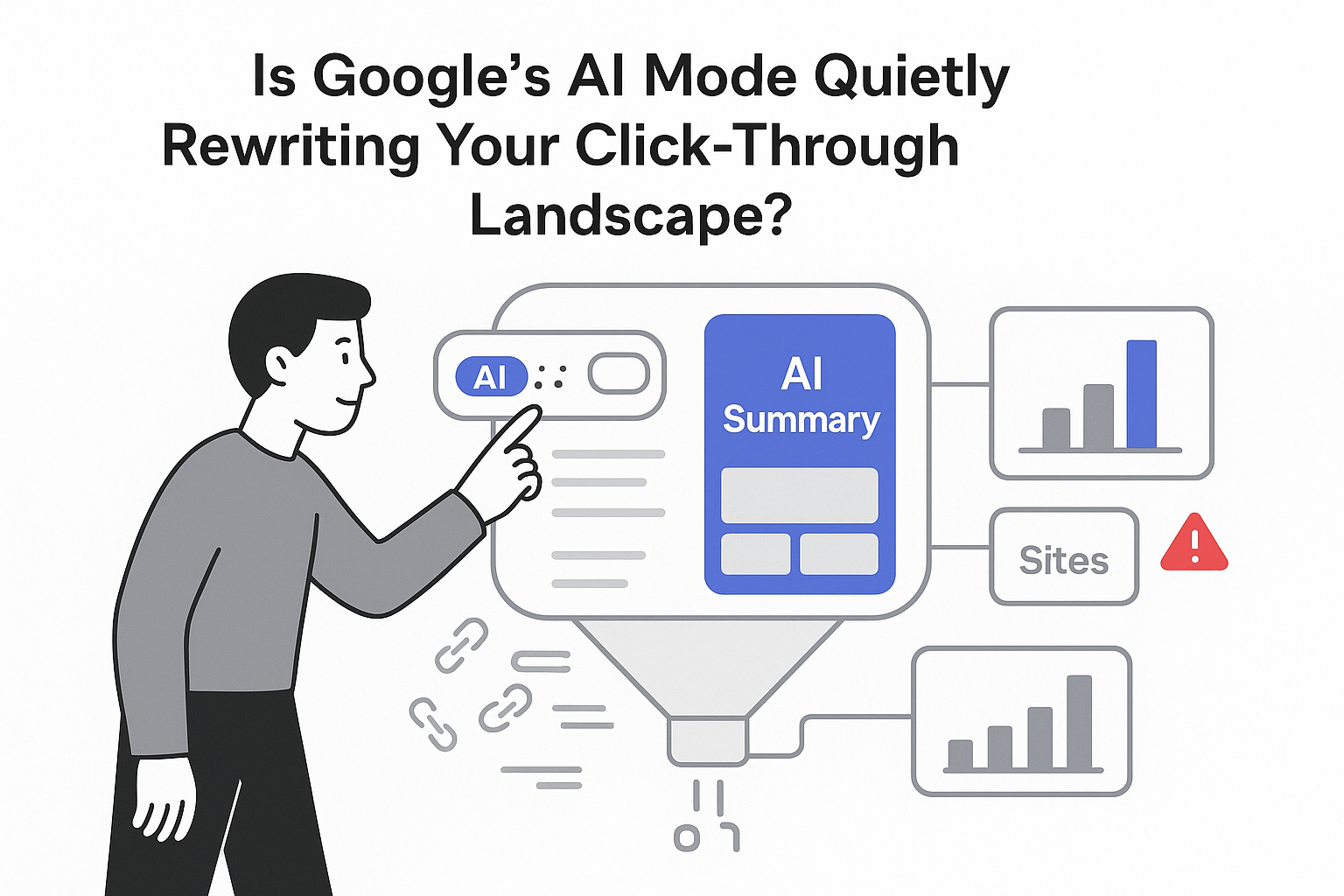
New third-party tracking data shows that Google’s AI Mode now cites its own properties far more often than it did nine months ago, and that these self-citations are shifting from local Business Profiles toward links to Google organic search result pages.
Google AI Mode self-citations overview and executive snapshot
Executive snapshot
- Google properties now account for 17% of all citations in AI Mode answers, up from 5% in the prior SE Ranking study - more than a 3× increase across 1,321,398 citations. [S1][S2]
- When YouTube is included, Google-owned sites represent roughly 20% of all AI Mode sources. [S1]
- Within Google’s own citations, 59% now point to organic search result pages and 36% to Google Business Profiles; previously, 97% of Google citations went to Business Profiles. [S1][S2]
- Across 20 niches, Google is the top-cited domain in 19. Its citation share reaches 53.18% in Travel, 48.74% in Entertainment & Hobbies, and 30.54% in Real Estate, while still leading with 5.13% in Finance and 6.48% in Insurance. [S1]
- Ahrefs data shows AI Mode and AI Overviews share only 13% of cited URLs, and just 38% of AI Overview citations come from the top 10 organic results. [S4][S5]
For marketers, this suggests that organic search remains a key input to AI features, while Google’s own properties capture a growing share of citations and AI interfaces do not simply mirror traditional rankings.
Study methods and data sources for Google AI Mode citations
SE Ranking’s latest study, published in a new SE Ranking report, collected AI Mode answers for 68,313 keywords in February, recording 1,321,398 individual citations. [S1] Data was gathered using SE Ranking’s Keyword Research Tool and its AI Mode Tracker, which simulates queries and extracts the linked sources from AI Mode’s answer panels and citation carousels. [S1] The dataset is segmented across 20 topical niches, such as Travel, Real Estate, Finance, Insurance, and Career & Jobs. [S1]
An earlier SE Ranking analysis of AI Mode, published in July and summarized by Search Engine Journal, reported that 5% of AI Mode links pointed to Google properties and that 97% of those Google links went to Google Business Profiles. [S2] A separate SE Ranking study on AI Overviews found that 43% of those summaries linked back to Google properties such as Google Maps, Flights, or other search surfaces. [S3]
Ahrefs conducted two independent analyses, as reported by Search Engine Journal. The first compared URLs cited in AI Mode with those in AI Overviews and found only a 13% overlap in cited URLs despite similar answer content. [S4] The second measured how often AI Overviews cite URLs from the top 10 organic Google results and found a rate of 38%. [S5]
Key limitations
- All datasets rely on simulated queries and scraped outputs, not on Google’s internal logs.
- SE Ranking’s keyword set and niche definitions may not match the distribution of real-world user queries, and most details about geography and language are not public. [S1]
- Citations are counted as links within AI results; the studies do not measure click-through rates, user engagement, or conversions from those links. [S1][S4][S5]
- SE Ranking sells AI visibility tracking products, including the AI Mode Tracker used for this research, which creates a commercial incentive around this topic. [S1]
Findings on Google AI Mode links to its own properties and to organic results
SE Ranking’s comparison of two AI Mode datasets shows a marked rise in Google self-citation. Google-owned domains accounted for 5% of AI Mode links in the July report; by the February dataset, that share reached 17%, with Google plus YouTube totaling about 20% of all citations. [S1][S2] In practical terms, roughly one in five AI Mode citations now points to a Google-controlled property.
The composition of those Google citations has also shifted. In the earlier study, 97% of Google citations went to Google Business Profiles, tying self-citation primarily to local-intent queries. [S2] In the newer dataset, only 36% of Google citations go to Business Profiles, while 59% lead to Google organic search result pages shown in the AI Mode citation panel. [S1] The remaining fraction splits between Google Support (1.7%), Google Flights (0.1%), and other Google properties (3%). [S1]
This shift matters because a citation to an organic search results page inserts an extra layer between the AI answer and third-party websites. The AI result links first to a Google SERP, which then lists multiple external domains. That structure gives Google an additional opportunity to present its own vertical products, ads, or aggregations before users reach other sites.
By niche, Google’s prominence varies but remains high. SE Ranking reports that Google is the top-cited domain in 19 of 20 niches studied. [S1] In Travel, 53.18% of AI Mode citations go to Google properties; in Entertainment & Hobbies, the share is 48.74%; and in Real Estate it is 30.54%. [S1] Even in more specialized or regulated categories such as Finance (5.13%) and Insurance (6.48%), Google is still the top-cited domain, beating any single competitor. [S1] The one exception is Career & Jobs, where Indeed receives roughly three times as many citations as Google, and LinkedIn also ranks highly. [S1]
Comparing AI Mode to AI Overviews, the rate of linking back to Google appears lower for AI Mode (17%) than for AI Overviews (43%) in SE Ranking’s respective datasets. [S1][S3] However, the self-citation rate in AI Mode has risen sharply from 5% to 17% between the two SE Ranking reports. [S1][S2]
Ahrefs data adds another perspective: AI Mode and AI Overviews reach similar conclusions in many cases but only share 13% of cited URLs. [S4] In addition, only 38% of AI Overview citations come from URLs ranking in the top 10 organic results on the corresponding SERP. [S5]
Implications of Google AI Mode citations for SEO and marketing strategy
Interpretation - likely implications
-
Organic rankings remain a base layer, but not the full picture.
The increase in Google citations that point to organic search result pages indicates that AI Mode often uses classic SERPs as a structured source behind the scenes. [S1] Combined with Ahrefs’ finding that 38% of AI Overview citations come from top 10 organic URLs, organic visibility still feeds AI surfaces, although not deterministically. [S5] For marketers, sustained work on organic rankings remains important for AI exposure, even as AI interfaces abstract away direct blue-link clicks. -
Local search reliance on Business Profiles remains high, with broader coverage emerging.
The drop from 97% to 36% of Google citations pointing to Business Profiles, and the rise of citations to organic SERPs, means AI Mode now references Google’s own assets across more query types than purely local. [S1][S2] Local businesses still depend heavily on accurate, complete Google Business Profiles for AI visibility, but category, informational, and comparison queries now more often feed through organic SERPs within AI Mode. -
Verticals with high Google citation share likely see more “Google-first” navigation flows.
In Travel, Entertainment & Hobbies, and Real Estate, where 30–53% of citations point to Google properties, many AI Mode interactions likely start with a click to a Google page (for example, a SERP, Maps, or a vertical product) before reaching external sites. [S1] For brands in these verticals, performance measurement that only tracks direct organic clicks may underestimate the role of AI Mode and intermediate Google pages in user journeys.
Interpretation - tentative implications
-
AI visibility tracking may need to be separate from rank tracking.
The 13% URL overlap between AI Mode and AI Overviews, plus the 38% reliance on top-10 URLs for AI Overviews, suggests that AI citation behavior diverges from standard rankings. [S4][S5] Relying solely on rank-tracking tools as a proxy for AI exposure may miss important changes. Separate monitoring of when and how a brand is cited in AI Mode or AI Overviews offers a more direct signal of presence in these interfaces. -
Competitive sets in AI Mode differ from classic SERPs.
With Google being the top-cited domain in 19 of 20 niches and vertical leaders like Indeed and LinkedIn dominating the Career & Jobs category, the set of domains that appear most often in AI answers can skew toward platforms and aggregators. [S1] This may compress direct exposure for smaller brands, even when they rank well organically.
Interpretation - speculative considerations
-
Self-citation growth may reflect a preference for keeping users within Google ecosystems.
The shift from linking almost exclusively to Business Profiles to linking heavily to organic SERPs and other Google products might signal a design goal of routing more AI clicks through Google-controlled surfaces. [S1][S2] While this is plausible, the datasets do not confirm Google’s intent, so this remains speculative. -
Regulatory and antitrust scrutiny could increase if self-citation continues to rise.
With AI Overviews linking back to Google in 43% of cases and AI Mode now at 17% and climbing, regulators assessing platform self-preferencing in search may look closely at AI interfaces. [S1][S3] The marketing impact would depend on future policy outcomes, which are unknown.
Contradictions, data gaps, and open questions on Google AI Mode
The available studies highlight several tensions and missing pieces:
-
Different AI surfaces, different citation behavior.
SE Ranking finds heavy self-citation in both AI Mode (17%) and AI Overviews (43%), yet Ahrefs reports only 13% overlap in actual cited URLs between these two surfaces. [S1][S3][S4] This indicates that AI Mode and AI Overviews may use different retrieval pipelines or ranking layers even when they answer similar queries. -
Weak connection between top rankings and AI citations.
AI Overviews draw 38% of citations from top 10 organic URLs, which is meaningful but leaves most citation slots going to URLs outside the first page. [S5] Marketers cannot assume that a high organic rank guarantees prominent AI mentions, but the datasets do not explain which additional factors drive inclusion. -
Click-through and revenue impact remain unmeasured.
None of the cited studies report user behavior metrics such as CTR from AI citations, dwell time, or conversion outcomes. [S1][S3][S4][S5] The business value of being cited - whether directly or via a Google SERP link - remains an open question. -
Limited visibility into query mix and geography.
SE Ranking’s 68,313-keyword set spans 20 niches but may not reflect the full query distribution, long-tail searches, or non-English markets. [S1] Without more detail, extrapolating these percentages to all Google traffic involves uncertainty.
These gaps mean that while patterns in self-citation and citation composition are clear, the downstream traffic and revenue implications are only partially understood.
Data appendix: Google AI Mode citation statistics
Key quantitative points from SE Ranking and Ahrefs
| Metric | Value | Source |
|---|---|---|
| Keywords analyzed in latest AI Mode study | 68,313 | [S1] |
| Total AI Mode citations collected | 1,321,398 | [S1] |
| Share of all AI Mode citations to Google properties (latest) | 17% | [S1] |
| Share to Google properties in previous AI Mode study | 5% | [S2] |
| Approximate share to Google-owned including YouTube (latest) | ~20% | [S1] |
| Within Google citations: share to organic SERPs | 59% | [S1] |
| Within Google citations: share to Business Profiles | 36% | [S1] |
| Within Google citations: Google Support | 1.7% | [S1] |
| Within Google citations: Google Flights | 0.1% | [S1] |
| AI Overviews that contain links back to Google | 43% | [S3] |
| Niches where Google is top-cited domain | 19 of 20 | [S1] |
| Google citation share in Travel | 53.18% | [S1] |
| Google citation share in Entertainment & Hobbies | 48.74% | [S1] |
| Google citation share in Real Estate | 30.54% | [S1] |
| Google citation share in Finance | 5.13% | [S1] |
| Google citation share in Insurance | 6.48% | [S1] |
| AI Mode vs AI Overviews: overlap in cited URLs | 13% | [S4] |
| AI Overview citations coming from top 10 organic results | 38% | [S5] |
Source IDs
- [S1] SE Ranking - AI Mode citation study (February dataset, 68,313 keywords; 1,321,398 citations), as summarized by Search Engine Journal.
- [S2] SE Ranking - prior AI Mode study (July report) on Google self-citations, as summarized by Search Engine Journal.
- [S3] SE Ranking - AI Overviews self-referencing study, “43% of AI Overviews contained links back to Google,” as summarized by Search Engine Journal.
- [S4] Ahrefs - comparison of URLs cited in Google AI Mode vs AI Overviews (13% overlap), as summarized by Search Engine Journal.
- [S5] Ahrefs - study on AI Overview citations sourced from top 10 organic results (38%), as summarized by Search Engine Journal.





.svg)

.svg)
.svg)