
AI Brain Fry in Marketing: What a 1,488-worker HBR study shows about cognitive strain from AI tools
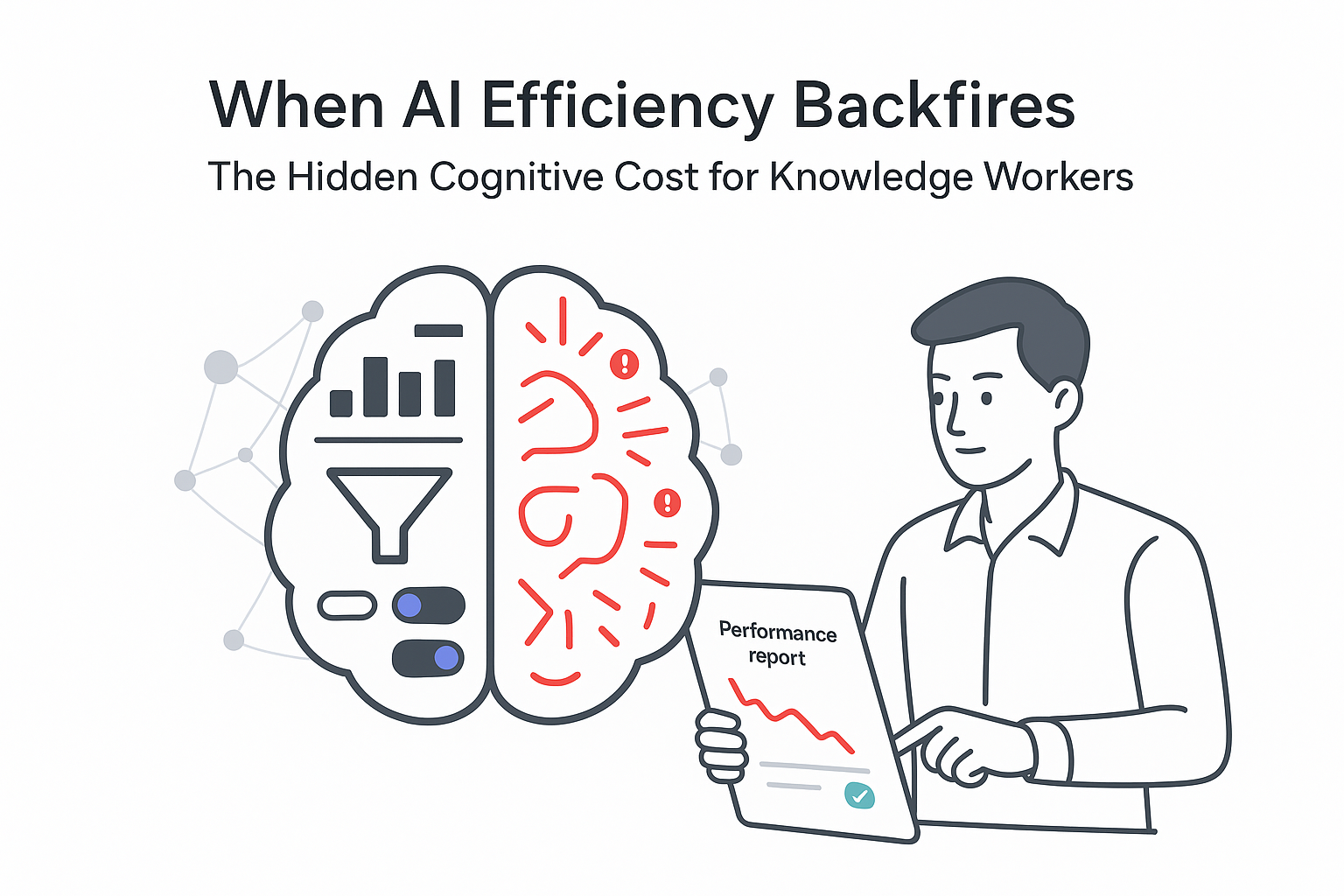
New data from a study of 1,488 U.S. workers suggests that heavy AI use is linked with a specific kind of mental fatigue the authors call "brain fry", with marketing teams reporting the highest rates of this strain.
Executive Snapshot
This section summarizes the main quantitative takeaways before moving into detail.
- 14% of 1,488 full-time U.S. workers reported "brain fry" from AI overuse, defined as acute mental fatigue from excessive AI use, interaction, or oversight beyond their cognitive capacity.
- Marketing workers reported the highest brain fry rate at about 25%, compared with 19% in HR, 17% in operations and engineering, 16% in finance and IT, and 5% in legal and compliance.
- High-oversight AI work was linked to 19% greater information overload, and workers with brain fry scored 33% higher on decision fatigue than those without it.
- Workers reporting brain fry said they made 11% more minor errors and 39% more major errors, and they showed a 39% higher rate of active intent to quit (34% vs. 25%).
- Using AI to automate routine tasks correlated with 15% lower burnout, but did not reduce mental fatigue. Manager support reduced mental fatigue by 15 to 28%, while perceived pressure to do more because of AI raised it by 12%.
Implication for marketers: high-intensity, multi-tool AI oversight appears to raise cognitive load, error risk, and churn risk in marketing teams even when overall productivity improves.
Method & Source Notes
The core data comes from a Harvard Business Review article by researchers from Boston Consulting Group and the University of California, Riverside. The authors surveyed 1,488 full-time U.S.-based workers at large companies across industries and roles in January 2026. Respondents were 48% male and 51% female; 58% were individual contributors and 41% were leaders.
"Brain fry" was defined as mental fatigue from excessive use of, interaction with, or oversight of AI tools beyond a person's cognitive capacity. The survey measured:
- Self-reported brain fry
- Degree and type of AI use, including oversight intensity and number of tools
- Perceived productivity and information overload
- Decision fatigue, error frequency, burnout, and quit intentions
The Harvard Business Review article is the primary source for the brain fry construct and all associated metrics. An interview with CBS News featuring coauthor Julie Bedard adds interpretive commentary but no additional quantitative data. The article also references a Yale study that found no evidence of job displacement in AI-exposed occupations over 33 months and a PwC CEO survey in which 56% of 4,000+ CEOs reported no revenue or cost benefits from AI so far. Both are secondary mentions here.
Key limitations include the self-reported nature of the data, the U.S.-only and large-company-only sample, and the cross-sectional design, which shows correlations rather than causation. A Search Engine Journal (SEJ) summary cites both 25% and 26% brain fry for marketing workers, suggesting minor rounding or reporting inconsistencies in secondary coverage.
Findings on AI brain fry and marketing workloads
The study finds that brain fry is not universal but is concentrated in specific kinds of AI work and in certain functions, with marketing at the top. Overall, 14% of surveyed workers reported brain fry attributed to AI overuse. By function, marketing workers had the highest rate at about one quarter (approximately 25%), followed by HR and people operations at 19%, operations and engineering or software development at 17%, finance or accounting and IT at 16%, and legal or compliance at 5%.
Workers described symptoms such as a "buzzing" sensation, mental fog, slower decision-making, and the need to physically step away from their screens. One finance director quoted in the study recounted going back and forth with AI to reframe ideas and synthesize data to the point of not being able to judge whether the final output "even made sense", and having to stop work until the next day. Many of the heaviest AI users were high performers and early adopters considered "superstars" inside their companies, rather than casual or reluctant users.
The type of AI work mattered. AI oversight - monitoring, checking, and correcting AI outputs - was reported as the most mentally taxing mode of AI engagement. Workers whose AI tools required a high degree of direct monitoring reported higher mental effort and more fatigue than those dealing with lower-oversight tools. High oversight was associated with a 19% increase in information overload scores.
A second major factor was workload expansion. When AI adoption coincided with more tasks or responsibilities, workers experienced higher brain fry. Oversight plus workload growth widened what the authors call the worker's "sphere of accountability", meaning more outcomes and tools to watch in the same amount of time.
Tool count showed a non-linear pattern. Perceived productivity increased from one AI tool to two, and again from two to three, though the gain from the third tool was smaller. After three tools, perceived productivity declined. This suggests a threshold beyond which adding more AI tools creates coordination and monitoring overhead that outweighs perceived productivity benefits. For marketing teams that may touch writing assistants, image or video generators, analytics copilots, and AI baked into ad and marketing platforms, this three-tool ceiling is a relevant reference point.
The business impact of brain fry showed up across performance and retention measures. Workers reporting brain fry scored 33% higher on decision fatigue scales than those who did not. They also reported higher error rates: 11% more minor mistakes and 39% more major mistakes. Turnover risk was noticeably higher. Among workers without brain fry, 25% showed active intent to quit; among those with brain fry, 34% did, a 39% relative increase in quit intent. The authors distinguish brain fry from burnout: burnout focuses on emotional exhaustion, while brain fry is framed as acute cognitive strain from pushing attention and working memory beyond their limits.
AI had mixed effects on well-being. When workers used AI to replace routine or repetitive tasks, burnout scores were 15% lower, indicating an emotional benefit. However, this did not reduce mental fatigue measures. Manager and organizational practices also influenced outcomes: workers whose managers made time to answer AI questions had 15% lower mental fatigue scores; workers who felt their organization expected them to accomplish more because of AI had 12% higher mental fatigue; and employees who felt their organization valued work-life balance had 28% lower mental fatigue.
Interpretation & implications for marketing and PPC teams
This section summarizes what the numbers likely mean for channel strategy, staffing, and tool choices in marketing functions.
Likely: Heavy AI oversight work is a cognitive risk area in marketing
Marketing teams often use AI for drafting content, optimizing ads, segmenting audiences, and analyzing performance data. These uses typically require judgment, editing, and compliance checks rather than pure automation. The finding that oversight-heavy AI work and workload expansion are the strongest predictors of brain fry suggests that marketing managers should treat high-volume AI editing and quality assurance as load-bearing cognitive work, not "free" capacity.
Likely: Limiting active tools per person can protect performance
The pattern of rising productivity up to three AI tools, followed by a decline, aligns with common martech stacks where individuals toggle among multiple AI-infused systems. For marketing and PPC teams, it is reasonable to cap the number of distinct AI tools that any one person must actively monitor, configure, and correct, and to consolidate overlapping tools where possible.
Likely: AI can lower burnout while raising cognitive strain
The same workers who benefit from AI removing manual tasks can still experience more brain fry, because mental fatigue and emotional burnout are different constructs. For marketers, this means using AI to reduce repetitive tasks, such as report creation or simple copy variants, may improve job satisfaction but will not automatically reduce the mental load of supervising multiple AI systems.
Tentative: Manager behavior is a strong lever for mitigating brain fry
The associations between lower mental fatigue and managers answering AI questions (minus 15%), and between work-life balance norms and mental fatigue (minus 28%), suggest that practical support and realistic expectations are protective. For marketing leaders, this likely supports:
- Making time for AI-related coaching and review
- Being explicit that AI speed gains should be used partly to improve quality or planning, not only to add more campaigns and channels
- Treating sudden spikes in AI-related oversight work as conditions that may require workload rebalancing
Tentative: Brain fry may threaten retention of top marketing talent
Because heavy AI users in the study are described as "superstars" and early adopters, and because brain fry is linked with a 39% higher rate of active quit intent, marketing teams could see higher churn specifically among their most AI-savvy contributors if cognitive load is unmanaged. That risk is especially relevant for senior performance marketers, analytics leads, and content leads who run many AI experiments simultaneously.
Speculative: AI stack design may become an organizational design question
If the three-tool productivity ceiling holds in follow-up studies, portfolios of AI-augmented marketing tools may need to be designed around human cognitive capacity as much as feature sets. That could mean explicitly assigning "AI steward" roles, segmenting oversight tasks across team members, or scheduling "no-AI" focus blocks to allow complex strategy work without constant model supervision. These ideas extend beyond the data but are consistent with the reported patterns.
Contradictions & gaps in the current AI-workload evidence
The HBR study's findings sit alongside other research that paints a mixed picture of AI's impact on work. A Yale study tracking AI-exposed occupations over 33 months found no evidence of net job displacement, suggesting that, so far, AI has changed tasks more than headcount. A PwC survey of more than 4,000 CEOs reported that 56% had not yet seen revenue or cost benefits from AI investments. Combined with the brain fry study, this indicates that organizations may be absorbing cognitive and organizational costs before realizing clear financial gains.
Several gaps and caveats limit how far these findings can be generalized for marketing leaders. The brain fry construct is new, grounded in self-report, and has not yet been widely replicated outside this study. Measures of mental fatigue, decision fatigue, burnout, and intent to quit are all correlational; the data cannot prove that AI use causes these outcomes. It is possible that already high-pressure roles both adopt AI earlier and experience more strain regardless of AI. The sample covers only U.S. workers in large firms, leaving out smaller agencies, in-house teams at smaller companies, and non-U.S. markets.
There are also minor inconsistencies in secondary reporting, such as marketing brain fry cited as both 25% and 26%. Without direct access to the full instrument and raw data, it is unclear how stable the brain fry measure is across time, industries, or specific marketing subfunctions like SEO, paid search, or brand. Future studies with longitudinal designs, task-level logging of AI use, and role-specific breakdowns would help clarify how AI-intensive marketing work affects long-term performance, error rates, and retention.





.svg)

.svg)
.svg)