
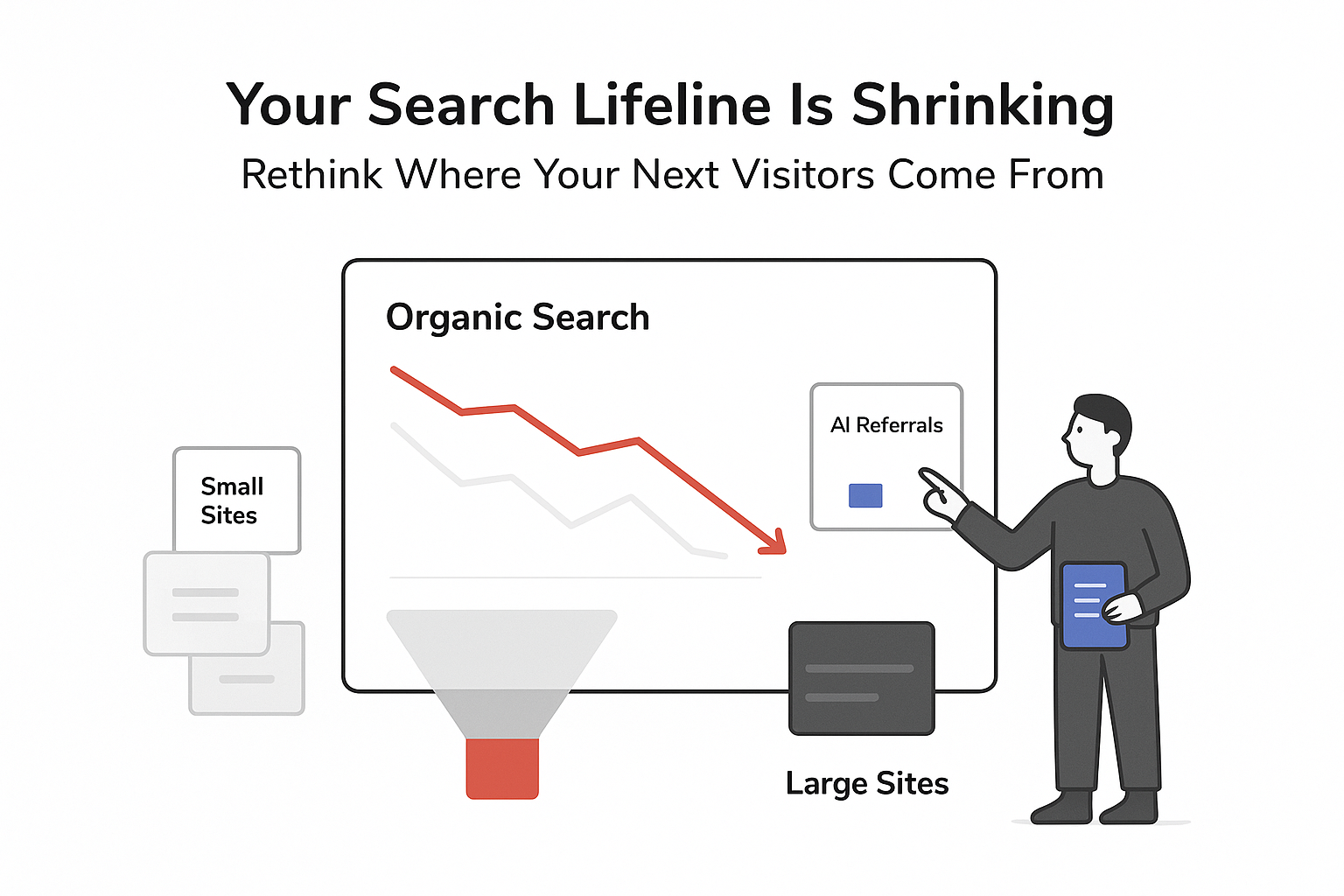
Search referral traffic is falling across publishers, with new Chartbeat data showing the steepest declines for smaller sites that depend most on Google. This report summarizes the numbers reported exclusively by Axios, context from prior Chartbeat reporting, and practical implications for marketing and audience strategy.
Executive Snapshot
- Small publishers (approximately 1,000-10,000 daily page views) saw a 60% drop in search referral traffic over two years; mid-sized publishers lost 47%; large publishers (100,000+ daily page views) lost 22%. [S1]
- Google Search page views declined 34% year-over-year from December 2024 to December 2025; Google Discover referrals fell 15% in the same period. [S1]
- Across all Chartbeat-tracked publishers, weekly page views fell 6% between 2024 and 2025, indicating lower overall consumption, not only a channel shift. [S1]
- ChatGPT referrals grew by more than 200% from December 2024 to December 2025 but still account for less than 1% of all page-view referrals across publishers. [S1]
- AI chatbot referrals send more total page views to news and media sites but higher per-article engagement to “utilitarian” how-to sites (health, gardening, advice). [S1]
Implication for marketers: dependency on Google Search as a primary traffic source has become materially riskier for small and mid-sized publishers, and AI referrals are not yet a meaningful replacement.
Search referral traffic decline for small publishers: method & source notes
Chartbeat is a long-standing analytics provider focused on publishers. Its tools are installed on thousands of client sites globally, with a strong concentration in news and media brands. The data summarized here comes from internal Chartbeat aggregate reporting shared with Axios and then covered by Search Engine Journal (SEJ). [S1]
What was measured
- Metric: Page views and referral traffic by source (Google Search, Google Discover, AI chatbots including ChatGPT, direct, email, apps, internal links). [S1]
- Scope: “Thousands” of publisher sites worldwide using Chartbeat analytics. [S1]
-
Timeframe: [S1]
- Two-year trend in search referral traffic by publisher size (exact start month not disclosed, described as “over two years”).
- Year-over-year change from December 2024 to December 2025 for Google Search and Discover referrals and AI chatbot referrals.
-
Publisher size segmentation (by average daily page views): [S1]
- Small: 1,000-10,000
- Mid-sized: 10,000-100,000
- Large: 100,000+
Additional context
Earlier Chartbeat data, cited in Reuters Institute-related coverage, showed a 33% global decline in Google Search referrals in aggregate before this new size breakdown was made available. [S1] Reuters Institute survey work also reported that publishers planned to increase investment in owned channels such as email, apps, and direct traffic. [S1][S2]
Key limitations and caveats
- The underlying Chartbeat dataset has not been published directly; all figures come via Axios and SEJ summaries. [S1]
- Chartbeat’s client base skews toward news and media; results may not generalize to all site types (for example, B2B blogs or online retailers). [S1][S2]
- Causality is not measured. The data describes changes in traffic, not specific causes such as algorithm updates, AI overviews, or news cycle intensity. [S1]
- “AI chatbot referrals” are treated as a single category; performance may differ across platforms (ChatGPT, others), but that granularity is not provided. [S1]
Organic search traffic trends by publisher size and Google channel
Chartbeat’s new breakdown clarifies that search referral losses are not evenly distributed. Smaller publishers are seeing the steepest declines.
Size-based search traffic changes in Chartbeat data
- Small publishers (1,000-10,000 daily page views) experienced a 60% drop in search referral traffic over the two-year measurement period. [S1]
- Mid-sized publishers (10,000-100,000 daily page views) lost 47% of search referral traffic across the same period. [S1]
- Large publishers (over 100,000 daily page views) saw a 22% decline in search referrals. [S1]
- Earlier aggregate Chartbeat figures (across all publisher sizes) showed a 33% global decline in Google Search referrals before this size-based segmentation was made available. [S1]
These figures indicate that smaller sites saw almost three times the relative loss in search referrals compared with large publishers (60% vs 22%). [S1]

Channel-specific changes within Google
Between December 2024 and December 2025 across Chartbeat’s network: [S1]
- Page views from Google Search fell by 34%.
- Page views from Google Discover fell by 15%.
This suggests the main drop is in classic search results, with Discover remaining more stable but still declining.
Overall traffic changes
Across all publishers in Chartbeat’s data: [S1]
- Weekly page views decreased by 6% from 2024 to 2025.
- Chartbeat reportedly attributed part of this to external factors such as a quieter election cycle, but that attribution is interpretive, not directly measured.
Fact-only summary
- Search referrals are shrinking faster for smaller publishers than for larger ones. [S1]
- Google Search is declining faster than Google Discover. [S1]
- Overall audience volume is also slightly down (-6%), so not all lost search traffic is being fully replaced by other sources. [S1]
AI chatbot referral traffic compared with Google search visits
AI chatbots, especially ChatGPT, are growing as referral sources but still account for a very small share of publisher traffic in Chartbeat’s network.
AI referral growth and share
- ChatGPT referrals grew by more than 200% between December 2024 and December 2025. [S1]
- Even after this growth, all AI chatbots combined account for less than 1% of total publisher page-view referrals across Chartbeat’s clients. [S1]
Engagement patterns by site type
- News and media sites receive the highest total volume of page views from AI chatbot referrals but the lowest engagement per article from those referrals. [S1]
- “Utilitarian” sites that focus on how-to content (such as health guidance or gardening instructions) see fewer total AI referrals but more page views per article. [S1]
Axios interprets this as: [S1]
- Users often click news citations in chatbots for quick fact-checks or context, without extensive on-site reading.
- Users who click on how-to content from chatbots appear more likely to engage with multiple pages or spend more time per article.
Comparison with search
There is no direct numerical comparison of average engagement from AI vs search in the dataset, but the overall volume of AI referrals (less than 1% of all page views) is far smaller than search, even after search declines. [S1]
Fact-only summary
- AI chatbot referrals are growing rapidly in percentage terms but from a very small base. [S1]
- They have not materially replaced lost search traffic. [S1]
- Engagement from AI referrals appears more promising for practical, problem-solving content than for breaking news. [S1]
Marketing strategy implications of falling search referrals for publishers
The following section is interpretation based on the data above and other industry research. It draws implications for strategy and spend rather than reporting new measurements.
Interpretation (Likely): Search dependence is now materially riskier for small and mid-sized publishers
Given a 60% decline in search referrals to small publishers and a 47% decline for mid-sized ones, business models built on organic search traffic are exposed to sharp volatility. [S1] If search provided a large share of ad impressions, affiliate clicks, or inbound leads, revenue will tend to follow that downward curve unless other channels compensate.
For large publishers, a 22% decline is material but appears more manageable, especially because Chartbeat notes that these publishers have grown direct, internal, email, and app-based referrals as a share of traffic. [S1] That indicates larger brands have been more successful at building repeat audience behavior and channel diversity.
Implication (Likely): Channel mix should shift toward owned and direct audience relationships
- Publishers of all sizes, but especially small and mid-sized, should treat search as one important referrer rather than the main foundation for audience acquisition.
- The growth of direct and internal traffic, plus email and app referrals at large news organizations, suggests: [S1][S2]
- Building strong email lists and newsletters.
- Encouraging repeat visits via homepage, apps, and push notifications.
- Improving on-site navigation and internal linking to increase page views per session.
These are not new tactics, but the magnitude of search losses makes them more central to sustainability.
Interpretation (Tentative): Content that solves specific problems may gain more from AI referrals over time
Because utilitarian sites (health, gardening, advice) see higher per-article engagement from AI chatbot referrals than news sites, publishers with strong how-to or reference content may see more value from AI-driven citations as usage grows. [S1]
Near term:
- AI referrals are still under 1% of traffic, so they should not guide major investment on their own. [S1]
Medium term (speculative):
- As AI assistants integrate more browsing and link attribution, publishers with authoritative, practical content may see disproportionate gains from AI citations compared with those focused on commoditized news summaries.
Implication (Likely): SEO strategy needs to prioritize defensible niches and repeat engagement
With Google Search traffic falling 34% year-over-year and 60% over two years for small sites, chasing broad, highly competitive queries that AI can answer easily is less attractive. [S1] Instead:
- Focus on topics where your brand has authority, depth, or unique data that AI responses are likely to reference or cannot fully replace.
- Emphasize on-site experiences that encourage visitors to read multiple articles or sign up for recurring touchpoints (email, membership), so each visit has more long-term value.
Interpretation (Tentative): Revenue models that assume constant search growth are exposed
For ad-supported publishers, fewer search-driven page views mean:
- Lower fill for programmatic ads unless offset by growth elsewhere.
- Reduced inventory for sponsorships that depend on large audiences.
For publishers using content to support sales or lead generation, fewer organic search leads may:
- Increase customer acquisition costs if paid search or paid social must backfill.
- Make referral partnerships, direct sales outreach, and branding activities more important for pipeline creation.
Data contradictions, limitations, and open questions on search traffic declines
Data gaps and unknowns
- No breakdown by vertical beyond “news/media” vs “utilitarian how-to”:
- We do not know whether B2B, finance, education, or entertainment sites follow the same patterns. [S1]
- No visibility into regional differences:
- Search and AI usage patterns likely differ by country and language, but this dataset does not disclose such segmentation. [S1]
- AI chatbot category is aggregated:
- ChatGPT growth is highlighted, but other assistants are grouped, so performance differences across tools are unclear. [S1]
Potential contradictions or alternative explanations
- Chartbeat attributes part of the 6% drop in overall weekly page views to a quieter election cycle. [S1] That is plausible for news-heavy portfolios but may not explain declines at lifestyle or how-to sites. Without segment-level data, it remains an assumption.
- The data shows search declines and AI growth over the same period, but does not prove that AI is the driver of lower search referrals. Algorithm changes, shifting user behavior, or changes in publisher output could also matter. [S1][S2]
External evidence and how it fits
- Reuters Institute’s Digital News Report series has documented a trend where major news brands gain a larger share of direct, app, and email traffic, while dependence on platforms such as search and social has eased slightly over multiple years. [S2]
- That pattern aligns with Chartbeat’s observation that large publishers are compensating for search losses with growth in owned channels. [S1][S2]
- However, Reuters Institute work also shows that smaller and lesser-known outlets often rely more heavily on external platforms, suggesting they may have less capacity to replace lost search traffic quickly. [S2]
What marketers and publishers still lack
- Public, site-level examples: Chartbeat has not released a site-by-site dataset that would let others see how different strategies influence resilience to search declines. [S1]
- Data on the business impact: The current reporting covers traffic, not revenue, churn, or lifetime value. We can infer pressure on revenue but not quantify it. [S1]
- Forward-looking projections: No estimates are provided on whether search declines are stabilizing or accelerating beyond December 2025, nor on how quickly AI referrals might grow. [S1]
Data appendix: key numbers on search and AI referrals (Chartbeat via Axios/SEJ)
| Metric | Segment / Definition | Change | Period | Source |
|---|---|---|---|---|
| Search referral traffic | Small publishers (1,000-10,000 daily PVs) | -60% | Two-year period (not specified) | [S1] |
| Search referral traffic | Mid-sized publishers (10,000-100,000 daily PVs) | -47% | Same two-year period | [S1] |
| Search referral traffic | Large publishers (100,000+ daily PVs) | -22% | Same two-year period | [S1] |
| Google Search page views | All Chartbeat publishers | -34% | Dec 2024 vs Dec 2025 | [S1] |
| Google Discover page views | All Chartbeat publishers | -15% | Dec 2024 vs Dec 2025 | [S1] |
| Weekly page views (all sources) | All Chartbeat publishers | -6% | 2024 vs 2025 | [S1] |
| AI chatbot referrals (ChatGPT and others combined) | All Chartbeat publishers | >+200% | Dec 2024 vs Dec 2025 | [S1] |
| AI chatbot share of total page-view referrals | All Chartbeat publishers | <1% | As of Dec 2025 | [S1] |
| Global Google Search referrals (aggregate, all sizes) | All Chartbeat publishers (earlier dataset) | -33% | Period prior to 2026 (not dated) | [S1] |
Sources
- [S1] Matt G. Southern, “Search Referral Traffic Down 60% For Small Publishers, Data Shows,” Search Engine Journal, March 2026, summarizing Chartbeat data shared with Axios and earlier Chartbeat figures cited via Reuters Institute coverage.
- [S2] Reuters Institute for the Study of Journalism, Digital News Report series (2022-2024), regarding shifts from platform-dependent traffic to more direct, email, and app usage among news publishers.





.svg)

.svg)
.svg)