
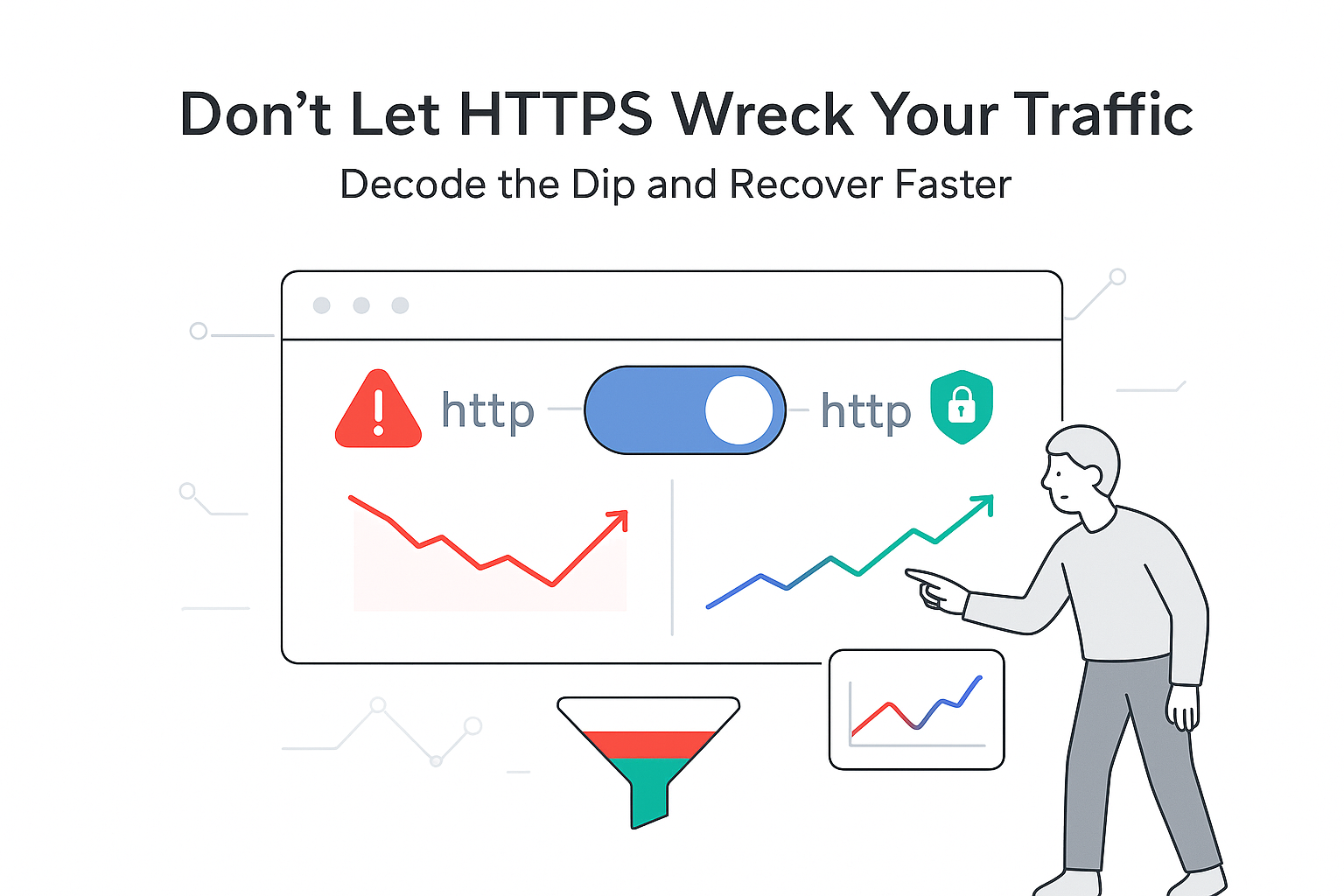
HTTPS migration SEO impact
How HTTPS Migrations Reprice Short-Term SEO Risk and Why Rankings Often Dip Before Recovering
Google's recent clarification on HTTPS migrations makes one point clear: moving from HTTP to HTTPS is not just a security tweak, it functions as a full URL migration. That change can temporarily depress organic rankings, especially if you stack other site changes or rush the process. The central question for marketers is how much short-term SEO risk to expect from HTTPS moves and which levers actually influence recovery speed versus long-term gain.
This piece analyzes John Mueller's comment about a site that lost its top-3 rankings right after moving to HTTPS and changing its WordPress theme. It looks at how Google systems treat HTTPS moves, why volatility is normal, what mistakes make losses persist, and how marketers can plan HTTPS projects so they behave like controlled, predictable migrations instead of traffic shocks.

Key Takeaways
- HTTPS migrations function as full site moves. Google must recrawl and reprocess every URL, so short-term ranking drops over 1-6 weeks are common and not usually a sign the move failed.
- The biggest SEO risk is stacking changes (HTTPS plus theme plus content) and misconfiguring redirects, canonicals, and sitemaps; security is rarely the problem, implementation is.
- Reverting back to HTTP usually deepens losses by forcing Google through a second migration. Fixing the HTTPS setup and waiting for recrawl is almost always safer.
- Misuse of Google's URL Removal tool can hide both HTTP and HTTPS versions of the same URLs, turning a temporary dip into a broader visibility outage.
- For most established sites, HTTPS remains a net positive: better browser treatment, a modest ranking signal, and lower long-term risk of user distrust and data issues.
Situation Snapshot
A 15-year-old financial site moved from HTTP to HTTPS on a GoDaddy hosting plan, replaced its old WordPress theme, and updated content. Shortly after, the owner reported losing long-standing top-3 Google rankings and opened a Reddit thread where they explained their situation and asked whether reverting to HTTP might restore them [S1][S2].
Key facts from the thread and coverage:
- The site previously ranked in the top 3 for core queries on HTTP.
- The owner implemented HTTPS and 301 redirects using a "Really Simple SSL" plugin.
- The move happened only "a few days" before they posted about lost rankings.
- Some HTTP URLs were still not updated to HTTPS in Google's index at the time of posting [S1][S2].
- John Mueller responded that "moving to HTTPS is a bit like a site migration," stressing that every URL must be recrawled and that they should give it time and avoid the URL Removal tool for HTTP URLs [S2].
Google has long stated that HTTPS is a lightweight ranking factor and a recommended default configuration [S3][S4]. The tension to analyze is why a supposedly positive change can coincide with sharp short-term ranking loss.
Breakdown and Mechanics
At a system level, Google treats HTTPS migrations as structured site moves.
From old state to migration change
Old state: An HTTP URL set (all your pages) with accumulated signals such as links, content quality, engagement, and history.
Migration change: HTTP URLs 301 redirect to HTTPS URLs. Sitemaps, internal links, canonicals, hreflang, and structured data should all be updated to reference HTTPS.
How Google processes the move
When Google encounters this change, its processing flow typically looks like:
- Detect 301 mapping between HTTP and HTTPS URLs.
- Test and validate redirects.
- Schedule recrawl of HTTPS URLs.
- Recalculate canonical choices and consolidate ranking signals.
- Update index and rankings.
That chain introduces several practical realities:
-
URLs are different resources.
http://example.com/pageandhttps://example.com/pageare separate URLs. Even with a perfect 301, Google has to revisit and re-evaluate each HTTPS URL, which consumes time and crawl budget [S3]. -
Signals need to be consolidated.
Links and other signals tied to HTTP must be reassigned to HTTPS through redirect mappings and canonical decisions. Google has indicated that 301s pass signals strongly, but consolidation is not instant, so rankings can wobble during this handover.
-
Crawl budget and site size matter.
- Small sites (hundreds of URLs) can often be recrawled in days.
- Larger sites (tens or hundreds of thousands of URLs) may take weeks before coverage and rankings stabilize, based on Google documentation and industry case studies [S1][S3].
For a mid-size content site with roughly 10,000 URLs, a 1-3 week volatility window is common, and longer if crawl rate is low.
-
URL Removal tool risk.
Mueller warns against using the URL Removal tool on HTTP URLs during a migration because removal requests operate at the URL pattern level. If Google treats HTTP and HTTPS versions as equivalent in that context, removal can suppress both versions in results, temporarily wiping those pages from search [S2].
In the Reddit case, the owner also changed the WordPress theme and updated content at the same time. That alters layout, internal linking, and possibly text relevance. Google now sees multiple variables shifting in one period:
- Theme and structure changes.
- Content edits.
- A full protocol migration.
Mueller focused on HTTPS because that alone is enough to cause short-term drops, and it is the safest lever to wait out while Google reprocesses the site.
Impact Assessment
Organic search (SEO)
Impact direction: short-term risk of traffic drops, long-term modest upside.
Winners: sites that treat HTTPS as a planned migration, with full redirect mapping, updated canonicals, clean sitemaps, and minimal changes to content structure during the move.
Losers: sites that bundle HTTPS with theme redesigns, URL changes, or content rewrites, or that leave mixed HTTP/HTTPS internal links and partial redirect coverage.
Action points for organic search:
- Treat HTTP to HTTPS as a classic site move: design redirect maps, test for 1:1 301s (no chains), and run crawl comparisons before and after.
- Ensure every signal layer points to HTTPS: internal links, canonical tags, hreflang, structured data URLs, XML sitemaps, and Open Graph tags.
- Monitor Google Search Console for:
- Coverage of HTTPS URLs versus HTTP.
- Spikes in soft 404s or redirect errors.
- Crawl rate and index counts for both protocols.
- Avoid configuration changes that alter URL paths or site architecture in the same window as the protocol move.
Paid search and other paid traffic
Impact direction: usually neutral if handled correctly, but operational risk exists.
- Update all ad destination URLs to HTTPS to avoid redirect hops, which can hurt landing page experience and tracking consistency.
- Verify that tracking templates and UTM parameters survive redirects and do not break on HTTPS destinations.
- Check that any call tracking, affiliate tags, and third-party scripts load over HTTPS to avoid mixed-content warnings that can hurt conversion.
Analytics, martech, and operations
Impact direction: medium operational risk during rollout.
- Confirm that analytics tags fire correctly on HTTPS pages and that no data filters rely only on
http://URL patterns. - Check canonical host settings in analytics platforms so reports do not split traffic between HTTP and HTTPS.
- For older tools or custom scripts, test whether all assets are loaded from secure endpoints; legacy HTTP resources blocked by browsers can break tracking or UX.
For many small businesses, missteps in analytics and tagging around the migration can hide recovery in the data, leading teams to assume SEO has not rebounded even when traffic is already improving.
Scenarios and Probabilities
Base case - temporary volatility, recovery within weeks (likely)
- Implementation: redirects mostly correct with only minor gaps; content and URL structure largely unchanged.
- Outcome: traffic and rankings drop for key queries for 1-6 weeks as Google recrawls and reassigns signals, then return near prior levels or slightly better.
- Probability: high for sites that planned the migration and did not heavily alter content at the same time.
Upside case - clean migration plus incremental gains (possible)
- Implementation: flawless 1:1 redirects, fully updated internal links and sitemaps, no major layout or content changes.
- Outcome: short dip (days to a couple of weeks) followed by minor improvement from HTTPS as a tie-breaker signal, better user trust (no "Not secure" warnings), and slightly improved crawl efficiency.
- Probability: moderate, more common for smaller sites or highly managed enterprise migrations.
Downside case - compounded errors and extended losses (less likely but possible)
- Implementation: partial redirects, mixed content, URL Removal tool applied to HTTP, and a theme change that radically alters internal linking and layout.
- Outcome: many URLs drop from the index or lose signals; traffic remains depressed for months. Some site owners panic and revert to HTTP, causing a second migration and prolonging instability.
- Probability: low to moderate, primarily when non-technical teams treat HTTPS as a simple hosting toggle rather than a structured project.
Risks, Unknowns, and Limitations
- The Reddit case lacks hard data: no server logs, Search Console exports, or crawl reports are public, so root cause cannot be confirmed for that specific site [S1][S2].
- Theme and content changes occurred at the same time as HTTPS, so their impact is entangled with the protocol move.
- Broader algorithm updates or manual actions are not ruled out in the Reddit thread; if present, they would change the interpretation of the ranking loss.
- Crawl budget and reprocessing speed vary by site authority, change frequency, and server response; any timeframes here are based on Google documentation plus industry experience, not official guarantees [S1][S3].
- If future Google guidance changes (for example, treating HTTPS moves as even lighter-weight transitions), some of the short-term risk described here would shrink.
In practice, treating HTTPS adoption as a structured migration project, not a quick security toggle, is what separates short-lived volatility from prolonged SEO losses.
Sources
- [S1]: Search Engine Journal (Roger Montti), 2026, article - "Google Explains Why HTTPS Migration May Negatively Impact SEO."
- [S2]: Reddit, r/TechSEO, 2026, thread - "Lost top 3 Google rankings after moving to HTTPS," including comment by John Mueller.
- [S3]: Google Search Central, documentation - "Move a site with URL changes" and "Secure your site with HTTPS."
- [S4]: Google Webmaster Central Blog, 2014, blog post - "HTTPS as a ranking signal."







.svg)

.svg)
.svg)