
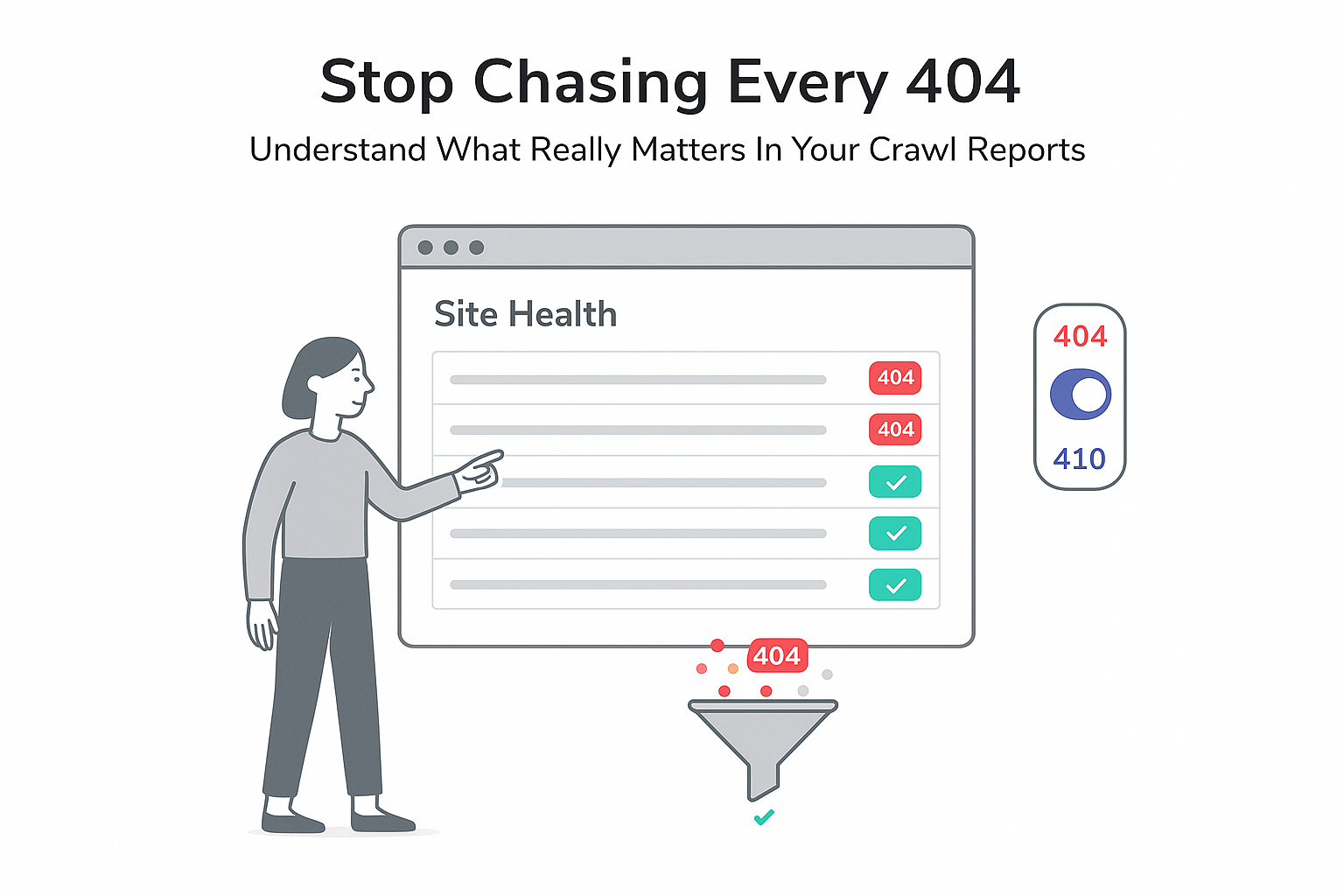
Google Search Advocate John Mueller says ongoing Googlebot requests to URLs that return 404 status codes are normal and not a problem for site owners. In a recent Reddit discussion about Google Search Console crawl reports, he added that this behavior means Google is ready to pick up more content from those sites.

Google on 404 crawling and site content
The discussion started with a Reddit user reporting repeated 404 URLs in Google Search Console crawl statistics. The user said these URLs had been removed from the site's XML sitemap, which now lists only live pages. They were worried this was wasting crawl resources and asked whether returning 410 status codes would help.
Mueller responded that:
- These 404 crawl reports "don't cause problems" and site owners can leave them as they are.
- Googlebot may recrawl these URLs for "potentially a long time" and using 410 instead of 404 would not change that behavior.
- "In a way, this means Google would be ok with picking up more content from your site."
He also clarified that Search Console is reporting Googlebot's failed crawl attempts, not independently crawling those URLs itself. He did not indicate any penalty or ranking issue tied to the presence of these 404 reports.
His comments appeared in a discussion on the r/SEO subreddit about Google Search Console and old 404 pages, where he wrote his responses.
HTTP 404 and 410 status codes in web standards
The HTTP 404 status code is formally defined as "404 Not Found" in the HTTP Semantics specification RFC 9110. According to the web standard definition of the 404 status code, 404 indicates that the origin server did not find a current representation of the requested resource. It also clarifies that 404 does not say whether the absence is temporary or permanent.
The HTTP 410 status code is defined as "410 Gone" in the same specification. The official web standard for 410 status code explains that 410 means the resource is intentionally gone and that this condition is likely permanent. Clients should not expect the resource to become available again at the same URL.
The official web standard for the 404 status code does not instruct servers or crawlers to treat a 404 response as a signal that a page is broken. Instead, it focuses on describing what the server knows about the requested resource at the time of the request. The "error" label commonly used for 404 refers to the failed request rather than a broken page.
Google's crawling behavior and historical guidance
Google representatives have consistently said that the search engine handles 404 and 410 responses in similar ways. In practice, Googlebot may continue to recrawl URLs returning either status code for extended periods. Googlers have also said 410 responses can sometimes remove URLs from the index slightly faster than 404 responses.
In a 2014 video on Google's official Webmaster Help channel, Matt Cutts outlined this approach to 404 handling. He said the crawl team effectively protects a URL for a short time after a 404 response in case the issue is temporary. Cutts added that Googlebot will still recheck those URLs later to confirm whether they remain gone or have returned.
These explanations describe ongoing recrawling of missing URLs as part of Google's normal crawling systems. They also state that serving 404 or 410 for removed pages is acceptable. Both Cutts and Mueller present this behavior as standard operation rather than an error condition.
In the same 2014 video, Cutts said it is fine to serve 404 for pages that are gone and that using 410 is also fine when a site owner knows a page is permanently removed.







.svg)

.svg)
.svg)