
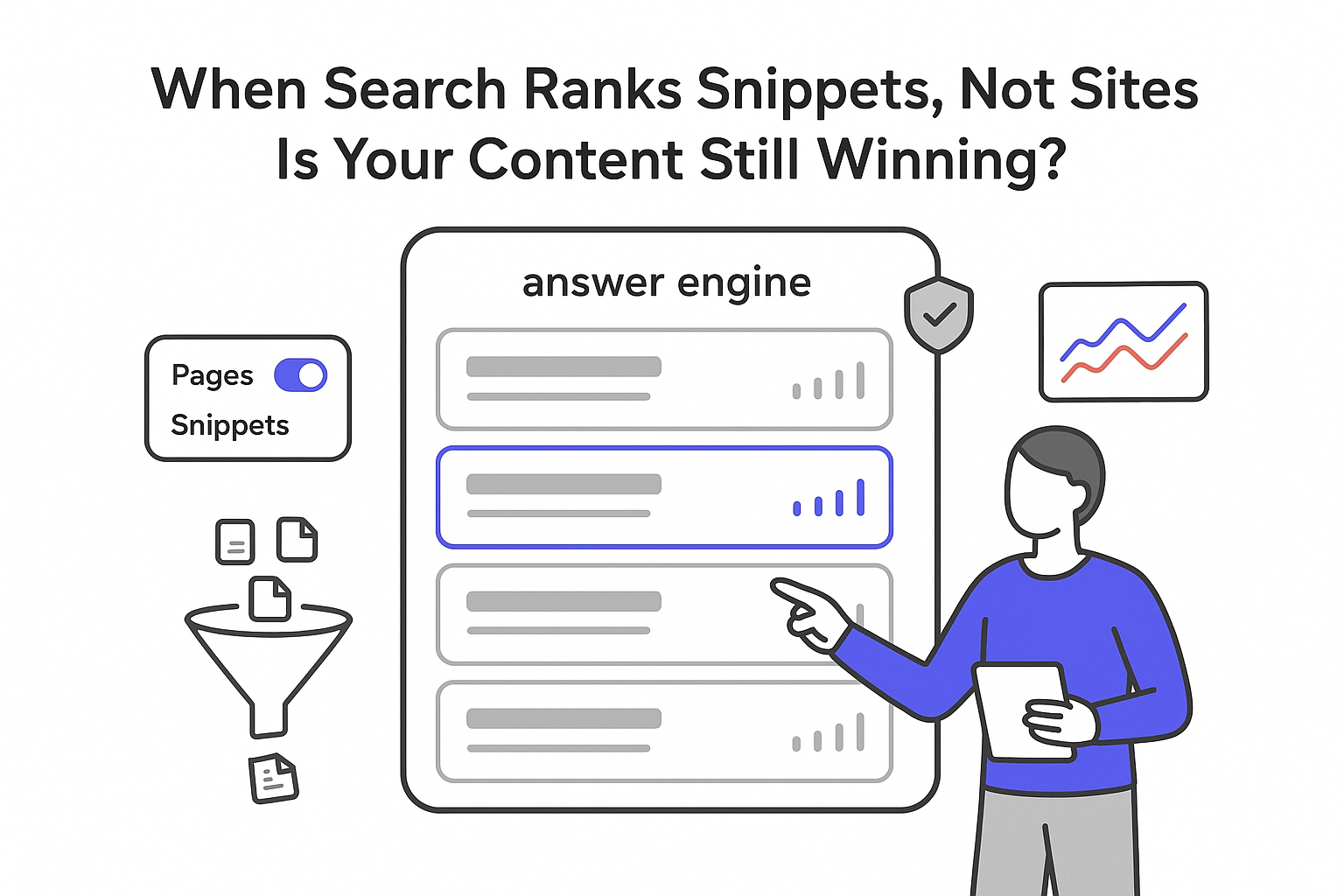
How Perplexity-Style AI Search Reprices SEO: From Page Rankings to Snippet Selection
Perplexity's description of its AI search architecture points to a structural shift: visibility is moving from page-level rankings to snippet- and user-context-level selection. That reframes how marketers should think about answer engine optimization (AEO) versus traditional SEO and GEO-style AI summaries.
Key takeaways for AI search and answer engine optimization
- Eligibility still depends on classic SEO; exposure depends on snippets and context: Links, crawlability, and indexation still determine whether your pages enter Perplexity's corpus, but what gets surfaced is decided at snippet level and shaped by user memory. Marketers should treat "being indexed" and "being cited in answers" as two separate optimization problems.
- Search is no longer a single leaderboard per query: With personal memory feeding the context window, two users with the same query can land on different answers and citations. This reduces the value of universal rank tracking and increases the importance of segment-level performance data and brand search strength.
- Sub-document indexing rewards dense, self-contained facts: Engines retrieving about 130k tokens of snippets (roughly 26k micro-fragments) favor content that expresses clear, atomic facts in short spans of text. Structured, fact-rich sections will outperform long, meandering narratives for AI answer inclusion.
- GEO and AEO call for different tactics: For GEO-style systems that summarize top organic results, improving traditional rankings still moves the needle. For AEO systems that retrieve snippets directly (like Perplexity's), semantic clarity, internal structure, and comprehensive topical coverage matter more than chasing specific SERP positions.
- Measurement and monetization models will change: As AI answer engines spread via APIs and integrations, more user questions will be satisfied off-site. Expect less reliable organic traffic as a proxy for visibility, greater importance for citation monitoring, and eventual AI-native ad formats that insert sponsors into answer flows.
Situation snapshot
This analysis is triggered by an interview on Search Engine Journal with Jesse Dwyer of Perplexity AI, where he explains how Perplexity's AI search works and how it differs from traditional SEO and Generative Engine Optimization (GEO). [S1]
Key factual points from the interview:
- Personalization and memory: Perplexity and similar tools can load personal memory into the model's context window, allowing different users with the same query to receive different answers and underlying citations. [S1]
- Classic SEO signals still matter: Perplexity uses a link-based popularity and relevance measure "similar to PageRank" to score websites, which influences which pages are eligible to be retrieved. [S1]
-
Whole-document vs sub-document indexing:
- GEO-style systems (for example, ChatGPT browsing over Bing) run a traditional web search, grab the top 10-50 pages, and then ask the LLM to summarize them.
- Perplexity's "AI-first" approach uses sub-document indexing: instead of storing and retrieving full pages, it stores granular snippets (estimated at about 5-7 tokens, or 2-4 words, converted to numerical embeddings). [S1]
- Context window saturation: Perplexity's system tries to fill the model's entire context window (average cited as about 130k tokens) with the most relevant snippets, roughly equating to about 26k snippets per query. This is framed as a tactic to reduce hallucinations: a fully packed context leaves the model less freedom to invent. [S1]
- Differentiation layer: Perplexity's claimed edge lies between the index and those approximately 26k snippets: modulating compute, query reformulation, and proprietary models that select which snippets get pulled. [S1]
These details come directly from Perplexity and Search Engine Journal; external audits of the exact numbers and implementation details are not publicly available.
Breakdown & mechanics of AI search vs classic SEO
Thesis for this section: For marketers, the meaningful shift is not AI summaries as such, but the move from whole-page ranking to snippet retrieval plus personalized context filling.
1. Classic search - GEO-style AI summaries
Traditional web search works roughly as:
Query - index lookup - score and rank documents - return top results.
When an LLM sits on top of this (GEO):
Query - standard search (for example, Bing) - top 10-50 pages - LLM summarizes - user sees narrative answer plus links.
Mechanics and implications:
- The index is built and scored at page level.
- Optimization levers are familiar: topical authority, backlinks, content quality, on-page structure.
- If you move from rank 9 to rank 3, your odds of inclusion in the AI summary usually increase, because the LLM is fed that shortlist.
For marketers, GEO systems mostly re-price traditional SEO work but do not change the fundamental leaderboard logic.
2. Sub-document AI search (Perplexity-style AEO)
Dwyer describes a different pipeline:
Content - split into small snippets - convert each snippet into vector embeddings - index these vectors.
Then, for each query:
Query (plus personal memory) - transformed into embeddings - retrieve the most relevant snippets up to context window size (about 130k tokens) - LLM generates an answer using only those snippets.
Key mechanical differences:
- Granularity: The primary retrieval unit is a snippet (a few words), not a page.
- Volume: Instead of 10-50 pages, the model sees tens of thousands of snippets that together roughly consume the context window.
- Context composition: User memory plus query plus general corpus all compete for that finite 130k-token budget.
-
Eligibility vs selection:
- Eligibility: Influenced by web-scale signals (links, authority) that decide which documents and snippets make it into the index at all.
- Selection: Driven by semantic match and proprietary retrieval logic that choose which snippets fill the context for each query.
Cause-effect chain for visibility:
Links plus technical SEO - page gets indexed and scored - page text is chopped into snippets - snippets enter vector index - query fires - retrieval selects some of those snippets (or none) - LLM answer cites sources.
This shifts competition from "my page vs your page" to "my snippets vs your snippets for this context."
3. Personalization and non-universal results
Because user memory can occupy part of the context window:
User profile and history - transformed into tokens - occupy a share of the 130k tokens - remaining capacity for external snippets shrinks or shifts by user.
Effects:
- Two users typing "best CRM for small businesses" may see answers constructed from different snippet sets, depending on prior searches, saved data, or interactions.
- From a marketer's point of view, the "SERP" is no longer a consistent, shared space; it becomes a user-specific context.
This is what Dwyer means by AI search no longer being a zero-sum game in the classic sense: multiple brands can be the "go-to" answer for different cohorts, even under the same query text.
Impact assessment for marketers
Organic search and SEO strategy
Shift in optimization targets
- From page rank to snippet suitability: Traditional SEO still matters for crawl, indexation, and authority. But within AI answers, your exposure is governed by whether the engine can extract useful, self-contained snippets that directly address common questions.
- Content structure: Headings, bullet lists, definition-style sentences, and concise statements of facts or comparisons are more likely to produce high-value snippets than long, discursive paragraphs.
What this means in practice
- Express key facts in short spans that stand alone:
- Example: "Shipping time: 2-3 business days in the US; 5-7 days internationally."
- Example: "Our CRM targets teams of 5-50 sales reps."
- Reduce dependency on context across many sentences. If a statement only makes sense when read across three paragraphs, it is a weaker candidate for snippet retrieval.
- Maintain link earning and authority-building efforts: Perplexity's use of a PageRank-style signal means off-page authority remains a gatekeeper for inclusion.
Winners and losers
- Likely winners: Brands with deep, high-authority content organized into clear sections and data-rich summaries; specialists with comprehensive coverage of specific topics.
- Likely losers: Thin affiliate content, duplicated listicles, and pages relying on clickbait or heavy pagination for monetization; these offer less unique, high-value snippet material.
Measurement, analytics, and reporting
Rank tracking becomes less meaningful
- If AI answers differ per user, a single position number for a keyword no longer reflects reality.
- GEO environments still roughly correlate with traditional rankings; AEO environments do not.
Practical implications:
- Shift some focus from rank positions to:
- Share of AI citations (where tools or logs allow you to detect when your domain is referenced in AI answers).
- Query-level traffic patterns: Look for keywords where organic traffic declines but brand or direct engagement remains stable or grows. That can signal that AI answers are satisfying informational intent upstream.
- Expect more variability across user cohorts; segment analytics where possible (returning vs new, logged-in vs anonymous, geography).
Paid media and PPC
As of the latest public information (up to late 2024), large AI search players are experimenting with sponsorship models, but most marketers still buy search ads via Google and Microsoft rather than directly through AI answer engines.
Implications and reasonable expectations (marked as speculation where applicable):
- Speculation - AI-native ad placements: Expect AI engines to introduce ad units that:
- Insert sponsored options into answer narratives.
- Attach sponsored links at the end of AI answers, clearly labeled as recommendations.
- Bidding dynamics: If AI answers reduce generic search volume but concentrate higher-intent queries into fewer flows, CPCs on the remaining high-intent keywords may rise on classic search platforms, while AI-native placements introduce new budget lines. (Speculation)
For now, PPC teams should:
- Monitor shifts in query mix and impression share as AI answer surfaces grow.
- Watch announcements from AI search vendors for direct-buy ad inventory or partnerships with existing ad networks.
Brand positioning and content strategy
Because AI answer engines can cite multiple domains and fuse them into a single narrative:
- Clear, authoritative statements and unique data increase the odds of being quoted directly rather than replaced by a competitor's similar content.
- Brands that publish original research, clear comparisons, and unambiguous claims give engines quotable material.
This favors:
- Building topic authority through clusters of high-signal pages.
- Avoiding overly generic or derivative content that adds little beyond what can already be indexed from stronger sites.
Scenarios & probabilities
These are directional and tagged with rough likelihoods, not precise forecasts.
Base scenario (Likely)
- Adoption: AI answer engines grow as a companion to, not a replacement for, classic search over the next 2-3 years.
- Architecture split: GEO-style (summarizing existing SERPs) and AEO-style (sub-document retrieval) approaches coexist. Large incumbents (Google, Microsoft) lean on GEO-like approaches inside their ecosystems; independent players (Perplexity and others) emphasize AEO and APIs.
- SEO impact: Organic traffic from purely informational queries erodes gradually, particularly on broader explainer topics. Commercial and local-intent traffic remains more resilient.
- Tactics: Marketers treat AEO as an extension of SEO: same fundamentals, with added emphasis on snippet-ready content and monitoring AI citations.
Upside scenario for prepared marketers (Possible)
- Higher visibility via citations: Brands that move early on snippet-oriented structuring and original data see their share of citations in AI answers outpace their traditional rankings.
- AI-integrated funnels: Some brands integrate AI search APIs in their own products or support flows, turning generic AI search behaviors into controlled, branded experiences.
- Measurement tools mature: Third-party vendors begin to track AI answer inclusion and citation frequency, giving marketers clearer attribution for off-site influence.
Downside scenario (Edge but material)
- Aggressive answer replacement: AI engines answer a higher proportion of queries without clear or prominent links, particularly on commercial research terms.
- Opaque ecosystems: Limited transparency into which sources are used and how often, plus weak or nonexistent referral data, makes optimization and ROI measurement difficult.
- Consolidation: Major platforms vertically integrate AI search and advertising, leaving limited room for independent tools and alternative measurement.
Risks, unknowns, limitations
- Limited independent verification: The described numbers (for example, 130k tokens, about 26k snippets) and processes come from Perplexity's own representatives and have not been fully audited by external researchers. Real-world implementations may differ. [S1]
- Fast-moving product changes: AI models, context window sizes, retrieval strategies, and personalization features are evolving quickly. An approach described in early 2024 may look different by late 2025.
- Lack of standardized metrics: There is no widely adopted metric yet for share of AI answer presence, making it hard to compare performance across engines or verticals.
- Regulatory and privacy factors: The extent to which personal memory can be used safely and legally may be constrained by future regulation, which could reduce personalization and shift mechanics again.
- Speculation boundaries: Statements in this analysis flagged as speculation, especially around future ad formats and ecosystem dynamics, could be falsified by new product directions, regulatory interventions, or user pushback.
Sources
- [S1]: Roger Montti / Search Engine Journal, 2026, article: "Perplexity AI Interview Explains How AI Search Works" (interview with Jesse Dwyer, Perplexity AI).





.svg)

.svg)
.svg)