
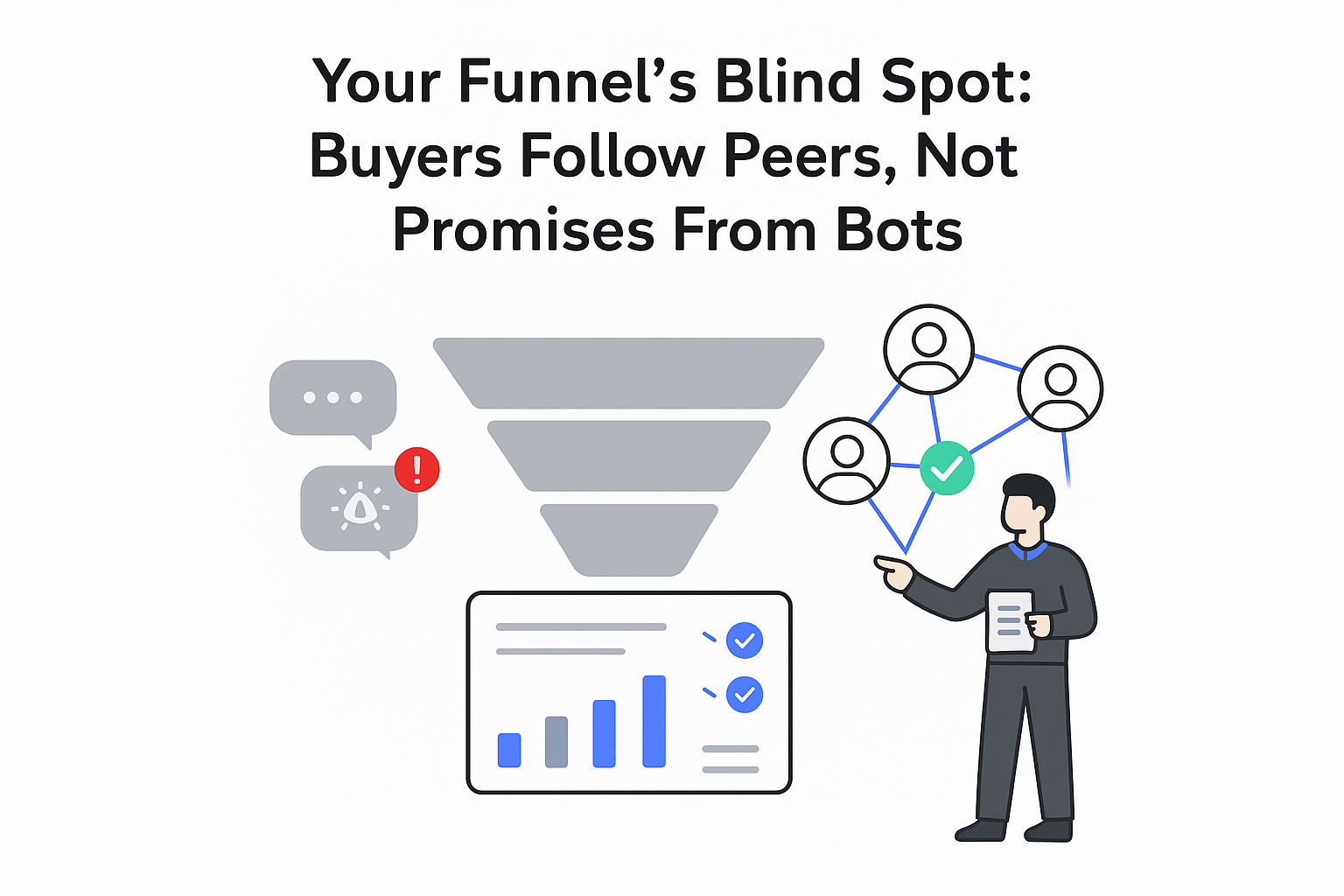
B2B Buyers Trust Peers Over AI Chatbots: Evidence on Trust, Content Value, and Self-Directed Research
Peer validation is now carrying more weight than AI tools in B2B purchase decisions. Buyers are relying heavily on personal networks, testimonials, and independent research while delaying or avoiding direct contact with sales teams.
Executive Snapshot: B2B buyers trust peers over AI chatbots
- 73% of B2B decision-makers say they trust peer recommendations when evaluating business purchases, compared with 39% who trust AI chatbots and 36% who trust social media sources.[S1]
- Only 18% of respondents use AI chatbots at all during B2B research. Among those users, 41% cite inaccurate information and 40% cite conflicting information as key issues.[S1]
- Real-user testimonials are rated "very valuable" by 37% of buyers, ahead of video demos (32%), community discussions (27%), and analyst reports (27%), while white papers and one-sheets rank last at 17%.[S1]
- 83% of decision-makers conduct their own research before speaking to a sales team. 65% complete research within a week, while 31% spend several weeks or longer.[S1]
- 55% say their biggest frustration is knowing which information sources to trust, with 48% struggling to find real user testimonials and 46% challenged by filtering vendor content.[S1]
For marketers, the implication is that peer-driven proof and practical evidence (testimonials, demos, original data) now matter more for trust than polished vendor-controlled assets or AI-driven assistance.
Method & Source Notes
The core statistics in this report come from "The Hidden B2B Journey," a new report based on a joint Reddit and SurveyMonkey survey of 1,200 U.S. business decision-makers responsible for or influential in B2B purchases.[S1] The study reports findings on information source trust, content value, research behavior, and frustrations during the buying process. It is a self-reported survey; detailed sampling and fieldwork dates are not specified in the summary used here. Additional detail and charted results are available via Reddit for Business.
Additional context comes from three related research efforts:
- A joint study by the Interactive Advertising Bureau (IAB) and Talk Shoppe on consumer use of AI for shopping recommendations, which found that shoppers often verify AI suggestions on brand websites and through search, reflecting limited unverified trust in AI outputs.[S2]
- A survey of 797 B2B leaders by TopRank Marketing and Ascend2 reporting that original research content tends to achieve higher engagement and perceived trustworthiness than standard thought-leadership formats.[S3]
- LinkedIn research on senior B2B marketers indicating that 94% view trust as a key factor in B2B marketing success.[S4]
Limitations across these sources include U.S.-heavy samples, reliance on self-reporting rather than observed behavior, and limited visibility into industry and company-size breakdowns. The Reddit/SurveyMonkey data does not disaggregate "peer recommendations" into specific channels (for example, colleagues vs. online communities), which constrains tactical precision.[S1]
Findings: B2B buyer trust, content value, and research behavior
Reddit and SurveyMonkey's data shows a clear hierarchy of trust across information sources used in B2B evaluation. Peer recommendations are trusted by 73% of respondents, making them the top source.[S1] Vendor websites (55%) and search engines (54%) form a second tier of relatively trusted sources, followed by review sites (46%).[S1] AI chatbots (39%) and social media (36%) are lower on the trust scale.[S1] This ranking suggests that while buyers do not disregard vendor content or search, they give more weight to sources perceived as independent or experience-based.
Usage patterns show that AI chatbots are still a minority channel in B2B research. Only 18% of respondents say they use chatbots at all during their evaluation process.[S1] Among those users, the leading concerns are inaccurate information (41%) and conflicting information across answers (40%).[S1] Combined with the relatively low trust score for chatbots, this indicates that AI tools are present but not yet central in high-stakes B2B decision-making. Parallel consumer data from IAB and Talk Shoppe shows that shoppers using AI for product advice often verify recommendations on websites and other trusted channels, supporting the idea that AI outputs usually require confirmation.[S2]
When respondents rated content types by value, real-user testimonials stood out. 37% of buyers call them "very valuable," making them the top format among those listed.[S1] Video demos follow at 32%, suggesting that seeing the product in action is widely useful.[S1] Community discussions and analyst reports tie at 27% "very valuable," reflecting interest in both peer exchanges and expert perspectives.[S1] At the bottom of the list, only 17% of respondents rate white papers and one-sheets as "very valuable."[S1] This is notable given how many B2B content programs still rely on gated white papers as primary lead-generation assets. Separate research from TopRank Marketing and Ascend2 links original research content with stronger engagement and higher perceived trust than standard thought leadership, reinforcing the move away from generic, text-heavy formats.[S3]
The same Reddit/SurveyMonkey study documents a pronounced shift toward self-directed research. 83% of B2B decision-makers say they research on their own before they speak with a sales team.[S1] The speed of that process varies: 65% report that their research takes a week or less, while 31% say it stretches over several weeks or more, particularly in categories such as software, professional services, and HR solutions.[S1] During this autonomous phase, buyers face several recurring pain points. The most common is uncertainty about which information sources to trust (55%).[S1] Nearly half (48%) struggle to find real user testimonials, and 46% report difficulty filtering through vendor-produced content to reach what they consider objective or experience-based information.[S1] These complaints align with LinkedIn findings that 94% of senior B2B marketers regard trust as a central factor in B2B success, highlighting a gap between marketers' intentions and buyers' actual experience of trust signals.[S4]
Interpretation & Implications for B2B marketing strategy
The points in this section are interpretation and recommended applications, not direct survey outputs.
Likely: Trust-building efforts should center on peer proof and independent voices
Given that 73% of buyers trust peer recommendations and only 39% trust AI chatbots, placing user stories and peer perspectives at the center of messaging is a logical priority.[S1] Programs that support reference customers, case studies with named organizations, and participation in relevant communities are likely to influence evaluation more than incremental changes to vendor-controlled collateral. Community discussions and analyst reports also rank reasonably well for perceived value, so cultivating mentions and participation in independent forums and analyst coverage can support trust from multiple directions.[S1]
Likely: Content strategy should pivot from generic white papers toward testimonials, demos, and original research
With only 17% of respondents calling white papers and one-sheets "very valuable," continued heavy reliance on these formats for lead generation carries a risk of misalignment with buyer needs.[S1] In contrast, real-user testimonials (37% "very valuable") and video demos (32%) address two clear buyer goals: hearing from people who have already used the product and seeing proof of how it works.[S1] The TopRank/Ascend2 findings that original research drives stronger engagement and trust than typical thought leadership suggest that data-backed studies, surveys, or performance benchmarks grounded in customer outcomes may outperform generic opinion pieces.[S3] For SEO and PPC, this points to landing pages that surface testimonials, star ratings, short demo videos, and key research findings prominently, rather than pushing all substantive content behind forms.
Tentative: AI chatbots are better suited as internal tools and guided assistants than as primary advisors for buyers
Low usage (18%) and modest trust (39%), combined with concerns about accuracy and consistency, indicate that AI chatbots are not yet a primary decision resource for most B2B buyers.[S1] This does not mean AI has no role; it suggests that AI may add more value behind the scenes to support content production, summarization, and internal enablement than as a standalone "virtual sales rep." For organizations that deploy customer-facing chatbots, integrating verified knowledge bases, clear sourcing, and escalation paths to human experts is likely important for trust. Prompts within the chatbot that direct users to testimonials, demos, or documentation can help connect AI-assisted discovery with more trusted evidence.
Likely: Self-directed research requires stronger mid-funnel and late-funnel content on owned properties and search
Since 83% of decision-makers conduct research before contacting sales, and 65% complete that research within a week, buyers often progress through consideration and shortlisting stages without direct sales input.[S1] Vendor websites and search engines both sit in the mid-tier of trust (55% and 54%), which means they remain important but need reinforcement from peer and third-party validation.[S1] In practice, SEO and PPC programs benefit from surfacing queries that map to evaluation and comparison - such as implementation details, integration information, pricing ranges, ROI examples, and competitor comparisons - and addressing them clearly on-site. Structured content that reduces friction (checklists, feature comparisons, FAQs grounded in real use cases) can reduce the frustration buyers report around filtering vendor material and identifying trustworthy sources.[S1]
Tentative: Community and review strategies can bridge the gap between vendor content and peer recommendations
Given that review sites are trusted by 46% of respondents and community discussions are rated "very valuable" by 27%, systematic efforts to encourage reviews and support community engagement are likely to pay off.[S1] This may include working with customer success teams to encourage reviews post-implementation, contributing expert commentary in relevant forums, and simplifying how prospects can move from community threads to concrete proof points such as case studies and demos. These activities extend the organization's presence into channels that buyers already treat as closer to peer or independent spaces, which may carry higher trust than direct vendor messaging.
Contradictions & Gaps in the current evidence on B2B buyer trust
Several gaps limit how precisely marketers can act on this dataset. First, "peer recommendations" in the Reddit/SurveyMonkey study are treated as a single category.[S1] The term likely spans many contexts - colleagues, professional networks, private Slack groups, industry events, public forums - but the report does not break out which environments matter most. That distinction influences investment decisions: community sponsorships, customer advisory boards, reference programs, and social proof initiatives differ significantly in cost and reach.
Second, there is a partial disconnect between stated trust and usage for AI chatbots. While 39% of respondents say they trust AI chatbots as an information source, only 18% report using them in B2B research.[S1] The survey does not clarify whether non-users avoid chatbots because of access, awareness, or perceived risk, nor whether users rely on chatbots for early discovery or later comparison.
Third, the sample is U.S.-only, and the available summary does not provide segmentation by role, seniority, company size, or industry.[S1] Trust patterns for a technical buyer in a large enterprise may differ from those of a founder in a small business, but that variation is not visible. Historical comparison is also limited: many earlier B2B studies highlighted white papers and analyst reports as highly valued for complex purchases, while this dataset places white papers near the bottom.[S1] Without harmonized question wording or longitudinal tracking, it is unclear whether this shift reflects changing buyer behavior or differences in survey design.
Finally, the referenced studies on AI shopping trust, original research performance, and marketer attitudes toward trust use different populations and definitions of "trust" and "value."[S2][S3][S4] They broadly point in the same direction, toward heightened concern for credible, evidence-based content, but they are not directly comparable.
Data Appendix: key B2B buyer trust and content statistics
| Metric | Value | Note | Source |
|---|---|---|---|
| Trust in peer recommendations | 73% | Respondents who trust this source for B2B purchases | [S1] |
| Trust in vendor websites | 55% | [S1] | |
| Trust in search engines | 54% | [S1] | |
| Trust in review sites | 46% | [S1] | |
| Trust in AI chatbots | 39% | [S1] | |
| Trust in social media | 36% | [S1] | |
| Use of AI chatbots in B2B research | 18% | Respondents who use chatbots at all | [S1] |
| Chatbot users citing inaccurate information as a problem | 41% | Share of chatbot users | [S1] |
| Chatbot users citing conflicting information as a problem | 40% | Share of chatbot users | [S1] |
| Real-user testimonials rated "very valuable" | 37% | By content type | [S1] |
| Video demos rated "very valuable" | 32% | [S1] | |
| Community discussions rated "very valuable" | 27% | [S1] | |
| Analyst reports rated "very valuable" | 27% | [S1] | |
| White papers / one-sheets rated "very valuable" | 17% | Lowest among formats listed | [S1] |
| Buyers who research on their own before sales contact | 83% | [S1] | |
| Buyers finishing research in a week or less | 65% | [S1] | |
| Buyers taking several weeks or longer | 31% | Especially for software, services, HR | [S1] |
| Biggest frustration: knowing which sources to trust | 55% | [S1] | |
| Frustration: finding real user testimonials | 48% | [S1] | |
| Frustration: filtering vendor content | 46% | [S1] | |
| Senior B2B marketers who see trust as key to success | 94% | From LinkedIn research | [S4] |
| B2B leaders surveyed on original research content | 797 | Sample size in TopRank & Ascend2 study | [S3] |




.svg)

.svg)
.svg)