
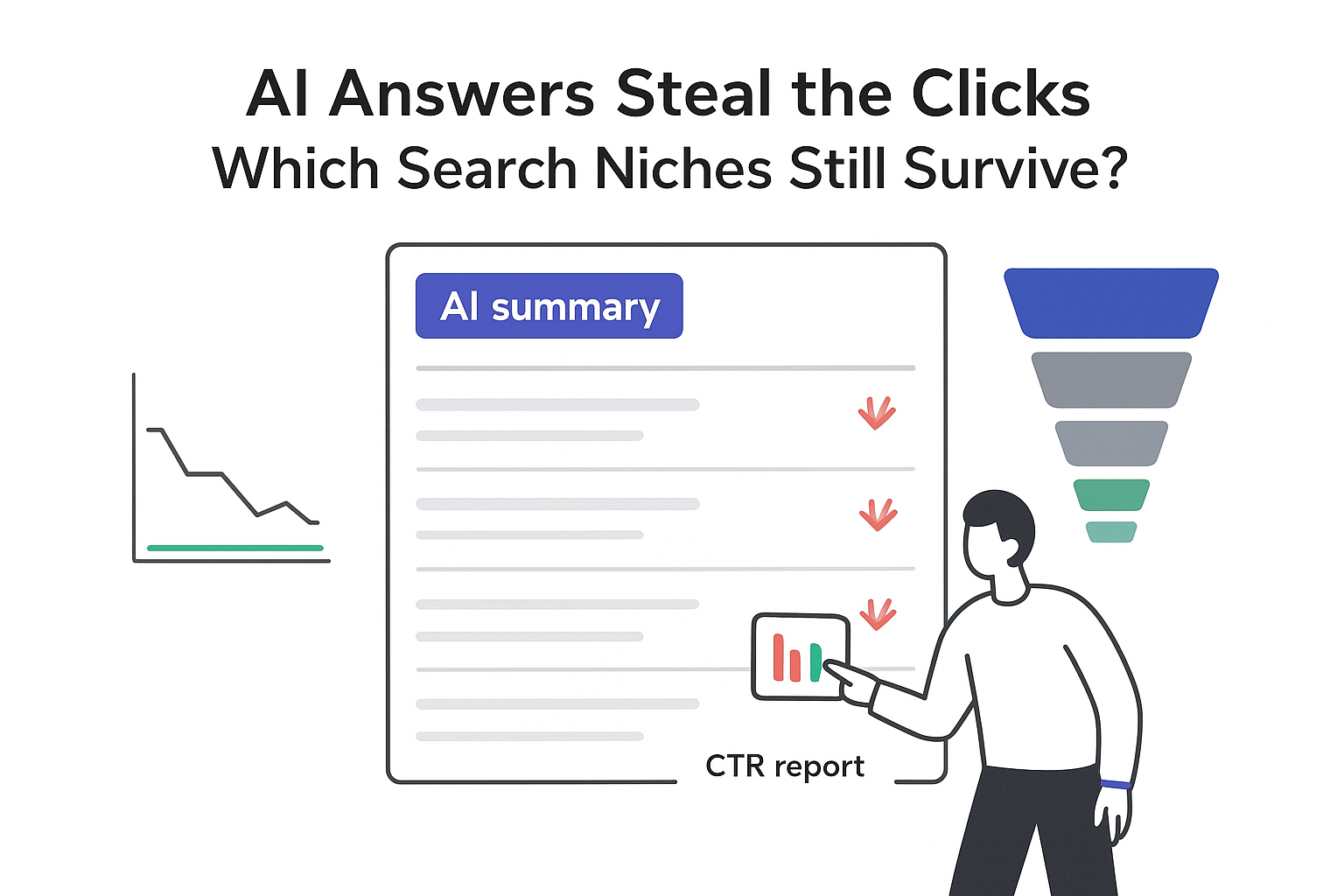
Google AI Overviews in Germany: 59% drop in position 1 organic CTR
SISTRIX's latest Germany-wide dataset, published in its SISTRIX analysis, quantifies how Google's AI Overviews are reducing organic clicks, with steeper top-position losses than previously reported in US-focused studies.

Executive snapshot: Google AI Overviews impact on organic CTR in Germany
- AI Overviews (AIOs) appear on roughly 20% of German Google searches, up from 17% in August. [S1][S5]
- When an AIO is present, the position 1 organic click-through rate falls from 27% to 11% - a 59% relative drop. [S1]
- The probability that a search leads to any organic click falls from 57% (no AIO) to 33% (with AIO). [S1]
- SISTRIX estimates around 265 million organic clicks are lost per month in Germany, equal to a 6.6% average loss across all keywords. [S1]
- Parenting and baby sites lose more than 24% of organic clicks; health and home improvement sites are also heavily affected, while recipes (about 1% loss), news (7.37% loss), shopping, and travel show much smaller impact. [S1]
For marketers, this points to material SEO downside in informational verticals, while transactional categories remain comparatively stable so far.
Method and source notes on AI Overviews CTR data
SISTRIX analysis (Germany) - primary dataset
What was measured
- Presence and placement of Google AI Overviews on German SERPs.
- Estimated click-through rates by organic position with and without AIOs.
- Estimated changes in monthly organic clicks by keyword, category, and domain. [S1]
Scope
- More than 100 million German keywords from SISTRIX's proprietary database. [S1]
- AIO prevalence compared between August and the more recent measurement (17% to 20%). [S1][S5]
Method (as described or inferable from SISTRIX's notes)
- Identification of SERP features (including AIOs and their placement) across the keyword set.
- Use of internal CTR models linked to visibility data to estimate click distribution by position and feature mix. [S1]
Key limitations
- Clicks are model-based estimates from an SEO tool, not direct data from Google or browser logs.
- Keywords skew toward commercially and informationally significant queries and may not fully reflect long-tail behavior.
- The study covers Germany only and does not capture country-specific SERP experiments elsewhere.
- SISTRIX is a commercial vendor; methods and models are not fully transparent or independently audited.
Other referenced sources
- SE Ranking analysis of US results: AI Overviews appearing on roughly 21% of searches in November (US market, proprietary keyword sample). [S2]
- Pew Research Center study of US users: when an AIO was present, users clicked results about 8% of the time vs 15% without AIOs (around 47% relative reduction in click behavior). [S3]
- GrowthSRC analysis: approximately 32% drop in position 1 CTR in US tests with AIOs. [S4]
These secondary studies differ in geography, time period, keyword sets, and whether they model clicks or observe user behavior directly, which limits strict one-to-one comparison.
Findings: how Google AI Overviews change organic clicks and SERP behavior
AIO prevalence and placement in Germany
- AI Overviews are present on around 20% of German Google searches in the SISTRIX dataset. [S1]
- This is close to SE Ranking's 21% prevalence estimate for US searches, though based on a separate sample and methodology. [S2]
- 79% of AIOs in German results appear above the organic listings; the remainder show up lower on the page, after some organic results. [S1]
- SISTRIX previously reported 17% prevalence in August, indicating continued but slower growth to 20%. [S5]
Impact on click-through rates
- Position 1 organic CTR:
- Without AIO: 27%.
- With AIO: 11%.
- Relative change: -59% for the top organic result when an AIO is present. [S1]
- Any organic click on the page:
- Without AIO: 57% of searches yield at least one organic click.
- With AIO: 33% of searches yield at least one organic click.
- Relative reduction: around 42% fewer searches resulting in any organic click when AIOs appear. [S1]
Overall click loss at market level
- SISTRIX estimates that, across all tracked German keywords, AIOs account for around 265 million fewer organic clicks per month. [S1]
- Averaged across all keywords (including those without AIOs), this equates to a 6.6% organic click loss. [S1]
Comparison with other markets
- Pew's US user study: click activity dropped from 15% to 8% when AIOs were shown, a 47% relative reduction in clicking behavior. [S3]
- GrowthSRC's US analysis: about 32% drop in position 1 CTR with AIOs present. [S4]
- The German data shows a steeper position 1 loss (59%), though this may reflect different methodologies, sample compositions, and timing rather than a true country-level difference. [S1][S3][S4]
Findings: category-level and domain-level impact of AI Overviews in Germany
Category-level effects
SISTRIX grouped keywords into content categories and estimated organic click changes. [S1]
- Highest estimated losses:
- Parenting and baby content: more than 24% reduction in organic clicks.
- Health portals and home improvement content: losses well above the 6.6% overall average.
- Moderate impact:
- News and media: around 7.37% loss, slightly above the market-wide average but far below the hardest-hit informational niches.
- Minimal impact or near-neutral:
- Recipe sites (for example, Chefkoch): around 1% estimated loss.
- Shopping and travel booking queries: described as "barely affected" in SISTRIX's summary.
SISTRIX attributes these differences to query intent: informational lookups where an AI summary fully answers the question show larger organic click loss, while queries where the user must complete a task (booking, purchase, comparison) show smaller losses. [S1]
Domain-level winners and losers (Germany)
By total lost clicks (absolute impact): [S1]
- Wikipedia: around 31.6 million fewer organic clicks per month (about 5% of its Google traffic in Germany).
- DocCheck: around 4.8 million fewer clicks per month.
- AOK: around 4.0 million fewer.
- ADAC: around 3.1 million fewer.
- Pons: around 3.1 million fewer.
By share of organic traffic lost (relative impact): [S1]
- lumedis.de: around 30% loss.
- ratgeber-herzinsuffizienz.de: around 29% loss.
- herzstiftung.de: around 29% loss.
Sites with very small estimated losses: [S1]
- wetter.com: around 0.18% loss.
- Booking.com: around 0.46% loss.
- Idealo: around 0.85% loss.
- Amazon: around 1.73% loss.
Collectively, this pattern supports SISTRIX's observation that AIOs mostly displace classic informational content, while domains tightly linked to transactions, bookings, or price discovery see far smaller shifts. [S1]
Interpretation and implications for marketing strategy (Likely / Tentative / Speculative)
Traffic forecasting and reporting
- Likely: For German sites in health, parenting, and home improvement, historic SEO performance is now an unreliable guide for future traffic. Double-digit organic losses in these verticals are consistent with the SISTRIX numbers. [S1]
- Likely: Standard CTR curves used for forecasting (for example, 25-30% for position 1) overstate expected traffic on AIO-affected queries, especially where summaries appear above results. [S1]
- Tentative: Custom models that factor in AIO prevalence and placement by keyword cluster will give more realistic traffic projections, particularly for informational content portfolios.
Keyword and content prioritization
- Likely: Query intent now matters not only for conversion but also for "AIO risk." Informational "what is," "symptoms," and "how to" queries are more exposed; transactional and booking-oriented queries are less exposed. [S1]
- Likely: SEO roadmaps that emphasize keywords with low AIO prevalence (brand-led, transactional, local service, comparison-heavy queries) will preserve more organic traffic value per ranking gained. [S1][S2]
- Tentative: For informational queries that consistently trigger AIOs, content formats that provide tools, calculators, interactive elements, or community contributions - things that cannot be compressed into a short AI summary - may maintain higher click value than plain explanatory articles.
Position strategy and ROI of ranking improvements
- Likely: The marginal benefit of moving from position 3 to 1 on AIO-affected queries is lower than historical models suggest, because the top result now competes with a prominent AI box that absorbs attention. [S1]
- Likely: On SERPs without AIOs, traditional ranking economics still hold; splitting reporting by "with AIO vs without AIO" will help isolate which rankings continue to yield expected returns.
Paid search and channel mix
- Tentative: Brands in high-loss verticals may view paid search as a short-to-medium-term way to recapture some lost exposure, but AIOs can also change ad viewability and scroll behavior, so simple "replace SEO with ads" formulas may not hold.
- Speculative: If AIOs continue to expand in coverage and usefulness, some informational traffic might move permanently into zero-click behavior, where users rely on summaries rather than site visits. That would shift the role of SEO for these queries toward brand visibility and trust signaling, not just traffic acquisition.
Measurement and tooling
- Likely: Adding AIO detection (presence, position, content type) at the keyword level to rank-tracking and analytics workflows will become important, especially in Europe where rollout is accelerating. [S1][S5]
- Tentative: Cohort-based reporting - separating informational vs transactional keyword groups - will help distinguish structural AIO effects from page-level or technical SEO issues.
Contradictions and gaps in current AI Overviews research
- Methodological variation:
- SISTRIX models German clicks from SERP layouts; Pew observes real user behavior in controlled tests; GrowthSRC's method is less fully documented. [S1][S3][S4]
- This likely explains why SISTRIX finds a 59% drop in position 1 CTR, while GrowthSRC reports 32% for US results and Pew reports a 47% drop in overall click behavior rather than position-specific data. [S1][S3][S4]
- Geography and language:
- Current high-quality datasets cover primarily the US and Germany. There is little published primary data for other European languages or emerging markets, which limits generalization.
- Device and interface breakdowns:
- Public summaries do not clearly separate desktop vs mobile effects, or different SERP layouts, even though user behavior and scroll depth often differ significantly by device.
- Paid search impact:
- None of the cited studies provide detailed primary data on how AIOs affect ad impressions, click-through rates, or CPCs. This is a material blind spot for budget planning.
- Long-term behavior change:
- Existing data comes from relatively early in the AIO rollout. It is not yet clear whether users will continue to trust and use AI summaries at the same rate over time, or whether behavior will shift as people adjust to the feature.
Overall, the direction of impact on informational organic traffic is consistent across studies, but the magnitude varies, and granular data on user journeys and paid performance is still limited.
Data appendix: key AI Overviews metrics for Germany
| Metric | Value | Source |
|---|---|---|
| Keywords analyzed (Germany) | >100 million | [S1] |
| Share of queries with AI Overviews (latest) | ~20% | [S1] |
| Share of queries with AI Overviews (August) | 17% | [S5] |
| AIOs appearing above organic results | 79% of AIO instances | [S1] |
| Position 1 CTR without AIO | 27% | [S1] |
| Position 1 CTR with AIO | 11% | [S1] |
| Relative drop in position 1 CTR when AIO present | -59% | [S1] |
| Probability of any organic click without AIO | 57% | [S1] |
| Probability of any organic click with AIO | 33% | [S1] |
| Estimated organic clicks lost per month (Germany) | ~265 million | [S1] |
| Average organic click loss across all German keywords | 6.6% | [S1] |
| Parenting/baby category click loss | >24% | [S1] |
| Recipe category click loss | ~1% | [S1] |
| News and media category click loss | 7.37% | [S1] |
| Wikipedia clicks lost per month (Germany) | ~31.6 million (≈5% traffic) | [S1] |
| lumedis.de organic click loss (share) | ~30% | [S1] |
| herzstiftung.de organic click loss (share) | ~29% | [S1] |
| wetter.com organic click loss (share) | ~0.18% | [S1] |
| Amazon organic click loss (share) | ~1.73% | [S1] |
Sources
- [S1] SISTRIX analysis (Johannes Beus), "AI Overviews in Deutschland: So stark sinken die Klickraten wirklich" (German market analysis, >100M keywords).
- [S2] SE Ranking, AI Overviews prevalence study for US searches (reported around 21% of queries with AIOs in November).
- [S3] Pew Research Center, experimental study of US users comparing Google search behavior with and without AI Overviews (8% vs 15% click frequency).
- [S4] GrowthSRC, analysis of Google CTR changes after AI Overview rollout in the US (approximately 32% drop in position 1 CTR).
- [S5] SISTRIX, earlier report on AI Overview prevalence in Germany (17% of queries in August).





.svg)

.svg)
.svg)