
Google AI Overview citations now rely far less on top-ranking pages
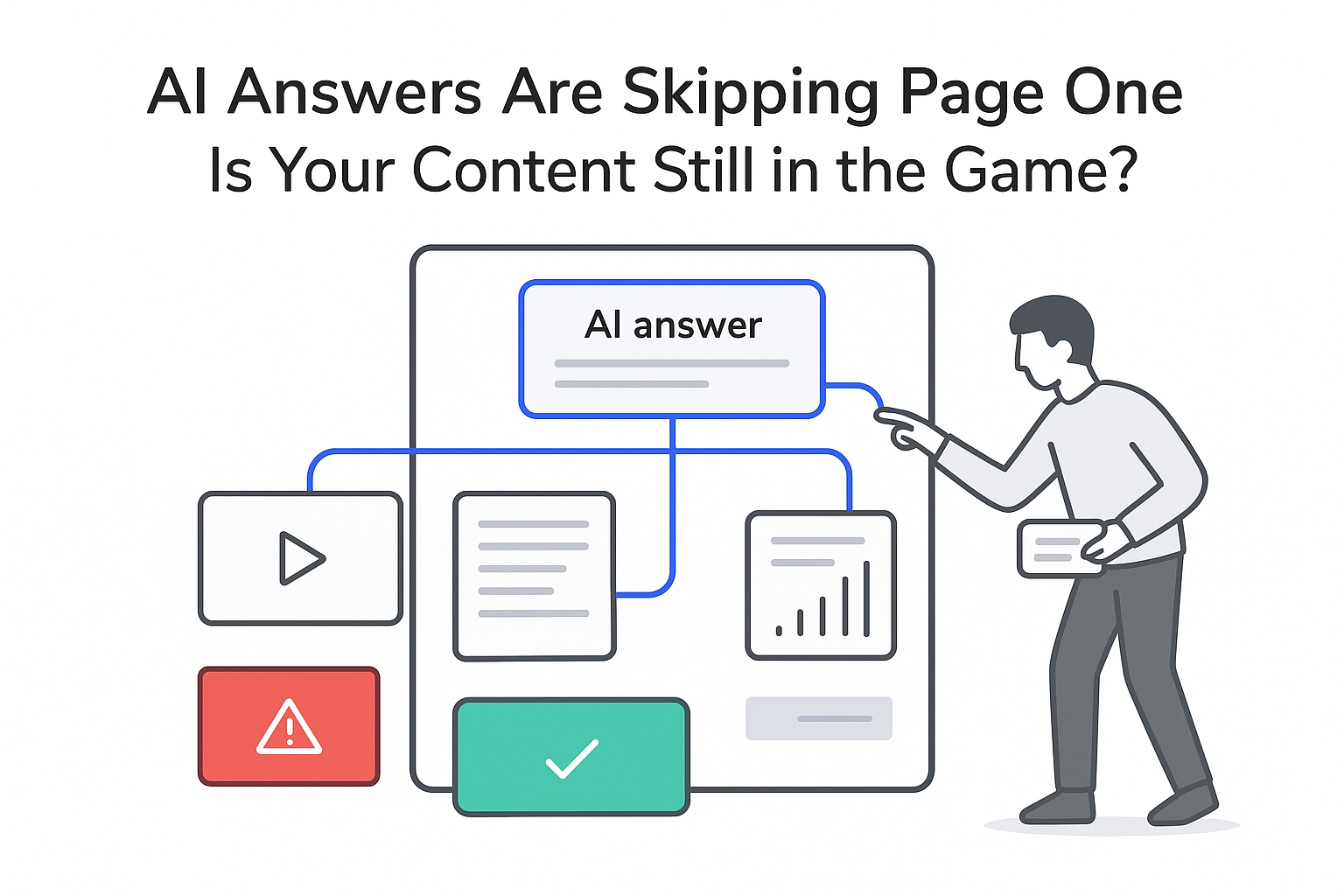
AI Overviews in Google Search are increasingly citing sources that do not rank on page one for the trigger query. Recent large-scale analyses show a steep decline in overlap between AI Overview citations and traditional organic rankings, with YouTube emerging as a disproportionately common cited source, especially among URLs that do not appear in the top 100 results. This is reshaping how SEO and content investments map to visibility within AI-driven search experiences.
Executive Snapshot
- In an Ahrefs study of 863,000 keywords and 4 million AI Overview URLs, only 38% of cited pages also ranked in the top 10 results for the same query; 31.2% ranked in positions 11-100 and 31.0% beyond 100.[S1]
- When counting only standard organic listings, 37% of cited pages ranked in the top 10, while 36% were beyond the top 100, indicating many citations come from sources effectively invisible in classic organic results.[S1]
- Ahrefs’ earlier July 2025 analysis found 76% overlap between AI Overview citations and top-10 results, while another 2024 study reported 75% overlap with the top 12, and a BrightEdge study in October 2025 found 54% overlap.[S1]
- A new BrightEdge analysis published February 12 reports roughly 17% overlap between AI Overview citations and top-10 organic rankings, using different methods and datasets.[S1]
- Among citations from pages not ranking in the top 100, 18.2% were YouTube URLs; overall, YouTube represented 5.6% of all citations and was the single most-cited domain, growing 34% in six months.[S1]
Method & Source Notes
- Primary quantitative data comes from Ahrefs’ updated Ahrefs analysis of 863,000 keywords that triggered AI Overviews and 4 million cited URLs, comparing citation sources with ranking positions for the same queries.[S1]
- The study ran two variants:
- One counting all result types on the page (ads, featured snippets, People Also Ask, video packs, etc.).
- One restricted to standard organic listings only.[S1]
- Historical comparison points (76%, 75%, 54% overlaps) draw from earlier Ahrefs and BrightEdge studies, as summarized by Search Engine Journal (SEJ); underlying sample sizes for those older studies are not detailed in the SEJ article.[S1] Ahrefs’ July 2025 work is referred to here as the previous version of this study.
- A separate BrightEdge analysis, reported February 12, measured roughly 17% top-10 overlap for AI Overview citations using its own methodology and index.[S1]
- Google’s documentation on AI features describes a query fan-out process, where an initial query is expanded into multiple related sub-queries; sources frequently appearing across those fan-out queries may be selected for AI Overviews.[S1][S2]
- All quantitative figures here are drawn from SEJ’s reporting of Ahrefs, BrightEdge, SE Ranking, and Google documentation; underlying raw datasets are not independently verified in this report.
Key limitations: Ahrefs, BrightEdge, and SE Ranking use proprietary crawlers and ranking models, which may not perfectly match live Google results; methods differ across studies, and Ahrefs notes its own parsing of AI Overview citations has improved, making older and newer datasets not fully comparable.[S1]
Google AI Overview citations and declining overlap with organic rankings
Findings - overlap between AI Overview citations and rankings
Ahrefs’ latest study indicates that AI Overview citations now have a much weaker connection to page-one rankings than earlier research suggested.[S1] Across 863,000 keywords that triggered AI Overviews, Ahrefs found that only 38% of cited URLs also appeared somewhere in the top 10 results when all result types (ads, SERP features, etc.) were considered.[S1] The remaining citations were split almost evenly between URLs ranking in positions 11-100 (31.2%) and URLs ranking beyond position 100 (31.0%).[S1]
When Ahrefs limited the comparison to standard organic results only, the pattern stayed similar. In that restricted view, 37% of AI Overview citations came from pages ranking in the top 10 organic results, and 36% from URLs ranking below position 100.[S1] This suggests that many AI Overview sources are effectively invisible in classic “blue link” results for that same query, especially if users rarely go past page one.
Historically, SEJ notes that an earlier Ahrefs analysis from July 2025 found a 76% overlap between AI Overview citations and top-10 organic results, and a 2024 study (also covered by SEJ) reported that 75% of AI Overview citations came from pages ranking in the top 12.[S1] BrightEdge’s own October 2025 study found a 54% overlap between AI Overview citations and organic results.[S1] By contrast, BrightEdge’s February 12 update reported only roughly 17% overlap with top-10 rankings.[S1]
Taken together, these data points describe a steady downward trajectory in correlation between classic organic rankings and AI Overview citation choices, though differences in sampling, timing, and detection methods mean the exact percentages are not directly interchangeable.[S1] The period of declining overlap also roughly coincides with Google’s global move to upgrade AI Overviews to Gemini 3, although the direct impact of that change on citation behavior is not yet quantified in the available studies.
AI Overview rankings, fan-out queries, and non-ranking sources
Findings - how fan-out and SERP features influence AI Overview sources
Ahrefs attributes the reduced overlap partly to changes in its own detection and partly to Google’s use of fan-out queries in AI Overviews.[S1] Since July 2025, Ahrefs has upgraded how it parses AI Overview content and extracts citations, likely capturing more of the URLs that were previously missed.[S1] This improvement alone can lower the measured top-10 overlap, because newly detected citations may be from pages that do not rank on page one.
The second factor is Google’s fan-out process. When an AI Overview is triggered, Google can decompose the user’s query into multiple related sub-queries and evaluate results across that expanded set.[S1][S2] Sources that appear frequently across those sub-queries may be selected for citation, even if they do not rank highly for the original query string itself.[S1] That mechanism helps explain why pages that rank only for related, narrower, or adjacent topics still appear as AI Overview citations.
Ahrefs’ comparison of “all results vs. organic-only” supports the idea that some citations come from sources surfaced in SERP features rather than traditional organic listings.[S1] The slightly higher share of non-ranking pages in the organic-only view indicates that certain cited URLs may be present in video packs, knowledge panels, or other search features that would be excluded when counting only standard organic rows.[S1]
A separate pattern is that a meaningful proportion of AI Overview citations come from URLs that are ranked so low (beyond position 100) that, in practical terms, they receive little or no traditional search traffic for that query.[S1] This indicates AI Overviews tap into a broader index universe than the subset that achieves visible rankings on the main results page.
YouTube citations in AI Overviews and video content priorities
Findings - YouTube’s prominence as an AI Overview source
Among AI Overview citations from pages not ranking in the top 100 for the same keyword, 18.2% were YouTube URLs in Ahrefs’ dataset.[S1] Across all citations, YouTube accounted for 5.6% of AI Overview sources, making it a major individual domain in the citation mix.[S1] Using its Brand Radar tool, Ahrefs also reports that YouTube is the most-cited domain in AI Overviews overall and that its citation frequency grew 34% over the previous six months.[S1]
Multiple independent studies reported by SEJ show a consistent pattern. SE Ranking’s analysis of German health-related queries found that YouTube was the most-cited domain in health AI Overviews, outranking official medical organizations and hospital sites among cited sources.[S1] In Ahrefs’ December AI Mode comparison study, YouTube was already the leading source for AI Overviews, while AI Mode (a distinct experience in Google Search) favored Wikipedia and Quora more heavily.[S1]
Despite YouTube’s strong presence in AI Overviews, many of these cited videos do not appear in the top 100 organic results for the trigger query, which suggests that the AI system is drawing on video content based on relevance across fan-out queries rather than only on traditional ranking strength.[S1] This is also consistent with broader observations from Ahrefs that YouTube surfaces frequently among cited sources that are not visible in standard web results.[S1]
Overall, the convergence of Ahrefs, SE Ranking, and BrightEdge reporting indicates that YouTube has become a structurally important input for Google’s AI-explained search results, especially for topics where the core SERP is dominated by text-heavy pages or where users may benefit from explanatory video content.[S1]
Strategic implications of AI Overview behavior for marketing teams
Interpretation & implications (analysis - not directly stated in sources)
Likely implications
- Single-keyword rankings are a weaker proxy for AI Overview visibility. With only 17-38% of AI Overview citations coming from top-10 results across current studies, relying on rank tracking for main keywords gives an incomplete view of exposure inside AI Overviews.[S1] Content strategies that focus solely on head terms are unlikely to align well with how AI Overviews select sources.
- Topical depth and query coverage matter more than one strong ranking. The fan-out mechanism means Google evaluates content across a cluster of related sub-queries. Pages (or domains) that thoroughly address a topic from multiple angles and question types are more likely to appear repeatedly across fan-out queries and be selected as citations. This favors comprehensive topical hubs, detailed FAQs, and resource libraries over thin, single-page treatments.
- Visibility in SERP features and alternative formats is increasingly relevant. Because a portion of citations appear to originate from sources shown in SERP features (video packs, etc.) rather than organic lists, optimizing for structured snippets, schema markup, and video packs gains added importance for AI Overview presence.
- YouTube and video content offer a distinct path into AI Overviews. The strong representation of YouTube among citations, especially from non-top-100 URLs, suggests that high-quality, well-optimized video content can surface in AI Overviews even when the corresponding site pages do not rank highly for the same queries.[S1] For topics where users often look for demonstrations, explanations, or walkthroughs, video may be a more reliable route into AI-generated answers than text alone.
Tentative implications
- Domain-level authority across a topic may weigh more than page-level rank for a single query. Since fan-out queries look at multiple related searches, domains that consistently appear with useful content across that cluster may be favored for citations, even if no single page is the top organic result. This suggests that consistent subject-matter coverage across many pages or videos could influence AI Overview inclusion more than one standout article.
- Monitoring AI Overview presence requires dedicated tracking. Given the divergence between rankings and citations, traditional rank tracking only partially reflects real visibility. While specific tools and methods are outside the scope of the sources, organizations that care about AI Overview exposure will likely need to monitor which of their URLs or videos are cited over time, separate from standard ranking reports.
- Content refresh cycles may need to account for AI evaluation as well as rankings. If AI systems pull from a wider index and consider more context across queries, updating and expanding evergreen resources across related questions may steadily improve citation likelihood, even without immediate ranking gains.
Speculative implications
- AI Overviews may reduce the advantage of incumbents that dominate classic SERPs. If Google continues to place more weight on fan-out coverage and less on direct ranking for the original query, domains that have not historically dominated page-one results could still gain AI Overview visibility by building strong topical and multimedia content portfolios.
- Video and other rich media could gradually shift from supporting assets to primary entry points for discovery in certain categories. The current data already show video, especially on YouTube, receiving outsized representation in AI Overviews compared with its appearance in classic organic results.[S1] If this trend accelerates, marketing teams may allocate a larger portion of content budgets toward video to maintain or improve AI Overview presence.
Contradictions & gaps
- Divergent overlap percentages. Recent studies report widely varying overlaps between AI Overview citations and top-10 rankings: 17% (BrightEdge, Feb 2026), 37-38% (Ahrefs latest), 54% (BrightEdge, Oct 2025), 75-76% (earlier SEJ- and Ahrefs-reported work).[S1] These discrepancies likely reflect a mix of real change over time, differing sample sets (industries, geographies, query types), and methodological differences, but the exact contribution of each factor remains unclear.
- Limited transparency on Google’s fan-out mechanics and weighting. While Google documents the existence of fan-out queries, it does not disclose how relevance, authority, freshness, or user-engagement signals are weighted in AI Overview source selection.[S2] As a result, content strategies tailored to AI Overviews must remain grounded in observed patterns rather than confirmed ranking factors.
- Incomplete coverage of non-English and vertical-specific behavior. The SE Ranking study on German health queries offers some evidence that YouTube dominance extends beyond English-language results, but there is limited published data across other languages and specialized verticals.[S1]
- Lack of direct traffic attribution to AI Overview citations. None of the cited studies quantify click-through or downstream engagement from AI Overview citations vs. classic results. This makes it difficult to model ROI from AI Overview visibility or prioritize efforts with confidence based solely on traffic or revenue impact.
Data Appendix - AI Overview citation statistics referenced
| Study / Source (via SEJ) | Timeframe (reported) | Metric | Result | Notes |
|---|---|---|---|---|
| Ahrefs large-scale AI Overview citation study[S1] | Latest (2026) | Share of AI Overview citations also in top 10 (all result types) | 38% | 863,000 keywords; 4M AI Overview URLs |
| Ahrefs large-scale AI Overview citation study[S1] | Latest (2026) | Citations from positions 11-100 (all result types) | 31.2% | Same dataset |
| Ahrefs large-scale AI Overview citation study[S1] | Latest (2026) | Citations from positions >100 (all result types) | 31.0% | Same dataset |
| Ahrefs organic-only view[S1] | Latest (2026) | Citations from top 10 organic results | 37% | Counts only standard organic results |
| Ahrefs organic-only view[S1] | Latest (2026) | Citations from positions >100 organic | 36% | Suggests many sources invisible in classic organic |
| Ahrefs prior AI Overview vs rankings study[S1] | July 2025 | Citations from top 10 organic results | 76% | Older parsing; not directly comparable |
| SEJ-covered earlier study[S1] | 2024 | Citations from top 12 organic results | 75% | Details not fully specified |
| BrightEdge overlap study[S1] | Oct 2025 | AI Overview - organic overlap (measure not limited to top 10) | 54% | Methodology differs |
| BrightEdge overlap study[S1] | Feb 12 (year per SEJ) | Citations overlapping with top-10 organic | ~17% | Based on BrightEdge’s dataset |
| Ahrefs YouTube analysis within AI Overview citations[S1] | Latest (2026) | Share of non-top-100 citations that are YouTube URLs | 18.2% | Among URLs not ranking in top 100 |
| Ahrefs YouTube analysis within AI Overview citations[S1] | Latest (2026) | Share of all AI Overview citations that are YouTube URLs | 5.6% | All citations |
| Ahrefs Brand Radar (YouTube growth)[S1] | Last 6 months | Change in YouTube’s share of AI Overview citations | +34% | YouTube identified as most-cited domain |
| SE Ranking German health queries study[S1] | Jan (year per SEJ) | Top cited domain in health-related AI Overviews | YouTube | Outranks official medical sites in citation frequency |
| Ahrefs AI Mode comparison study[S1] | Dec (year per SEJ) | Most frequently cited source for AI Overviews vs AI Mode | YouTube (AI Overviews); Wikipedia/Quora (AI Mode) | Shows different source preferences between two AI experiences |
Sources
[S1] Search Engine Journal, Matt G. Southern, “Google AI Overview Citations From Top-Ranking Pages Drop Sharply,” summarizing Ahrefs, BrightEdge, SE Ranking, and Google Search documentation (2026).
[S2] Google Search Central, “AI Overviews and other AI features in Google Search,” description of fan-out queries and AI source selection (referenced in [S1]).






.svg)

.svg)
.svg)