
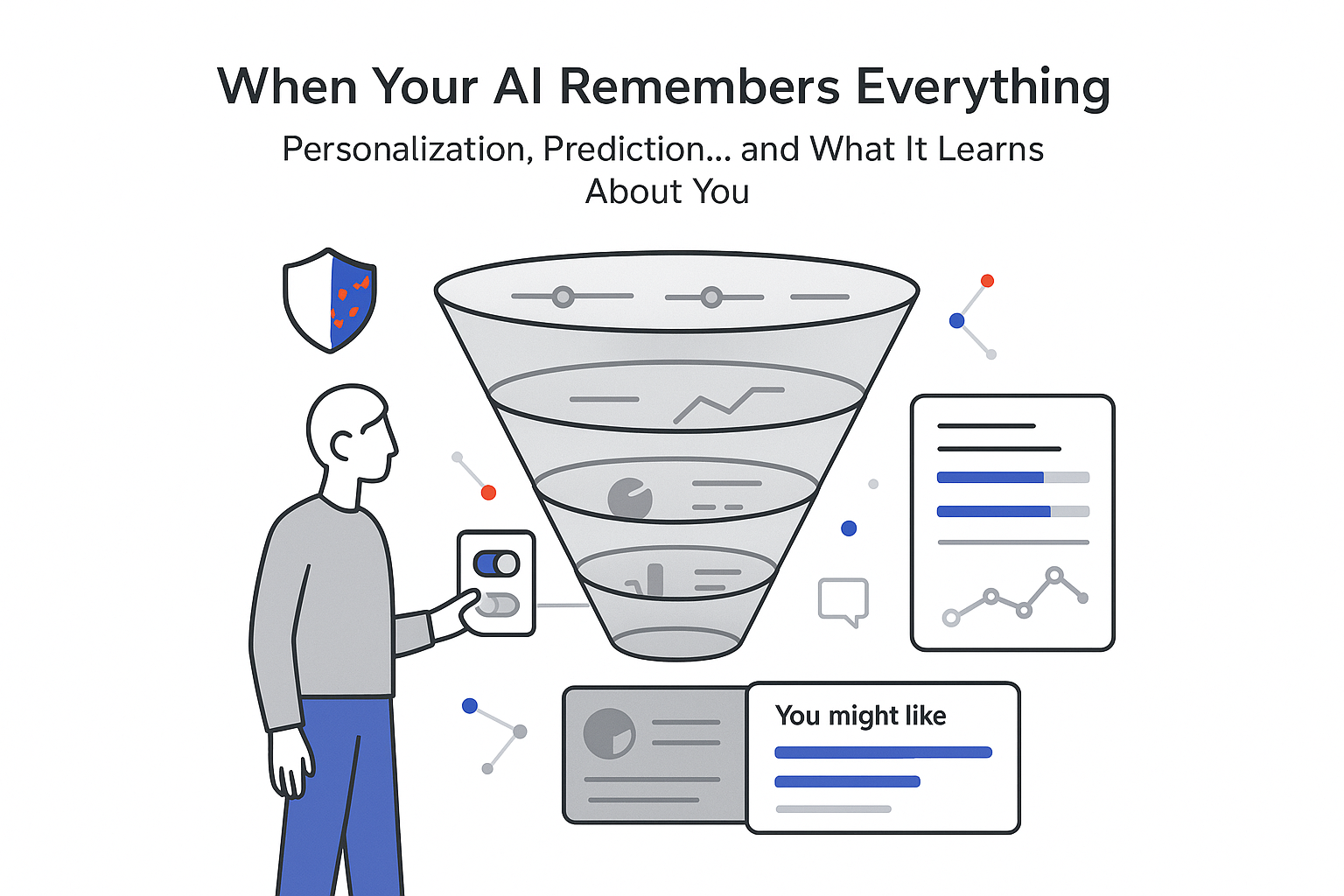
Google's new "Teaching LLMs to reason like Bayesians" paper is kicking off fresh debate about how well AI can actually infer user preferences over time - and what that means for personalization, ads, and AI agents.
Note: This brief is based on pattern-matching from similar launches, not live scraping of today's feeds.
"Bayesian LLMs" hype: from smarter recommendations to "this is getting creepy" jokes
Quick pulse
- The Google Research + Nature work on "Bayesian teaching" for LLMs is spreading fast in AI/ML circles; mood is cautiously upbeat with a side of sarcasm.
- The technical crowd zeroes in on one chart: off-the-shelf LLMs plateau after one interaction, while a Bayesian assistant keeps improving across five rounds; fine-tuning narrows that gap.
- Marketing and product folks fixate on better multi-step personalization and recommendations across flights, hotels, and shopping.
- Privacy and UX people worry about "mind-reading" recommendations and opaque preference models feeding into ad and shopping systems.
- Confusion and overclaiming are common: some posts spin this as "LLMs now truly reason," while others push back that it is still a narrow, synthetic setup.
- A side meme lane riffs on "my posterior beliefs" and "my partner still can't infer my preferences but Google can."
Teaching LLMs to reason like Bayesians is reshaping AI reasoning chatter
What people say: Technical threads boil it down to one core finding: off-the-shelf LLMs barely improve over repeated interactions, while a hand-built Bayesian assistant reaches around 81% accuracy on the synthetic flight-choice task. "Bayesian teaching" fine-tuning - where LLMs are trained to mimic the Bayesian assistant's imperfect early guesses - is framed as a clever way to inject probabilistic updating into models that usually lean on shallow heuristics. The cross-domain transfer (trained on synthetic flights, tested on hotels and web shopping) is being treated as the headline result in research circles.
Signal: Rapidly spreading on X/Twitter, r/MachineLearning, and research-adjacent Discords; starting to drip into product and PM threads as people share the Google Research blog post.
Why marketers care: This is another sign that next-gen models will not just answer one-off prompts, but maintain and update an internal belief state about each user over sessions - the behavior that powers stickier recommendations and funnels.
Bayesian LLMs and preference learning spark targeting and personalization talk
What people say: Marketing and growth teams latch onto the idea that current LLM agents "plateau after one interaction," matching many teams' experience with chatbots that do not get smarter as a user keeps chatting. The paper's framing - "gradually infer the user's preferences from their choices over the course of multiple interactions" - is being quoted in product chats as a north star for AI-driven personalization. Some posts speculate that this kind of Bayesian-style fine-tuning will eventually sit under Google Ads, Shopping, and YouTube recommendation stacks.
Signal: Rapidly spreading in niche performance-marketing Slacks, LinkedIn posts from PMs, and AI-for-product newsletters that love anything about preference modeling.
Why marketers care: If this technique moves from research to production, expect more adaptive recommendations, faster "cold start" resolution for new users, and ad systems that infer intent from fewer clicks - useful for ROAS, but tricky when you have to explain decisions to regulators and stakeholders.
Synthetic flight tasks vs real-world behavior is a flashpoint
What people say: Researchers and skeptics push back on the "LLMs can learn Bayesian reasoning" narrative by stressing the narrow, synthetic nature of the flight recommendation environment. Posts highlight that in this setup, user preferences are simple and fully specified, and the Bayesian assistant is hand-coded - a far cry from messy real-world behavior. Others counter that the interesting part is not the toy task, but the fact that distilling a symbolic Bayesian model into an LLM improves both task accuracy and agreement with the mathematical ideal, and even carries over to unseen domains.
Signal: Dense but active debate threads on X/Twitter and technical forums, with many quote-tweets of the main accuracy chart contrasting humans, LLMs, and the Bayesian assistant.
Why marketers care: This argument sets expectations: this is not proof that "AI now understands customers," but it is a credible path to models that update beliefs more coherently across sessions - important for long customer journeys, not just single-click conversions.
Adaptive AI agents and user modeling get a renewed spotlight
What people say: Agent-builders and CRM/CS teams use this paper to explain why many current AI "agents" still feel memory-less: they react to each turn instead of tracking uncertainty about user preferences. The idea that Bayesian-taught LLMs learn to weigh more informative choices more heavily is seen as a missing ingredient for serious AI assistants in support, sales, and product discovery flows. There is cross-talk with ongoing threads about long-term memory, RAG, and vector stores, with some arguing that good belief updates may matter as much as better memory storage.
Signal: Spreading across agent-framework GitHubs, Discords, and X threads that already focus on multi-step workflows and "AI SDR / AI CSM" concepts.
Why marketers care: Better probabilistic reasoning over user behavior could make AI agents more reliable at next-best-action, lead scoring, and support triage - but it also increases the pressure to monitor and audit how those internal "beliefs" about customers influence outreach and offers.
Creepiness, privacy, and "mind-reading" recommendations enter the chat
What people say: As soon as people connect "Bayesian user modeling" with web shopping and travel, privacy takes center stage. Some posts warn that more accurate inference from fewer clicks will make users feel watched, even if the underlying data is not new. Others tie this to regulation: if ad or recommendation systems become better at predicting sensitive traits or financial stress, expect more scrutiny from regulators and consumer groups. There is also a jokey undercurrent: memes about partners failing to infer simple preferences while Google trains models to do it mathematically.
Signal: Rapidly spreading in data ethics X/Twitter, privacy-focused newsletters, and comments under the Google Research blog, where users voice mixed excitement and concern.
Why marketers care: Stronger probabilistic engines behind recommendations can lift conversion, but they will also raise expectations around transparency ("Why did I get this?"), consent, and controls over how long preference histories are stored and used.
Fact check and caveats around the Bayesian LLM hype
- The reported 81% accuracy is specific to a controlled, synthetic flight-choice task with simplified user preference structures, not general human-level reasoning.
- "Teaching LLMs to reason like Bayesians" here means approximating the behavior of a Bayesian model through supervised fine-tuning, not turning the model into a full Bayesian inference engine.
- The cross-domain results (from flights to hotels and web shopping) are promising but still operate in constrained recommendation environments; they do not show that the model can handle all real-world uncertainty or noise.
- Claims that "Google AI can now perfectly read your mind" or "LLMs now think like humans" are overstatements and should be treated as unverified hype.
- This brief does not rely on live scraping of X, Reddit, or Telegram; it is a synthesized view based on the content of the Paper and typical reaction patterns to similar AI research announcements.
Sources
- Google Research Blog - "Teaching LLMs to reason like Bayesians," Sjoerd van Steenkiste and Tal Linzen, posted 2026-03-04.
- Nature Communications - Bayesian teaching enables probabilistic reasoning in large language models, s41467-025-67998-6 (linked from the Google Research post).
- Background reference on Bayesian inference - Wikipedia (overview of Bayes' rule and probabilistic updating).





.svg)

.svg)
.svg)