
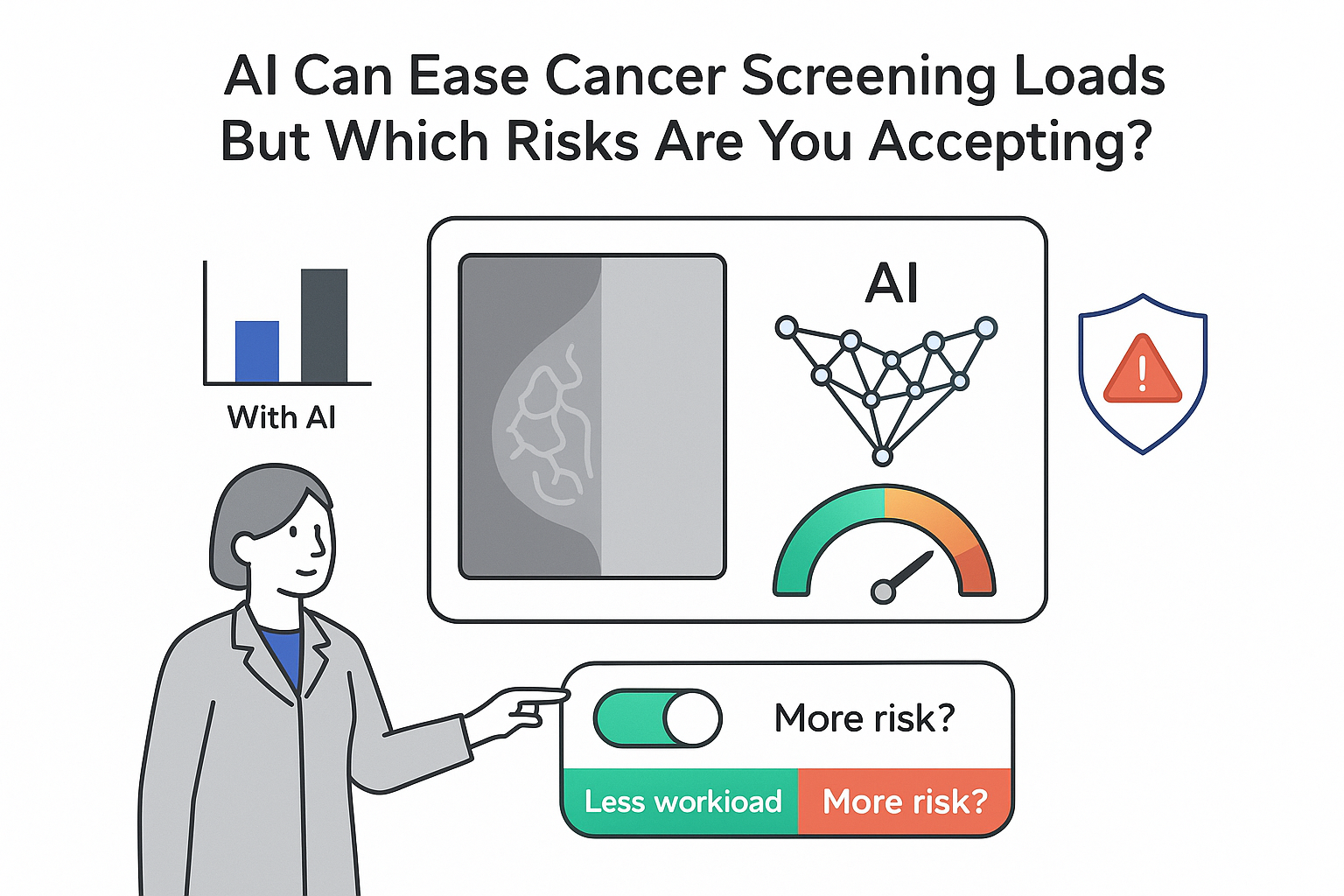
On March 17, 2026, Google Research released results from two Nature Cancer studies evaluating an AI mammography system within England's National Health Service (NHS) breast cancer screening services. The publications report standalone performance, technical deployment, and a simulated double-reader workflow that combines AI with human experts.
Study Overview
The two peer-reviewed papers are part of the Artificial Intelligence in Mammography Screening (AIMS) project within the English NHS.
The first study analyzed standalone AI performance using retrospective screening data and prospective technical deployment in live services. The second focused on an AI-supported double-reader workflow, using a large reader study with accredited mammography specialists to compare an AI-enabled workflow with standard human double reading.
Both studies build on earlier work from Google and academic partners showing that AI can match or exceed human readers on retrospective mammography datasets, including earlier work in this area, and sit within broader global efforts to apply AI to breast cancer screening.
Standalone AI Performance and Deployment (Study 1)
The first study evaluated the AI system using historical English NHS screening data and prospective non-interventional deployment.
In the retrospective analysis:
- Researchers analyzed 115,973 screening episodes from 125,000 women across five NHS breast screening services.
- The AI system achieved higher cancer detection sensitivity than the historical first human reader, without a reduction in overall specificity.
- Reported cancer detection increased from 7.54 to 9.33 cancers per 1,000 screened women.
- The AI system identified 25% of interval cancers that had not been detected in the historical double-read workflow.
In a separate prospective, non-interventional deployment phase, the AI system processed live cases in parallel with routine care:
- Deployment covered 9,266 screening episodes at 12 sites within two London NHS services.
- The median time from completed mammogram to AI read was 17.7 minutes, compared with a historical median of more than two days to the first human read at participating sites.
- Ongoing monitoring detected a distribution shift between the historical training data and more recent clinical data, illustrating how live monitoring can surface changes in the data over time.
- The paper reports detailed sensitivity, specificity, and ROC curve analyses for the AI system.
AI-supported Double-Reader Workflow (Study 2)
The second study examined how the AI system could support the NHS double-reading process, in which two human readers independently review each case and disagreements go to arbitration.
- The reader study used historical screening cases from 50,000 women, with 45,602 cases included after eligibility criteria across two screening services.
- Twenty-two accredited mammography readers arbitrated 8,732 cases, applying each site's established rules for when arbitration was required.
- The AI-supported workflow achieved non-inferior case-level sensitivity and specificity compared with the historical two-human workflow.
- Modeling based on the study data estimated a 46% reduction in total human reads under the AI-supported workflow.
- Time-weighted analysis suggested a 36% to 44% reduction in total reader time with AI support.
- Arbitration panels overruled correct AI recall recommendations in 93 cancer-positive cases, mainly interval and next-round cancers.
Background and Context
According to the UK's Office for National Statistics, breast cancer is the leading cause of death for women aged 35 to 64. Early detection through mammography screening saves lives by identifying cancers at more treatable stages.
The NHS Breast Screening Programme currently relies on a double-read workflow, where two human readers assess each case and discrepancies are resolved through local arbitration panels. This model supports high detection performance but depends on sustained specialist capacity.
Workforce constraints are significant. The Royal College of Radiologists reports an estimated 30% shortfall of clinical radiologists in the UK, with a projected 40% shortfall by 2028 without major expansion. These pressures have encouraged research partnerships between technology companies and NHS organizations, including the AIMS collaboration with Google and academic partners.
The new Nature Cancer papers provide large-scale evidence from both retrospective evaluation and prospective technical deployment within real NHS workflows. They also complement communications on the Google corporate blog published earlier this month and a detailed Google Research technical summary of the project.
Source Citations
- Google Research blog: "Improving breast cancer screening workflows with machine learning", March 17, 2026.
- Standalone performance and integration feasibility of an AI system for breast cancer screening, Nature Cancer, 2026.
- Reader study of an AI-enabled double-reader workflow for mammography screening, Nature Cancer, 2026.
- Deaths registered in England and Wales, 2022, Office for National Statistics.
- Breast screening: guidance for image reading, NHS.
- Clinical radiology workforce census report, Royal College of Radiologists, 2023.
- Artificial Intelligence in Mammography Screening (AIMS) study summary, UK Health Research Authority.
- Mammography screening and breast cancer mortality, peer-reviewed review of screening impact.
- AI for breast cancer screening: current evidence and future directions, The Lancet Digital Health.
- International evaluation of an AI system for breast cancer screening, Nature.
- Google blog: "Advancing AI for breast cancer detection".
- Receiver operating characteristic (ROC) curve, technical background.






.svg)

.svg)
.svg)