
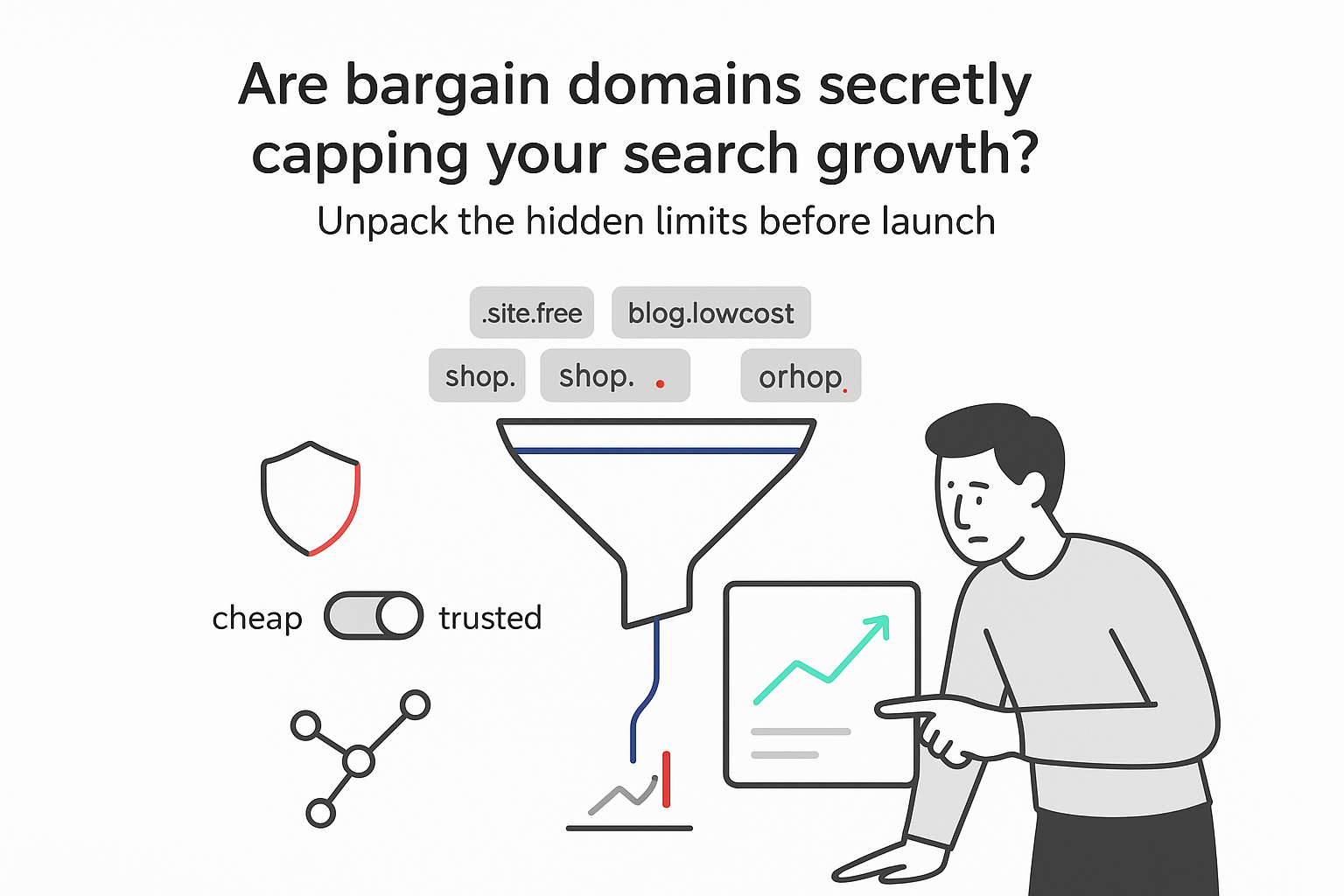
Google's recent comments on free subdomain hosting and cheap TLDs reinforce a structural reality: where you host and what you register affects how quickly - and sometimes whether - you can earn meaningful organic visibility, especially in crowded topics. For any project that depends on SEO as a core acquisition channel, using a free subdomain or spam-heavy TLD is a material strategic risk, not a trivial cost-saving choice.
Free subdomain hosting: SEO risk for new sites
This analysis evaluates the claim that "free subdomain hosting makes SEO harder" by unpacking how Google likely scores spam-heavy hosts, how that interacts with topic competition, and what it means for marketers planning new properties, tests, or microsites.
Mueller's and Illyes' comments are treated as signals about Google's internal incentives and constraints, not as isolated warnings. The goal is to convert those signals into concrete guidance on domain and hosting selection, channel mix, and launch sequencing for new projects.
Key takeaways
- Free subdomain hosts and cheap, spam-heavy TLDs raise the quality bar you must clear before Google is willing to rank you, which slows or caps organic growth. Avoid them for any asset expected to drive search-led revenue.
- Google appears to apply "neighborhood" or host-level quality signals even when subdomains are technically separate sites. One bad platform choice can outweigh months of good content work.
- In saturated topics where strong publishers already dominate, low-trust hosting choices compound the difficulty - expect longer ramp times, weaker long-tail coverage, and more reliance on non-search channels.
- For early-stage projects, search should be treated as a second- or third-wave channel: build direct, referral, and social reach first, then invest in SEO on a clean, owned domain once traction and differentiation are clear.
- Large brands with strong domains can use subfolders or branded subdomains off their main site to "borrow" domain-level trust, avoiding the drag associated with free hosts and cheap TLDs.
Situation snapshot

The trigger is a recent Reddit post where a publisher reported that their site, hosted on Digitalplat Domains (a free subdomain provider on the Public Suffix List), was indexed by Google but not appearing in standard search results. Google's John Mueller responded that the main issue was not technical implementation but the choice of a free subdomain environment that attracts spam and low-effort content [S1].
Mueller explained that free hosts often lack incentives to enforce strong quality controls. As a result, search engines encounter a large share of low-value or spammy pages from that host. Even though, in theory, each subdomain can be treated as a separate site (via the Public Suffix List), Google still sees the broader "neighborhood" and struggles to separate the rare high-quality site from the many poor ones [S1].
Mueller also cautioned against cheap TLDs that have become heavily associated with spam. This aligns with earlier comments by Google's Gary Illyes, who advised avoiding cheap TLDs that are widely abused, noting that search engines may even avoid picking up sitemaps from those domains [S2].
Finally, Mueller highlighted that the site's topic is heavily covered by long-established publishers. That means the site faces both a host-level disadvantage (low-trust environment) and a competition disadvantage (mature SERPs dominated by reputable domains) [S1].
Breakdown and mechanics
1. Host-level and domain-level quality scoring
A simplified process is likely:
Spammy host or TLD → High proportion of low-quality pages detected → Lower host-level trust and stricter filters → New pages from that environment must show unusually strong signals to overcome default skepticism.
Even if Google treats each subdomain as a separate "site" for technical purposes, it still sees patterns at multiple aggregation levels (host, TLD, related infrastructure). When most pages from a host or TLD trigger spam or low-quality classifiers, it is rational for Google to:
- Crawl and index more cautiously.
- Require stronger content or engagement signals before ranking.
- Possibly cap how many pages from that host are allowed to rank meaningfully.
Evidence:
- Mueller's "problematic flatmates" analogy explicitly frames this as a neighborhood effect where the environment makes it harder for a good site to stand out [S1].
- Illyes' remarks about cheap TLDs suggest that abuse at the TLD level can affect how search systems treat all domains under that extension [S2].
2. Public Suffix List vs neighborhood effects
The Public Suffix List is used to treat certain suffixes (including some free subdomain providers) as boundaries for "site" concepts (for cookies, security, etc.). In theory:
Public Suffix List entry → Subdomain treated as its own site.
However, Mueller's comments indicate that Google still considers the larger host environment:
Free host with many spammy subdomains → Repeated low-quality signals → Host or TLD reputation degrades → All subdomains inherit a tougher starting position, even if they are technically separate [S1].
Speculation: It is plausible that Google maintains both site-level scores (per PSL-based site) and aggregated scores at host or network level. If a PSL-listed host is mostly spam, Google might throttle discovery or ranking for all subdomains until strong evidence of quality is present. This would match the "diamond in the rough" framing Southern references [S1].
3. Competitive topic dynamics
Mueller notes that the publisher's topic is already "extremely well covered" [S1]. In such SERPs:
Strong incumbents with years of content and links → High topical authority → Stable ranking positions.
New site with generic coverage plus a weak host → Low perceived authority → Limited space to rank except on ultra-specific or novel queries.
Even on a clean, high-quality domain, breaking into these spaces is slow. On a spam-heavy host or cheap TLD, it becomes slower still, because the site must overcome both topical and host-level trust deficits at once.
4. Channel sequencing and incentives
Mueller suggests not treating search visibility as the first step. Instead, he recommends building an audience via direct interest and community engagement, then earning search visibility as a byproduct [S1].
In practice, this reflects Google's incentives:
User demand and off-site signals (mentions, links, branded search) → Evidence that a site helps real users → Systems become more willing to rank it.
A new site relying solely on free hosting and hoping for "SEO to work" reverses this sequence, which conflicts with how Google assesses trust and importance today.
Impact assessment
Organic search and content strategy
For organic search, the direction of impact from free subdomains and cheap spam-heavy TLDs is negative.
- Effect size (assumption-based): If a typical new, well-built domain in a moderately competitive niche might reach, for example, 1,000–3,000 organic visits per month within 12–18 months of consistent publishing and link acquisition, a similar site on a low-trust free subdomain may take significantly longer or never reach that range. This is a model, not measured data.
- Winners:
- Sites on clean, reputable TLDs with active quality control.
- Brands that consolidate content under a strong main domain (for example, /blog, /guides) rather than scattering content on separate, weaker hosts.
- Losers:
- Projects started on free hosts with the goal of ranking in competitive SERPs.
- Side projects or MVPs that plan to "move to a real domain later," as the early organic history may not transfer cleanly.
Concrete actions and watchpoints:
- Treat domain and TLD choice as a strategic element of SEO, not just a cost line item.
- Reserve free subdomains for non-SEO-critical use (internal testing, throwaway experiments, or assets that rely only on direct or paid traffic).
- If you already run a legitimate site on a free host or cheap TLD, plan a migration to a higher-quality TLD and paid hosting, with proper redirects and timing to minimize disruption.
Paid media and landing page choices
Paid traffic (search, social, display) is less sensitive to host-level spam signals but not immune:
- Platforms may apply quality filters to entire hosts or TLDs with high abuse rates, driving stricter ad approvals or lower quality scores in some cases.
- Users are often suspicious of unfamiliar or cheap-looking domains, which can depress conversion rates even when ad click-through remains acceptable.
Implications:
- For paid campaigns expected to scale, use domains that look trustworthy and are not associated with bulk spam use.
- Keep free-hosted pages for extremely low-risk experiments only, and monitor both approval rates and on-page engagement before investing.
Brand, product launch, and market entry
For new brands entering crowded topics, hosting choices compound existing challenges:
- In competitive informational or commercial SERPs, incumbents benefit from accumulated links, mentions, and content breadth.
- Launching on a low-trust host in those spaces can turn organic search from "slow but viable" into "highly unlikely to be a material channel" within your planning horizon.
Winners:
- Brands that route new sections, pilots, or product content through their existing trusted domains.
- New entrants that pick under-served topics or angles, combined with clean hosting.
Losers:
- Teams that launch content-heavy products on free subdomains expecting "organic to kick in later."
Practical adjustment: When search is expected to contribute meaningfully to CAC reduction or LTV expansion, require paid hosting and a reputable TLD in the business case. Treat the extra cost as part of channel enablement, not an optional upgrade.
Operations, experimentation, and portfolio management
From an operational standpoint:
- Free subdomains remain useful for internal prototypes, short-lived tests, or assets where organic visibility is irrelevant.
- For SEO-led tests (for example, trying a new content vertical), it is usually more effective to spin up a subfolder or branded subdomain under your current main domain, leveraging existing trust instead of starting from a degraded baseline.
Watchpoints:
- Maintain an inventory of all domains and subdomains in use. Avoid scattering content across multiple weak domains, which dilutes signals.
- Periodically review TLD choices across your portfolio; if any are known spam magnets, consider consolidation or migration.
Speculation: If Google continues tightening spam controls, properties on marginal TLDs or free hosts could see sudden drops in crawl frequency or index coverage. This risk should factor into long-term content planning and domain lifecycle decisions.
Scenarios and probabilities
Base case - stricter but stable neighborhood effects (likely)
- Google continues current behavior: neighborhood or host-level quality remains a significant factor.
- Free subdomain platforms and cheap, abuse-heavy TLDs remain disadvantaged but not outright blocked.
- Marketers who avoid these environments and build on reputable domains see relatively predictable SEO trajectories; those using free hosts experience slower or capped growth.
Implication: Domain and host selection remains a meaningful lever, but not the only determinant. Content quality and differentiation still matter heavily.
Upside case - better isolation of good sites on bad hosts (possible)
- Google improves its ability to isolate truly high-quality sites, even on historically spammy hosts or TLDs.
- Strong behavioral, link, or engagement signals allow a "good" site on a free subdomain to break out sooner.
- Large-scale abuse means aggregate skepticism remains; the floor improves, but not dramatically.
Implication: Risk of using free hosts lowers slightly, but the economics still favor owning a clean, branded domain for anything strategic.
Downside case - harsher penalties for spammy hosts and TLDs (edge to possible)
- Escalating abuse leads Google and other platforms to apply more aggressive host-level or TLD-level suppression.
- Some free hosts or cheap TLDs become quasi-toxic for organic search: crawling slows, new pages rarely rank, and recovery is difficult even after migrations.
- Reputable brands accidentally sharing those environments may need urgent consolidation or replatforming.
Implication: Projects depending on such environments could lose most organic visibility abruptly, with limited recourse. This is less likely but should be considered a tail risk in longer-term planning.
Risks, unknowns, and limitations
- Lack of direct metrics: There is no public data quantifying how much host-level quality reduces ranking potential. All numerical examples above are models meant to illustrate magnitude, not measured outcomes.
- Variation across hosts and TLDs: Not all free hosts or cheap TLDs are equally abused. Some may maintain better controls or have neutral reputations. Mueller's comments are directional, not a blanket blacklist.
- Simplification for support context: Mueller and Illyes often simplify explanations for public forums. Internal systems are likely more complex than the "bad neighborhood" analogy implies.
- Unknown future policy shifts: Google could adjust its treatment of PSL entries, host-level scoring, or TLD-related signals. Any such changes could lessen or heighten the disadvantage faced by free subdomains.
- External factors: User preferences, browser behavior, and other platforms' policies (for example, ad networks) might converge toward similar skepticism about spam-heavy environments, but this is not guaranteed.
What would invalidate key parts of this analysis:
- Strong evidence that sites on historically spammy free hosts or cheap TLDs rank as easily and as quickly as comparable sites on clean, paid domains, controlling for content, links, and topic difficulty.
- Public technical documentation from Google stating that host or TLD-level neighborhood effects have been fully neutralized for PSL-listed free subdomains.
Sources
- [S1]: Search Engine Journal / Southern, M.G., 2026, news article - "Google's Mueller: Free Subdomain Hosting Makes SEO Harder."
- [S2]: Search Engine Journal / Southern, M.G., n.d., news article - "Google: Don't Choose Cheap TLDs To Avoid Spam Risks," summarizing comments by Google's Gary Illyes.
- [S3]: Reddit, n.d., user thread in r/TechSEO - "My website is on Google but not showing up to..." (referenced by [S1]).





.svg)

.svg)
.svg)