
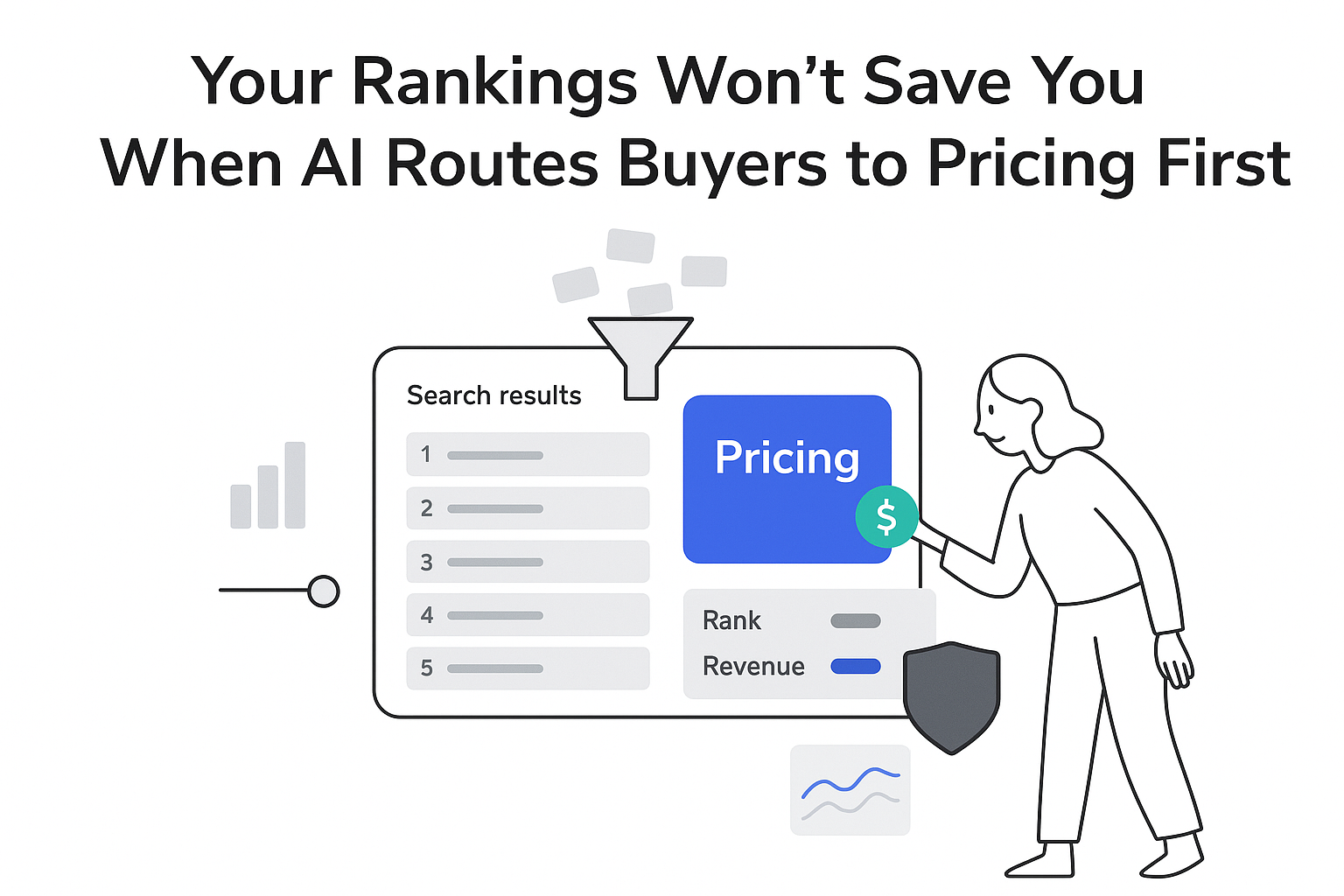
Does ChatGPT's premium model (GPT-5.4) create a new, brand-centric discovery layer that changes how SEO, content, and PPC should be planned, especially for comparison and product research queries?
Key takeaways from ChatGPT web search model changes
- GPT-5.4 behaves like a "brand-first researcher": it targets specific domains, pricing, and product pages. Brands with clear, ungated first-party content will gain more visibility with premium ChatGPT users, especially on comparison and "which tool" queries.
- GPT-5.3 behaves more like a traditional web search wrapper: it leans heavily on third-party media and review sites, so ranking and coverage on those properties still matters for visibility in the free or default ChatGPT experience.
- Google rankings are no longer a reliable proxy for ChatGPT visibility in premium models: in the study, 75% of GPT-5.4's cited domains did not appear in Google or Bing for the same queries, so classic SEO alone cannot guarantee inclusion in GPT-driven answers.
- Gated pricing directly reduces what GPT-5.4 can say about you: brands that hide pricing behind "contact sales" give the model less data for side-by-side comparisons, which likely shifts click-through and preference toward competitors with transparent pricing.
- ChatGPT is now a measurable channel: most cited URLs include
utm_source=chatgpt.com, so marketers can track this traffic separately, compare it to organic search, and decide whether to prioritize content for GPT-5.4 (first-party) vs GPT-5.3 (third-party coverage).
Situation snapshot: ChatGPT citation study and model behavior
The analysis is based on a Writesonic analysis of ChatGPT conversations comparing GPT-5.3 Instant (default for logged-in users) and GPT-5.4 Thinking (premium model) across 49 prompts that triggered web search. [S1][S2]

Key reported facts
-
Citation patterns
- GPT-5.4 sent 56% of citations to brand websites; GPT-5.3 sent 8%. [S1][S2]
- Across all prompts, the models shared only 7% of cited sources, indicating almost completely different link sets for the same questions. [S1][S2]
-
Query behavior
- Example CRM question: GPT-5.3 issued a single broad query and cited techradar.com and designrevision.com. GPT-5.4 issued separate, domain-restricted queries for hubspot.com, salesforce.com, attio.com (pricing), then checked g2.com and capterra.com for reviews. [S1][S2]
- GPT-5.4 averaged 8.5 sub-queries per prompt and used
site:operators in 156 of 423 total queries; no other model tested usedsite:at all. [S1][S2]
-
Page types and domains
- GPT-5.3: 32% of citations were blog posts and articles. Top domains included Forbes (15 citations), TechRadar (10), and Tom's Guide (10). [S1][S2]
- GPT-5.4: 22% of citations were brand homepages, 19% pricing pages, 10% product pages. Across 49 chats, it cited only 4 pricing pages (GPT-5.3) vs 138 pricing pages (GPT-5.4). [S1][S2]
- On "X vs Y vs Z" comparison prompts, GPT-5.3 never cited brand sites; GPT-5.4 cited brand domains in 83–100% of cases. [S1][S2]
-
Relationship to classic search
- For GPT-5.3, 47% of cited domains also appeared in Google results for the same query. [S1][S2]
- For GPT-5.4, 75% of cited domains did not appear in Google or Bing results for the same query. [S1][S2]
-
Tracking
- Most cited URLs carried
utm_source=chatgpt.com, enabling direct attribution in analytics tools. [S1]
- Most cited URLs carried
OpenAI's own documentation confirms that ChatGPT rewrites user prompts into search queries but does not explain how models choose domains or when they apply site: filters. [S3]
Breakdown and mechanics: how ChatGPT models query the web differently
Mechanically, the two models appear to implement two distinct search strategies.
1. GPT-5.3: single broad query → SERP-like sources → article-heavy citations
- Likely workflow (simplified): User prompt → 1–2 broad web queries → external search engine results → selection of high-authority, article-style URLs → answer + citations.
- Evidence: heavy reliance on Forbes, TechRadar, Tom's Guide, and other high-authority publishers; 47% overlap between cited domains and Google results. [S1][S2]
- Effect: This mirrors traditional SEO signals - the sites that already rank and earn links are more likely to be cited by GPT-5.3.
2. GPT-5.4: multi-step research → domain targeting → product/pricing-heavy citations
- Likely workflow (simplified): User prompt → intent parsing ("CRM comparison", "pricing", "features") → 8.5 average sub-queries → repeated
site:brand.comandsite:reviewsite.comcalls → aggregation of pricing, feature, and review data → answer + citations. - Evidence: extensive use of the
site:operator (156/423 queries), heavy skew toward brand homepages, product and pricing pages, and direct queries to G2/Capterra in the CRM example. [S1][S2] - Effect: The model behaves less like a generic web search front end and more like a researcher who knows which brands and review sites to inspect, then compiles a comparison.
3. Decoupling from Google and Bing rankings
- For GPT-5.4, 75% of cited domains did not appear in Google or Bing for the same queries. [S1][S2]
- Mechanistic implication: GPT-5.4 often bypasses "who ranks for this query?" and instead asks "which domains should I query directly to answer this intent?"
- This implies some internal mapping from topic → known brands and resources, using the model's training data and reinforcement signals, rather than live search rankings alone.
4. Why so little overlap between models?
- Only 7% source overlap across models suggests that "where to look" is coded differently in each system, likely via distinct retrieval heuristics tuned for speed (GPT-5.3) vs thoroughness (GPT-5.4). [Speculation, based on behavior]
- GPT-5.3 optimizes for latency → fewer queries, high-authority aggregators.
- GPT-5.4 optimizes for depth and precision → more queries, direct brand checks, more niche domains.
For marketers, this means:
- GPT-5.3 visibility is a function of your presence on established publishers and review sites that already rank in search.
- GPT-5.4 visibility is a function of the completeness and crawlability of your own product and pricing content, plus inclusion in the model's internal "brand list" for your category.
Impact assessment for SEO, PPC, and broader marketing
The commercial impact will differ by channel and by whether your audience skews toward free or premium ChatGPT usage. User mix data is not public, so the following impact calls are directional.
Organic visibility and SEO for ChatGPT search
Direction of impact
- For GPT-5.3 (default):
- Strong positive for publishers, review sites, and comparison blogs that already do well in organic search.
- Brands gain ChatGPT visibility mainly via third-party mentions, guest content, and inclusion in "Top X tools" lists.
- For GPT-5.4 (premium):
- Strong positive for brands with structured, ungated product and pricing pages.
- Neutral to negative for affiliates and media outlets, especially on comparison queries, as citations shift to first-party sites.
Who benefits / who loses
- Beneficiaries:
- B2B SaaS and software products with transparent pricing and detailed product pages.
- Brands that maintain clean information architecture:
/pricing,/features,/product-name, and easy navigation from the homepage.
- Disadvantaged:
- Brands hiding pricing behind "contact sales" workflows; GPT-5.4 has less concrete data for these products, weakening their presence in price-sensitive comparisons.
- Affiliates and listicle-driven publishers that relied on ranking for "[category] tools" queries; GPT-5.4 sends fewer citations their way.
Actions / watchpoints
- Audit your core product and pricing pages for clarity, crawlability, and completeness, especially for data points that power comparisons: pricing tiers, core features, integrations, and use cases.
- Ensure robots.txt and technical settings do not block ChatGPT's browsing agent (if present); monitor server logs where possible for ChatGPT user agents.
- Track
utm_source=chatgpt.comin analytics to identify which landing pages earn citations and refine content around those.
Paid search and performance marketing
Direction of impact
- Short term:
- Limited direct change to Google Ads or Bing Ads mechanics, but potential gradual shift in how users perform early-stage research, from classic search to ChatGPT conversations.
- Medium term:
- If premium ChatGPT adoption among high-intent users increases, some "what is the best X?" and "tool vs tool" search volume may migrate from search engines to ChatGPT.
- Review sites that previously monetized via PPC or affiliate may see fewer high-intent visits from premium users, which can alter auction dynamics over time. [Speculation]
Who benefits / who loses
- Beneficiaries:
- Brands that win strong citations in GPT-5.4 for "[Brand A] vs [Brand B]" type queries; these mentions may prime users before any search or ad click.
- Disadvantaged:
- Advertisers relying heavily on bidding against review sites or buying placements on those sites; if premium users see answers directly in ChatGPT, some of that traffic base may shrink.
Actions / watchpoints
- Segment paid search performance by query intent (for example, "what is...", "best...", "... vs ...") and watch for gradual volume or conversion-rate shifts that might correlate with growing ChatGPT referral traffic.
- For categories with high comparison activity (CRM, project management, analytics, etc.), build a monitoring routine: manually ask GPT-5.3 and GPT-5.4 your key comparison queries monthly and log how your brand appears (or does not).
- Consider aligning ad messaging with how GPT-5.4 describes you; if it consistently highlights specific strengths, those may be worth reinforcing in creative.
Analytics, attribution, and operations
Direction of impact
- Immediate:
- New identifiable referral:
utm_source=chatgpt.comlets you treat ChatGPT as its own channel or sub-channel. [S1]
- New identifiable referral:
- Medium term:
- As models and routing change, ChatGPT may send traffic that behaves differently from organic search or social, possibly higher intent for some categories (for example, B2B tools), but that needs validation per account.
Actions / watchpoints
- Create a dedicated channel grouping or segment for
utm_source=chatgpt.comin analytics; break out byutm_campaignor path if present. - Track key metrics: sessions, conversion rate, assisted conversions, and paths (for example, ChatGPT → direct return → conversion).
- Share this data with content and SEO teams regularly; use it to prioritize which pages to refine for GPT-5.4 (most-linked landing pages) vs where you might need more third-party coverage for GPT-5.3.
Scenarios and probabilities for ChatGPT search as a traffic source
These scenarios are speculative; likelihood tags are qualitative, not statistical.
-
Base case - dual discovery layer stabilizes (Likely)
- GPT-5.3 continues to behave as a SERP-aligned, article-heavy model; GPT-5.4 keeps its brand-first behavior.
- Marketers treat ChatGPT as a hybrid: invest in both first-party product/pricing clarity and placements on high-authority publishers.
- ChatGPT traffic becomes a meaningful but not dominant share of research-stage visits in B2B and software categories.
-
Upside case - premium model becomes a de facto comparison engine (Possible)
- Premium adoption grows among decision-makers; GPT-5.4 becomes a primary tool for tool and vendor research.
- Brands that invested early in accurate, structured, ungated information see measurable lift in assisted conversions and shorter sales cycles from ChatGPT-originating leads.
- Some review sites lose high-intent traffic share, and SEO budgets shift more toward first-party "decision support" content.
-
Downside case - behavior regresses toward SERP-like sourcing (Edge)
- OpenAI adjusts GPT-5.4's approach to rely more on generic search to address fairness or crawling concerns.
- Overlap with Google and Bing results increases; the advantage of first-party brand pages shrinks.
- ROI from optimizing for GPT-5.4-style behavior is lower, and classic SEO toward ranking pages again becomes the main route to AI-driven visibility.
Risks, unknowns, and study limitations
- Sample size and scope: The Writesonic study covered 49 conversations; this is informative but not comprehensive. Category coverage beyond software/CRM and similar topics is not fully clear. [S2]
- Temporal stability: OpenAI updates models and routing frequently. The behavior observed for GPT-5.3 and GPT-5.4 may shift without public notice. Findings should be treated as time-bound.
- User mix uncertainty: OpenAI does not publish what share of usage or traffic comes from premium vs free users. For many brands, default-model traffic may still dwarf premium traffic, muting the near-term commercial impact.
- Opaque domain selection: The process by which GPT-5.4 decides which brands or review sites to query directly is not documented. We do not know whether this is based on model training, human curation, popularity signals, or other factors. [S3]
- Attribution noise: While
utm_source=chatgpt.comhelps, models can summarize content from sites without generating a click. Brands may influence user choice without seeing corresponding traffic, which complicates ROI analysis. - Potential confounders: Some cited domains may be chosen for reasons unrelated to structure or content quality (for example, brand prominence in training data), which limits how precisely marketers can "optimize for ChatGPT".
Future data that could falsify or adjust this analysis would include: updated studies showing high overlap between GPT-5.4 citations and Google SERPs, OpenAI documentation revealing a different retrieval process, or analytics evidence that ChatGPT referrals remain negligible despite strong first-party optimization.
Sources
- [S1] Search Engine Journal / Matt G. Southern, 2026-03, News article - "ChatGPT's Default & Premium Models Search the Web Differently."
- [S2] Writesonic, 2026-03, Blog / study - "ChatGPT Citation Study: GPT-5.4 vs GPT-5.3."
- [S3] OpenAI Help Center, 2025-2026, Documentation - "How ChatGPT Search Works" (prompt rewriting and browsing description).
Validation: This analysis states a clear thesis, explains the mechanics behind GPT-5.3 vs GPT-5.4 behavior, quantifies effects using reported data, contrasts winners and losers and short- vs long-term scenarios, and flags speculation and limitations. Recommendations focus on specific actions around first-party content, third-party coverage, and analytics setup supported by the cited findings.




.svg)

.svg)
.svg)