
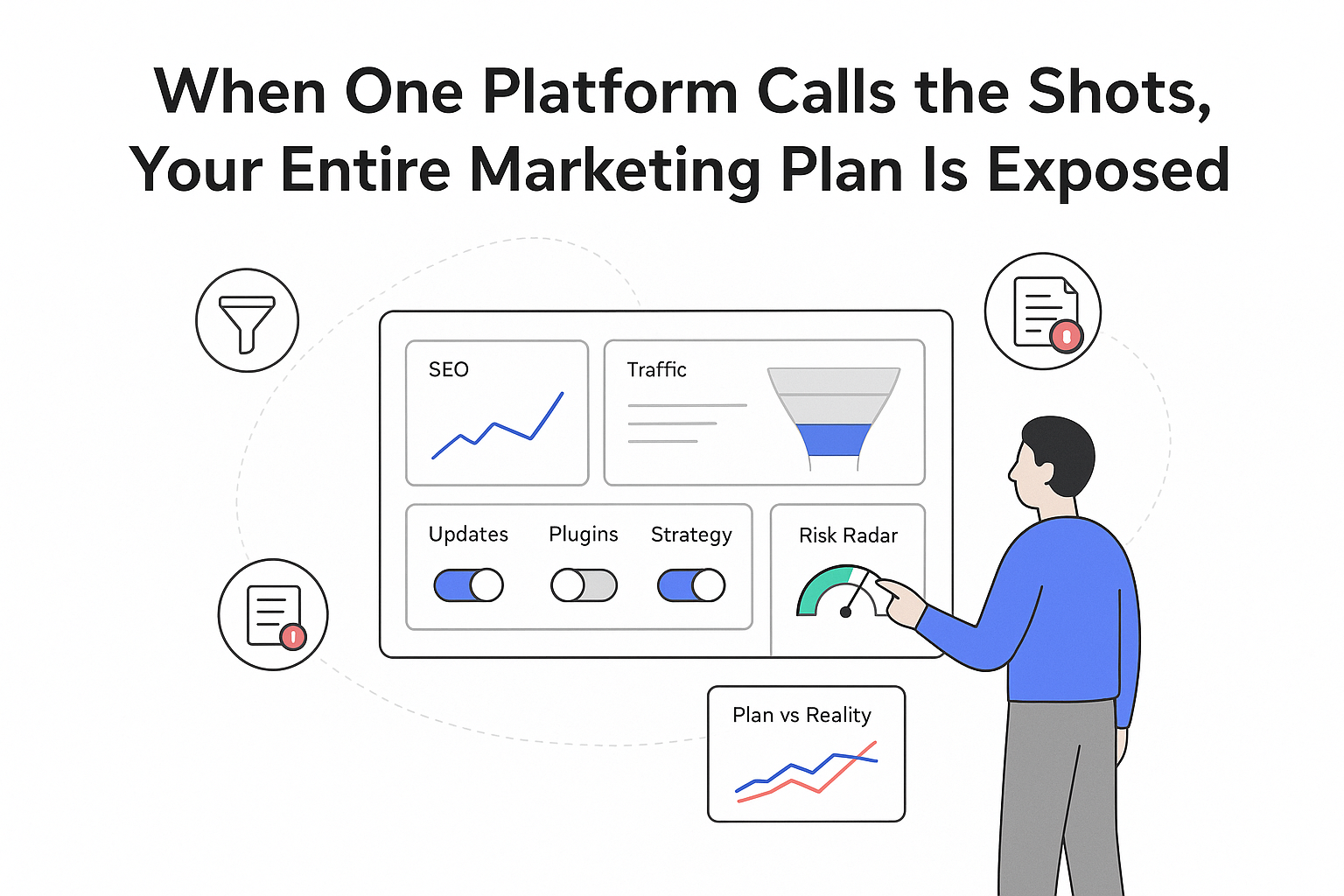
Why the benevolent dictator for life model in WordPress matters for marketing strategy
This analysis examines how the "benevolent dictator for life" (BDFL) model that guides WordPress and several other major open source projects reshapes platform risk and planning for marketers.
WordPress is effectively guided by a de facto BDFL. Strategic control is concentrated in a single leader, while execution remains community driven. For marketers who depend on WordPress for revenue, lead generation, and SEO, this governance pattern alters the risk profile and predictability of their core web stack.
Key takeaways
- WordPress is not a pure committee democracy: strategic direction ultimately runs through one leader. Marketers should treat WordPress leadership signals as an input to technology and content planning.
- The BDFL model trades slow consensus for faster, opinionated shifts (for example, the block editor). That can create short term disruption for SEO and conversion flows, but delivers more consistent long term direction.
- Governance is constrained by GPL licensing and the possibility of forks, which limits extreme moves, but practical switching costs keep most businesses on the main branch.
- Plugin, theme, and agency vendors are more exposed than end site owners. Marketers should watch for features moving from plugins into core and align with vendors that track core roadmaps closely.
- The main risk for marketers is not sudden project death, but medium term product bets (editing experience, performance, integration with commercial products) drifting away from their needs.
Situation snapshot
A short Search Engine Journal piece highlights that many open source projects are effectively run by a single founder with final say, often described as a Benevolent Dictator For Life (BDFL). Examples cited include Linux (Linus Torvalds), WordPress.org (Matt Mullenweg), Ruby on Rails (David Heinemeier Hansson), and Laravel (Taylor Otwell) [S1].
The term "BDFL" originated around Python creator Guido van Rossum in the mid 1990s and has since been used, half jokingly, to describe a model where one person holds ultimate decision power even as broad communities contribute code and feedback [S4].
In WordPress specifically:
- The project is open source, licensed under GPL, and driven by a global volunteer and contributor community.
- Many decisions are made through teams, proposals, and discussions, but major direction (for example, the Gutenberg block editor and the push toward full site editing) flows from the project leader's vision.
Recent discussion on X highlighted how this can feel from inside the community. A WordPress core contributor tweeted about BDFL style power, and another developer replied with a contrasting description.
"Feudal Lords For Life... running OSS like a fiefdom."
WordPress currently powers around 43% of all sites on the web and over 60% of sites using a known content management system [S2]. The plugin directory lists more than 59,000 free plugins [S3]. That scale makes its governance structure directly relevant for any marketer using WordPress for lead generation, content, or online retail.
Breakdown and mechanics
The core question: how does a BDFL model actually work in a large open source project, and why does it exist?
At a high level, the process looks like this:
Community feedback and ideas → Core teams write proposals and patches → BDFL or a small leadership group reviews major direction → Accepted plans move into releases → Ecosystem (plugins, agencies, hosts, site owners) adapts.
Why a BDFL model exists
- Coordination costs: Large projects can stall if every major choice requires broad consensus. A BDFL can resolve deadlocks and push through a clear roadmap.
- Product vision: The founder often has a long term view that might be unpopular in the short term (for example, major editor rewrites) but is meant to keep the project competitive over a 5 to 10 year span.
- Brand and trust: The founder's identity is tied to the project. Their reputation acts as a constraint against moves that would obviously harm the community or be seen as self dealing.
Constraints on the BDFL
Even though the term includes "dictator," power is not absolute:
- Licensing and forks: GPL licensing allows anyone to fork the codebase. Python itself moved from a BDFL model to a steering council after Guido van Rossum stepped down in 2018 [S4]. That precedent signals that if a project leader loses community confidence, alternative governance paths exist.
- Ecosystem dependence: Hosts, agencies, and plugin businesses have real money at stake. A sequence of decisions that breaks backward compatibility or depresses adoption would invite forks or migration to other tools.
- Public scrutiny: Roadmaps and code changes are visible. Pushback can be loud and public, as seen in the long running debates over Gutenberg.
How this plays out in WordPress
Using WordPress as an example, the pattern looks like:
Matt Mullenweg's long term product vision → Multi year Gutenberg and full site editing roadmap → Core commits and default themes shaped around that vision → Plugin and theme developers adjust or rebuild on the new model → Site owners and marketers see gradual shifts in editing workflows and available layouts.
This model makes big course corrections possible (for example, moving from the classic editor to blocks), but it also means stakeholders who disagree have limited power beyond lobbying, delaying adoption, or forking.
Impact assessment
Paid search and performance marketing
For paid search teams, WordPress is primarily an engine for landing pages, forms, and content that drive Quality Score and conversion rates.
- Directional impact: mixed but material.
- The BDFL model makes it more likely that WordPress continues to invest in a unified block editing experience over many years. That supports reusable layouts and global components, which can help large advertisers standardize landing pages across campaigns.
- On the risk side, shifts in default markup, scripts, or block behavior can affect page speed and stability. Performance regressions from certain themes or page builders can reduce Quality Scores and raise CPCs. Because these shifts follow leadership's roadmap, they may happen despite significant community concern.
- Marketers with heavy media spend should favor themes and builders that explicitly track core performance and editor changes, and avoid custom stacks that fight against where core is heading.
Organic search and technical SEO
- Directional impact: significant and ongoing.
- Core decisions around themes, image handling, lazy loading, and default schema affect how "SEO friendly" WordPress is out of the box. WordPress has already moved to include XML sitemaps in core, lazy load images, and support modern markup [S5].
- A BDFL can prioritize SEO related improvements (for example, closer alignment with Core Web Vitals) or push them behind other goals like editing experience. Which way that goes depends heavily on the leader's stated priorities.
- For SEOs, the key is that changes will likely follow a coherent multi year direction rather than shifting based on short term community polls. That makes published roadmaps, project leader interviews, and major release notes important predictive inputs.
Content, UX, and creative workflows
- Directional impact: high.
- The Gutenberg push shows how a single strong vision can restructure content workflows. Many content teams had to retrain and rebuild templates to match the block paradigm.
- Future directions, such as deeper pattern libraries, native layout systems, or tighter integration with specific commercial services, will likely follow similar "top down but open implementation" dynamics.
- For content and design leaders, that means planning for periodic major shifts (every few years) rather than endless small tweaks. Budget for training, template redesign, and QA when the roadmap signals major editor or templating changes.
Operations, vendor risk, and budgeting
- Directional impact: moderate but strategic.
- WordPress is often perceived as a "community asset," which can lead business owners to underestimate governance risk. Under a BDFL model, risk looks closer to a concentrated founder led SaaS product, except with an escape hatch via forking and self hosting.
- Plugin and theme vendors face higher risk. If core absorbs functionality previously handled by plugins (SEO, page building, forms, performance), some categories will be pressured. That can lead to consolidation around fewer, larger vendors who can react quickly to core direction.
- Marketers should:
- Avoid dependency on niche plugins that overlap with clear core priorities.
- Prefer vendors with a record of adapting quickly to major releases.
- Treat WordPress core direction as a factor when planning multi year marketing tech stacks, not as a static given.
Scenarios and probabilities
Base case: continued BDFL with gradual community checks (likely)
- The BDFL model remains, but with increasing use of teams, working groups, and public roadmaps.
- WordPress continues the block and full site editing direction, with incremental improvements in performance and accessibility.
- Implication for marketers: steady but opinionated evolution, with major changes signaled 12 to 24 months ahead. Most businesses stay on core WordPress, balancing plugins and themes that align with the roadmap.
Upside case: more formal shared governance, same vision (possible)
- Over time, leadership moves toward a steering council style model similar to Python, while keeping the same general vision [S4].
- Decision making becomes slightly slower but more predictable for edge cases (for example, deprecations and breaking changes), since there are more formal checks.
- Implication for marketers: lower governance risk, more predictable deprecation timelines, and a slightly slower pace of radical UI changes. This favors large organizations with strict change management processes.
Downside case: perceived "fiefdom" leads to fragmentation (edge)
- Leadership makes several moves that a large share of the community sees as self interested or misaligned (for example, perceived favoritism for specific commercial services).
- Prominent agencies and vendors start supporting serious forks or migrate client bases toward other CMSs or site builders.
- Implication for marketers: higher long term migration risk and a split plugin ecosystem. The main branch likely remains dominant for small sites, but enterprise or regulated sectors may move away over 3 to 5 years.
These scenarios rest on current dynamics: WordPress's massive installed base creates inertia against abrupt shifts, but governance perception can change over time if more incidents match the "Feudal Lord" narrative [S1].
Risks, unknowns, limitations
- Limited direct metrics on governance impact: there is little public quantitative data tying WordPress governance decisions to adoption rates, plugin business health, or migration patterns. Most assessment relies on observed trends and reasonable inference.
- Leader intent vs. outcome: public statements about benevolence and community focus can differ from how decisions feel in practice to contributors and vendors. This analysis takes both official and community voices at face value but cannot fully verify motivations.
- External competition: SaaS site builders and headless stacks continue to evolve. Their own roadmaps, pricing, and governance could pull marketers away from WordPress regardless of what the BDFL does.
- Timing uncertainty: even if the broad direction is clear (for example, continued focus on blocks), the exact timing of disruptive changes or deprecations is uncertain and can slip with resource constraints.
- Model generalization: while this piece uses WordPress as the main case, other BDFL led projects (Linux, Rails, Laravel) have different ecosystems and constraints. Lessons do not transfer one to one.
A key way this analysis could be falsified is if, over the next several years, major product decisions in WordPress are routinely reversed by community pressure despite leadership support. That would indicate BDFL power is largely symbolic rather than decisive.
Sources
- [S1] Search Engine Journal / Roger Montti, 2026 - Article: "Why Open Source Projects Are Run By Benevolent Dictators For Life."
- [S2] W3Techs, 2024 - Web technology survey: usage statistics for content management systems.
- [S3] WordPress.org, 2024 - Plugin directory statistics (total number of free plugins).
- [S4] Python.org / Python PEP documents - Background on the BDFL role and transition to a steering council after Guido van Rossum stepped down in 2018.
- [S5] WordPress.org, release notes for recent major versions - Core features such as lazy loading, XML sitemaps, and block editor expansion.






.svg)

.svg)
.svg)