
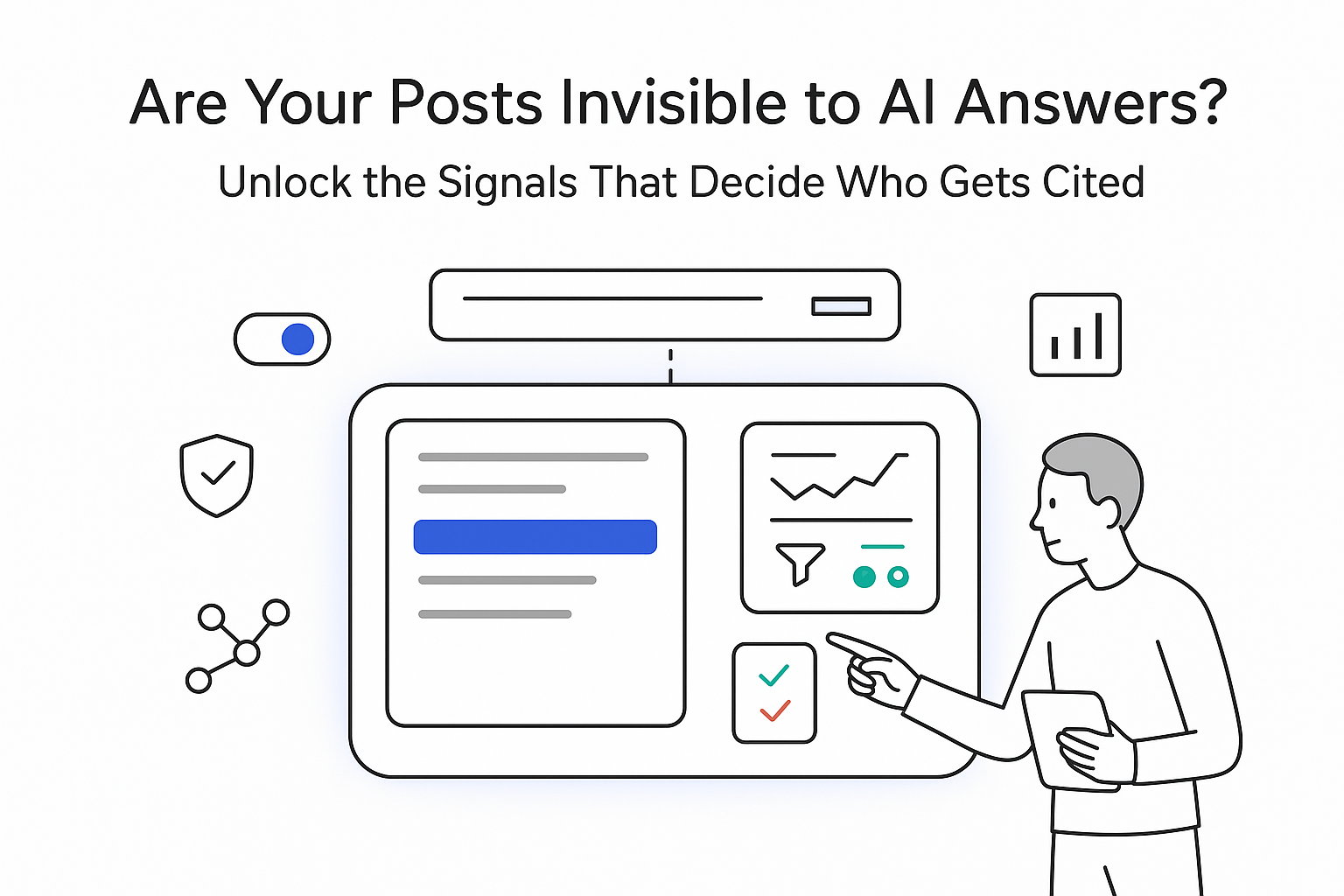
LinkedIn's internal tests indicate that AI search visibility is strongly influenced by content structure, semantic markup, and visible expert signals, and that traditional traffic metrics now miss part of top-funnel reach.
AI search visibility: executive snapshot
LinkedIn's marketing and organic growth teams ran internal experiments to understand how their content appears inside AI-generated answers (for example, LLM results and AI Overviews) and then adjusted both content and measurement based on those findings. [S1][S2]
- LinkedIn identified three primary on-page factors affecting AI visibility: logical headings, clear information hierarchy, and semantic HTML markup ("AI readability"). [S1][S2]
- They highlighted at least two key credibility signals that LLMs appear to favor: named expert authors with visible credentials and clear timestamps. Anonymous or undated content performed worse. [S1][S2]
- LinkedIn began tracking new AI visibility KPIs - including citation share, visibility rate, and LLM mentions - instead of relying on traffic alone for awareness content. [S1][S2]
- They added a separate traffic source classification for LLM-driven visits and started monitoring LLM bot activity in CMS logs. [S1][S2]
- Perplexity AI confirmed that its system retrieves content at the sub-document level, pulling fragments rather than full pages, which increases the importance of section-level structure. [S3]
For marketers, visibility inside AI answers now depends on machine-readable structure and credibility signals, and requires new KPIs beyond sessions and clicks.
AI-led content discovery research method and source notes
In a blog post on the LinkedIn Marketing Blog, Inna Meklin (Director of Digital Marketing) and Cassie Dell (Group Manager, Organic Growth) described internal testing by LinkedIn's marketing and organic growth teams. [S1] These findings were then summarized and contextualized by Search Engine Journal (SEJ) in February 2026. [S2]
What was measured:
- How LinkedIn content appeared in AI-generated search results and AI Overviews across major platforms. [S1][S2]
- The impact of changes in:
- Page structure (headings, hierarchy)
- Semantic HTML markup
- Author signals (named experts, credentials)
- Timestamps and style (conversational, insight-led text) [S1][S2]
- New visibility metrics - citation share, visibility rate, and LLM mentions - plus traffic from LLM-powered systems. [S1][S2]
Method (as described publicly):
- Internal experiments and ongoing optimization of LinkedIn's own marketing content based on observed performance in AI answers.
- Use of third-party AI visibility tools to monitor citations and mentions in LLM outputs. [S1][S2]
- Log and analytics analysis to identify LLM-driven visits and bot activity. [S1][S2]
Key limitations:
- No disclosed sample size, experimental design details, or quantitative lift figures.
- Results reflect LinkedIn's own content profile (authoritative B2B brand) and may not generalize directly to smaller sites.
- "Impact on the bottom line" from LLM visibility remains unquantified by LinkedIn's own admission. [S1][S2]
AI search visibility findings on content structure, markup, and author signals
LinkedIn and Perplexity each described how content is processed and cited by AI systems. Together, they outline a consistent pattern of what helps content appear inside AI-generated answers. [S1][S2][S3]
Content structure and semantic HTML in AI-generated search results
Facts:
- LinkedIn reported that headings and information hierarchy affected whether LLMs could correctly parse and surface content segments. [S1][S2]
- The authors stated that "the more structured and logical your content is, the easier it is for LLMs to understand and surface." [S1]
- Semantic HTML markup (for example, correct use of heading tags, sections, lists) contributed to what LinkedIn called "AI readability" - LLMs could more reliably interpret the purpose of each section. [S1][S2]
- Perplexity AI explained that it retrieves information at the sub-document level, pulling granular fragments rather than reasoning over an entire page at once. [S3]
- This fragment-based retrieval means that clearly segmented sections - with explicit headings and scoped paragraphs - are more likely to be extracted and cited. [S3]
Interpretation (Likely):
- Section-level clarity is now a core technical SEO requirement for AI search. Pages that are long but weakly structured risk being partially or completely ignored by LLMs.
- Semantic HTML is no longer only a usability and accessibility concern; it functions as a machine guidance system that increases a page's chances of being used as a source.
Author expertise, timestamps, and credibility in AI answers
Facts:
- LinkedIn's tests indicated that LLMs favor content that signals credibility and relevance, especially when it is:
- Authored by identifiable experts
- Supported by visible credentials or expertise indicators
- Clearly time-stamped [S1][S2]
- Anonymous material and pages without dates appeared to perform worse in LinkedIn's experiments, though no quantitative gap was disclosed. [S1][S2]
- The LinkedIn team described effective content as "conversational, insight-driven" rather than generic or purely keyword-focused. [S1]
Interpretation (Likely):
- E-E-A-T-style signals (experience, expertise, author identity, recency) used in classic search ranking appear to carry over into LLM citation behavior.
- Content that reads like an opinion-less brochure or generic rewrite is less likely to be chosen as a supporting fragment than material linked to a named, accountable expert.
- For topics where freshness matters, lack of a visible date is likely to reduce the odds of being surfaced by AI systems that aim to avoid outdated guidance.
Measurement shifts: citations, LLM mentions, and traffic sources
Facts:
- LinkedIn added new KPIs for awareness-oriented content, tracked via AI visibility tools:
- Citation share - how often LinkedIn's content is cited relative to other sources.
- Visibility rate - how often LinkedIn appears in AI answers for target topics.
- LLM mentions - references to LinkedIn content or brand within AI responses. [S1][S2]
- They also:
- Created a new traffic source classification in internal analytics for LLM-driven visits.
- Monitored LLM bot behavior in CMS logs, treating these crawls as a distinct activity pattern. [S1][S2]
- The team acknowledged a key measurement challenge: they could not yet quantify how LLM visibility affects revenue or conversions. [S1][S2]
- LinkedIn stated they are moving from a "search, click, website" model toward: "Be seen, be mentioned, be considered, be chosen." [S1][S2]
Interpretation (Tentative):
- For top-funnel informational content, classic KPIs such as organic sessions are becoming incomplete, because a growing share of consumption happens inside AI answers without a click.
- Brand and content teams will likely need dashboards that combine:
- LLM citations and mentions
- Traditional search visibility
- On-site engagement and pipeline metrics
- LLM-driven traffic may be small in absolute terms now, but its share will likely grow as AI answers become the default experience on more platforms.
Interpretation & implications for SEO and content strategy
Likely - Content structure as a ranking and citation filter
- Treat clear heading hierarchies, semantic HTML, and tightly scoped sections as prerequisites for AI visibility, not optional polish. [S1][S2][S3]
- Break long articles into clearly labeled segments that each answer a distinct question or subtopic; assume LLMs will lift those pieces in isolation. [S3]
Likely - Author and recency signals as credibility filters
- Use named authors with visible expertise for most informational content. Include concise bios near the article or on an author page. [S1][S2]
- Always display a publication date, and for time-sensitive topics, a last-updated date. Undated evergreen content is at a disadvantage for AI selection. [S1][S2]
Likely - New KPIs for awareness and category reach
- For thought leadership, track:
- Share of citations and visibility rate in AI answers (via AI visibility tools)
- Brand mentions in AI systems as a proxy for awareness [S1][S2]
- Retain traffic and conversions as core metrics, but treat them as partial signals of reach where AI answers resolve the user's need without a click.
Tentative - Content style and answer blocks
- A conversational, insight-led tone - with clear definitions, short answer blocks, and explicit takeaways - likely increases the chance that LLMs select those paragraphs as ready-made answer snippets. [S1]
- Consider structuring pages so that each major section begins with a concise "answer paragraph," followed by supporting detail, similar to how content is optimized for featured snippets.
Speculative - Category strategy and brand positioning
- As AI systems compress results into a small set of cited authorities, markets may consolidate around a limited number of go-to sources per topic.
- For brands aiming to be that source, early investment in AI-readable content and measurement could create a durable advantage, but the magnitude of this effect is still unknown. [S1][S2][S3]
Contradictions, gaps, and open questions on AI visibility
Evidence gaps:
- No quantified uplift - LinkedIn did not publish metrics such as "X% increase in citations after re-structuring pages," so the size of the effect is unknown. [S1][S2]
- Limited generalizability - LinkedIn is already a trusted authority in professional content. A smaller or newer brand may see weaker or different results from similar changes.
- Revenue impact not measured - LinkedIn explicitly stated they could not connect LLM visibility to revenue outcomes. [S1][S2]
Contradictions or uncertainties:
- Relative weight of signals - The data does not clarify whether structure, author identity, or recency has the largest influence on LLM citation likelihood.
- Role of backlinks and classic SEO - Neither the LinkedIn post nor the Perplexity interview gave concrete evidence on how traditional ranking factors (links, domain authority, schema types) translate to LLM selection. [S1][S2][S3]
- Platform-specific behavior - Perplexity's fragment-based retrieval is documented, but other platforms (for example, Google's AI Overviews, Microsoft Copilot) may use different retrieval and ranking logic that is not fully disclosed. [S3]
Strategic risk areas:
- Over-optimizing for AI answers without tracking lead and revenue performance could push teams toward visibility that does not pay off commercially.
- Treating AI visibility tools as precise measurement rather than directional indicators may lead to false confidence, given that LLM behavior can change rapidly with model updates and prompt adjustments.
Data appendix: LinkedIn AI visibility metrics and observed factors
Summary of AI visibility-related elements reported by LinkedIn and Perplexity:
| Category | Element | Source |
|---|---|---|
| Structural factors | Logical heading hierarchy | [S1][S2] |
| Structural factors | Clear information sections | [S1][S2] |
| Structural factors | Semantic HTML markup (correct tags) | [S1][S2] |
| Retrieval behavior | Sub-document / fragment retrieval | [S3] |
| Credibility signals | Named expert authors | [S1][S2] |
| Credibility signals | Visible credentials / expertise | [S1][S2] |
| Credibility signals | Clear timestamps | [S1][S2] |
| Content style | Conversational, insight-led writing | [S1] |
| AI visibility KPIs | Citation share | [S1][S2] |
| AI visibility KPIs | Visibility rate in AI answers | [S1][S2] |
| AI visibility KPIs | LLM mentions of brand/content | [S1][S2] |
| Analytics adjustments | Separate LLM-driven traffic source | [S1][S2] |
| Analytics adjustments | Monitoring LLM bot behavior in logs | [S1][S2] |
Sources
- [S1] LinkedIn Marketing Blog - "How LinkedIn Marketing is Adapting to AI-led Discovery" (Inna Meklin, Cassie Dell).
- [S2] Search Engine Journal - "LinkedIn Shares What Works For AI Search Visibility" by Matt G. Southern.
- [S3] Search Engine Journal - "Perplexity AI Interview Explains How AI Search Works" by Roger Montti (interview with Jesse Dwyer).




.svg)

.svg)
.svg)