

I often hear root cause analysis described as something built for engineers in a late-night incident room. I do not see it that way. For a B2B service company, it is often the clearest way to explain why qualified leads fell, why close rates slipped, or why client work keeps missing the promised date. When I stop guessing and trace a problem back to its source, decisions get calmer, spend gets smarter, and the same fire stops showing up every month.
In this guide, I keep root cause analysis practical. No jargon for its own sake. No theory added just to sound rigorous. Just a clear way to find what is really causing waste, delays, weak lead flow, missed revenue, and team friction across marketing, sales, onboarding, and service delivery.
Root Cause Analysis Definition
I use a simple definition: root cause analysis is a method for finding the deepest reason a problem keeps happening so I can fix the source, not just the visible mess.
That sounds obvious. In practice, it rarely is.
Most teams blur three different things:
- Symptom: what I can see
- Cause: what directly triggered the symptom
- Root cause: the deeper condition that allowed the cause to happen again and again
A plain business example makes the difference clearer.
A firm sees a drop in qualified leads. That is the symptom. A quick check shows that leads from one service page are no longer reaching the CRM. That is a cause. But the root cause may be broader: a routing rule was changed, no one owned lead-flow checks, and there was no alert when form submissions failed.
The problem was not weak demand. It was a broken system. That distinction is why root cause analysis matters in business. It helps me separate noise from signal and keeps a team from spending time on the wrong fix. Without that discipline, people blame the market, the team, or bad luck. Sometimes those factors matter. Often, they are only the surface story.
Why Root Cause Analysis Is Important
If I strip it down, root cause analysis matters because repeated problems are expensive. They drain margin, slow growth, and make planning feel less stable than the revenue report suggests. In B2B service companies, I usually see the same patterns show up again and again:
- revenue leakage from lost leads or weak handoffs
- lower lead quality after positioning drifts
- delivery delays caused by messy intake
- churn that starts with a poor first month
- wasted spend because tracking broke
- constant firefighting that keeps senior people trapped in small problems
At first glance, root cause analysis can feel slower than fixing the obvious issue and moving on. In my experience, it usually saves time because it stops the same problem from coming back under a slightly different name. A team that keeps patching symptoms may feel busy, but that is not the same as moving forward.
The benefits show up where leaders actually care: cleaner pipeline data, faster response times, stronger close rates, smoother delivery, less client friction, and fewer expensive surprises. It also improves accountability. I draw a sharp line between accountability and blame. Blame hunts for a person. Root cause analysis looks for the condition that made the mistake easy to repeat.
There is a quieter benefit too. When decisions are tied to evidence, teams trust them more. That lowers politics, cuts noise, and gives leaders a steadier footing when the month is already heavy.
How to Conduct Root Cause Analysis
When I conduct root cause analysis, I keep the process simple. A four-part flow is usually enough. To make it concrete, I will use one running example: a B2B service company sees a 30 percent drop in booked discovery calls from organic traffic.
Define the problem and set a baseline
My first move is not to guess. It is to define the problem clearly. Instead of saying, “Organic is down,” I would say, “Booked discovery calls from organic traffic fell from 42 per month to 29 over the last six weeks, while traffic stayed mostly flat.” That wording matters because vague problems produce vague answers.
From there, I set a baseline for the metrics that actually shape the issue. In this case, I would check sessions, form starts, form completions, call bookings, lead-to-meeting rate, and response time after submission. If a team is unclear on what should be measured in the first place, B2B measurement design: turning business questions into tracking requirements is the right starting discipline.
Gather data and isolate likely causes
Next, I pull evidence from several places. That usually means analytics, search performance, CRM records, call-booking data, page changes, routing rules, and sales feedback. I am looking for patterns, gaps, and changes that happened around the same time.
Maybe traffic is flat and rankings are stable, but form submissions dropped hard on mobile. Maybe submissions look normal, but only half are entering the CRM. Maybe meetings are down not because lead volume fell, but because response times doubled after a handoff change. If the underlying records are messy, the investigation will drift, which is why Data hygiene for B2B: how bad data breaks optimization matters more than most teams expect.
Determine the root cause
Once I have the strongest explanations, I test them. I keep asking what had to be true for the symptom to happen.
In this example, imagine I find three facts. First, a form update broke one hidden field on mobile. Second, leads from one service line were routed to an inactive owner. Third, there was no weekly check on form-to-CRM flow. The broken field and routing issue are direct causes. The root cause sits deeper: there was no reliable process for change review or failure alerts. That is what allowed the problem to sit there and keep hurting lead flow. In practice, that kind of weakness often overlaps with Content governance for B2B teams: roles, reviews, and version control, even when the failure first appears inside a form or CRM.
Implement the fix and verify the result
At that point, I fix the source, not just the symptom. I would repair the form, correct the routing, add a weekly audit, and create an alert when submissions fail or go unassigned. I would also document who owns each check and when it is reviewed.
Then I watch the same baseline metrics over the next few weeks. If results improve, good. If not, the first answer was only part of the picture. That last step matters. Root cause analysis is not a magic trick. Sometimes there is one root cause. Sometimes there are several. I am not looking for the neatest story. I am looking for the truest one.
The 6Ms Framework
When I need to widen the search without turning the exercise into chaos, I use the 6Ms framework. It is often shown as a fishbone diagram, and it works because it forces a team to look beyond the first easy answer. Many versions use Mother Nature as the sixth M. For service companies, I usually swap that for Market.
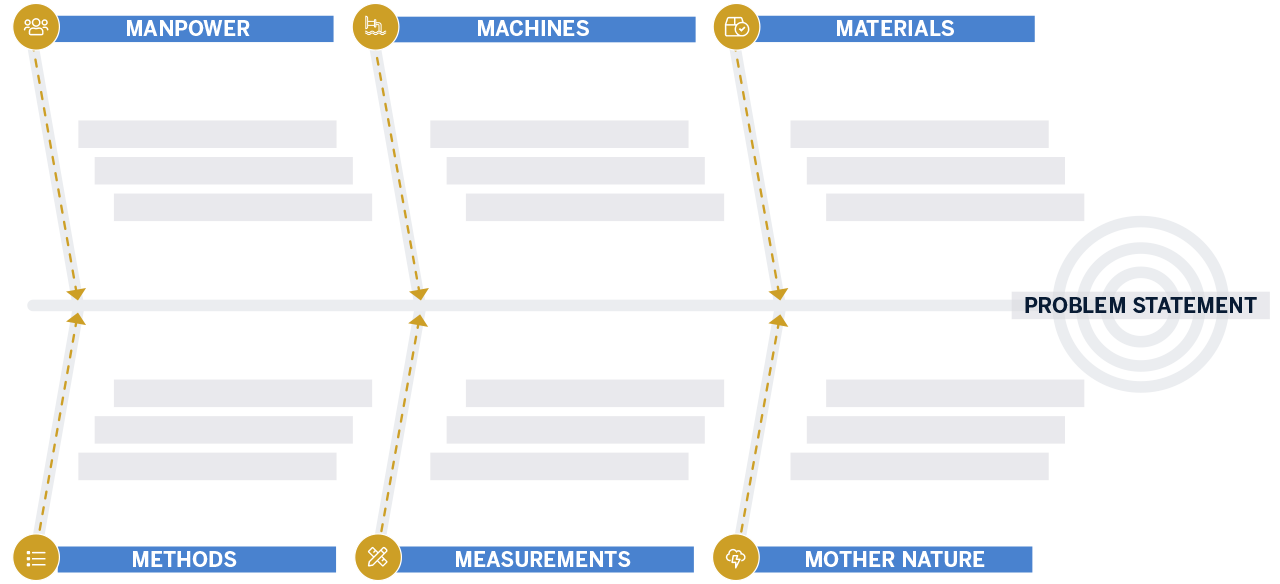
M | What I look for |
|---|---|
Manpower | skills, staffing, training, role clarity, handoffs, manager load |
Methods | SOPs, approval paths, sales process, onboarding flow, QA steps |
Machines | CRM setup, analytics, call routing, automation, project systems |
Materials | briefs, proposals, client inputs, messaging, templates, data quality |
Measurement | KPIs, attribution logic, lead scoring, reporting, review cadence |
Market | seasonality, budget freezes, policy shifts, local events, changes in how search results are displayed |
This framework is useful because many business problems are not caused by one thing in one place. A drop in close rate may look like a sales issue, but the real problem might sit in methods and materials. The proposal may overpromise. The handoff from marketing may create bad fit from the start. Or measurement may be broken, so sales is being judged on deals that were never qualified in the first place.
In a team session, I write the problem clearly, ask each function to add possible causes under the six categories, and label each item as proven, possible, or guessed. Only after that do I test the strongest explanations. In my experience, that sequence keeps the room more honest and reduces the usual finger-pointing.
Root Cause Analysis Methods
Different methods fit different problems. Some are fast and simple. Others are worth using when the cost of failure is high or the issue keeps returning.
Method | Best use case | Data needed | Speed | Limitation |
|---|---|---|---|---|
5 Whys | A clear issue with a short chain of causes, such as slow lead follow-up | Low to medium | Fast | Gets shallow if people guess instead of verify |
Pareto chart | Many repeated issues, such as reasons deals are lost or projects get delayed | Medium to high | Medium | Needs clean categories and enough volume |
Scatter plot | Testing whether two variables move together, such as response time and close rate | Medium to high | Medium | Correlation does not prove cause |
Fishbone diagram | Early-stage team brainstorming across many possible causes | Low at first, then medium | Fast to medium | Fills up with opinions if the process stops too early |
FMEA | Finding where a process could fail before it does, such as a new onboarding flow | Medium to high | Slower | Requires more effort and team time |
I reach for the 5 Whys when the issue is narrow and recent. I use a Pareto chart when I need to find the few causes driving most of the damage. A scatter plot is useful when leaders are leaning too hard on gut feel and I want to see whether two variables actually move together. A fishbone diagram helps early because it keeps the team from narrowing too fast. FMEA is the most formal of the group, but it is valuable when I want to pressure-test a process before clients feel the failure.
Root Cause Analysis Tools
Good tools support thinking. They do not replace it.
That sounds simple, yet it is easy to forget once a team is staring at dashboards. A CRM cannot judge context. An analytics platform cannot tell me why a buyer hesitated on a call. Even pattern-finding systems are only as good as the assumptions and inputs behind them.
For most B2B service companies, the core toolkit is fairly plain: CRM data for source, owner, stage movement, and response time; analytics for traffic, landing-page shifts, and form behavior; call notes or recordings for how prospects react; client feedback for what dashboards miss; and process maps or SOPs for where work actually breaks.
In more technical environments, teams may connect sources through integrations, use systems that map service dependencies, and keep evidence, owners, and next steps in shared case management. Those tools do not make the judgment call for me, but they can make recurring failures easier to trace across platforms.
The sharpest analysis usually comes from combining hard numbers with human evidence. If close rate falls, I do not stop at the dashboard. I want to hear lost-deal calls, read proposal comments, check response time by owner, and review what changed in pricing, scope, or positioning. That mix is where root cause analysis becomes genuinely useful.
Common Mistakes in Root Cause Analysis
The biggest mistakes in root cause analysis are usually not technical. They are human. People rush, defend their turf, or grab the first answer that feels tidy.
Trap | Do | Avoid |
|---|---|---|
Confusing symptom with cause | Name the visible issue first, then ask what created it | Treating the first visible problem as the root cause |
Stopping at the first answer | Ask what had to be true for that answer to happen | Ending the process because the room feels relieved |
Blaming people instead of systems | Check process, tools, handoffs, and incentives | Treating one employee mistake as the whole story |
Using too little data | Pull numbers, recordings, documents, and timeline changes | Deciding from one dashboard or one opinion |
Skipping other teams | Include people from each affected part of the process | Letting one department tell the entire story |
Jumping to solutions | Test the suspected cause first | Fixing fast before you know what broke |
Failing to verify the fix | Watch the baseline metrics after the change | Assuming silence means the issue is gone |
One more mistake deserves attention: searching for only one root cause. Sometimes there is one. Often there is a stack. A weak lead-flow problem may involve measurement, methods, and machines at the same time. If that is what the evidence shows, I would rather name the messy truth than force a clean but incomplete answer.
Tips for Root Cause Analysis
When I want root cause analysis to stay useful, especially under time pressure, I come back to a few habits:
- Define the problem in measurable terms. Counts, dates, stages, and percentages make the investigation sharper.
- Start with repeated issues. One-off problems matter, but recurring issues usually hide the biggest waste. That is also why The hidden cost of busy work metrics in B2B marketing is worth remembering - activity can look healthy while the real failure keeps compounding.
- Bring in the people closest to the work. Frontline insight often reveals where the process actually breaks.
- Quantify the cost. Tie the issue to missed meetings, delayed cash, churn risk, or lost hours.
- Test the suspected cause. A theory is not a fact just because it sounds plausible.
- Assign one owner and one review date. Shared concern is useful, but clear ownership is what gets follow-through.
If I had to reduce it to one rule, it would be this: if the answer cannot be tested, it is not strong enough yet. And in many cases, I do not need a long workshop to get there. A short review with the right data and the right people is often enough.
Root Cause Analysis Examples
The best examples feel familiar because they show how easily a plausible story can distract a company from the real issue.
Example 1: Drop in organic leads
Organic traffic stays steady, but qualified form fills fall by 28 percent. The first assumption is that search demand weakened or SEO stopped working. After review, the real problem turns out to be more operational: a form update broke one field on mobile, and a CRM routing rule sent some valid leads to an inactive owner. No alert flagged the failure. The right response is not a new traffic campaign. It is fixing the form, repairing routing, and adding checks that prevent the same failure from lingering.
Example 2: Lower close rate on sales calls
Call volume holds steady, but close rate drops from 31 percent to 19 percent. The quick explanation is that the sales team got worse at handling objections. The deeper issue often starts earlier in the journey. In this case, marketing messaging shifted toward fast results and broad fit, which brought in more low-fit prospects. Sales spent calls resetting expectations instead of moving deals forward. That kind of breakdown often overlaps with Service-line clarity in B2B: preventing internal confusion from reaching SERPs. The corrective action is to tighten qualification, refine the promise on key pages, update call language, and track fit by service line.
Example 3: Project delays and rising churn
Delivery dates keep slipping, and churn inside the first 90 days rises. The surface-level story says project managers need to push clients harder. The root cause sits in the setup: projects started without full kickoff inputs, scope was not locked before work began, and clients were never given a clear deadline policy for assets and approvals. The effective fix is to tighten intake standards, set scope gates before work starts, and make client responsibilities explicit from the beginning.
The pattern is consistent in all three examples. The first explanation sounded reasonable. It just was not deep enough. That is the real value of root cause analysis: it protects me from expensive stories that feel right but are wrong.
Root Cause Analysis Resources
I do not think a company needs a heavy resource library to do this well. What matters more is a short written record of each analysis: the problem, its business impact, the evidence reviewed, the confirmed cause, the actions taken, the owner, and the date I will check whether the fix worked. That kind of documentation keeps root cause analysis from turning into a one-meeting exercise that no one revisits.
Used well, root cause analysis is not a stiff corporate ritual. It is a practical way to cut through noise, protect margin, and fix recurring problems at the source. When a company gets good at it, I see fewer reactive decisions, fewer repeated mistakes, and far less chaos disguised as urgency.
 What B2B Competitors Know About Leads That You Don't
.svg)
