
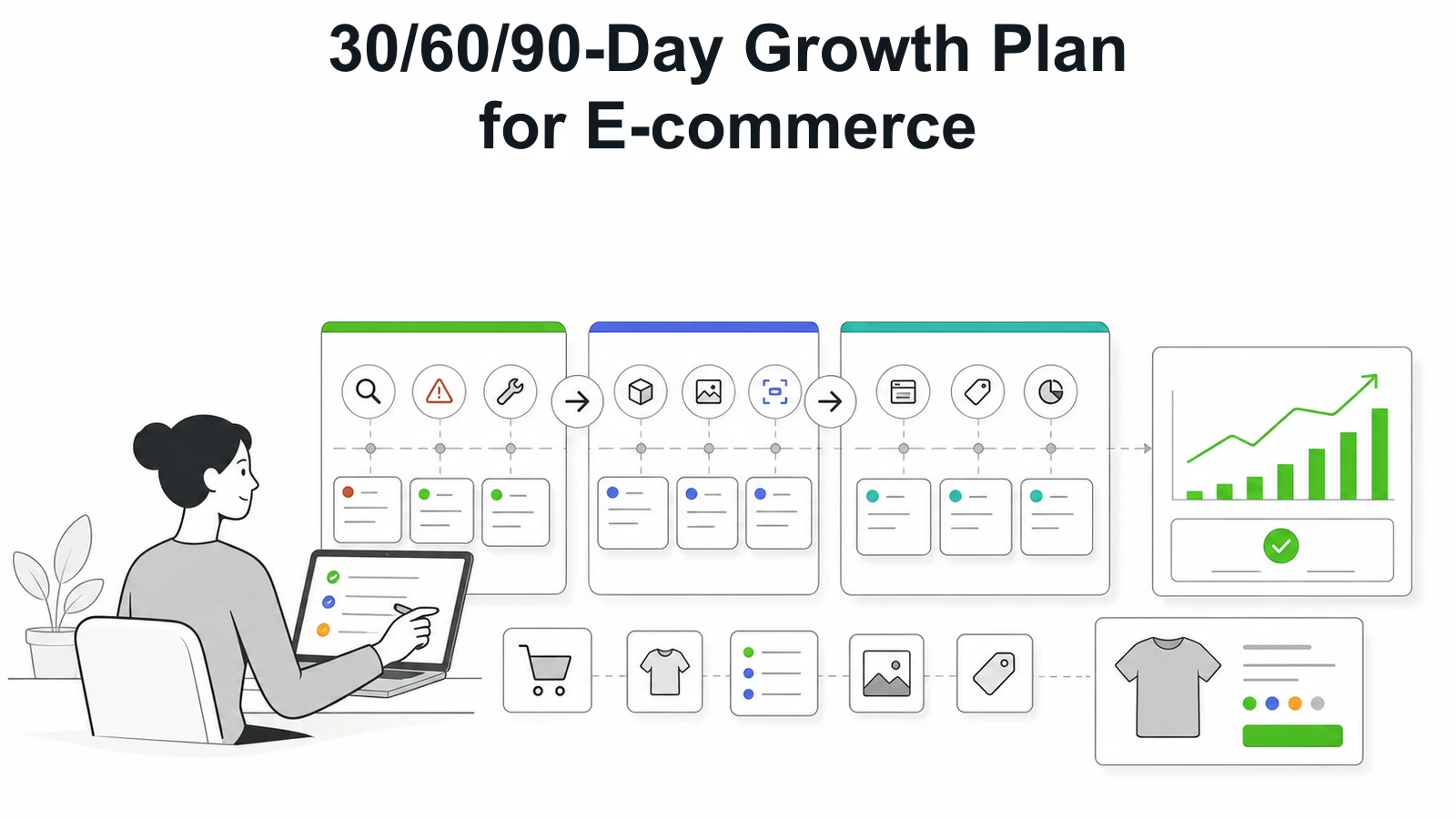
A useful 30/60/90-day growth plan does not start with a list of tactics. It starts with the current constraint.
For e-commerce, that usually means checking whether tracking, margin, paid spend, SEO demand, product feed quality, conversion paths, and retention signals can support the next level of spend or effort.
Days 1 to 30: make the numbers usable
The first month should establish the operating baseline. Clean up conversion tracking, product economics, channel reporting, feed issues, search terms, landing page performance, and the difference between new and returning customer behavior.
This phase should also identify immediate leakage repairs so the team stops obvious waste before adding more budget.
- Confirm primary conversion events and revenue accuracy.
- Map margin by product, category, and discount pattern where possible.
- Review Google Ads spend by query, product, audience, and campaign role.
- Find organic pages that get traffic without a useful commercial path.
- List CRO blockers on the highest-intent product, collection, and checkout paths.
Days 31 to 60: run focused growth tests
The second month should turn diagnosis into controlled tests. That may include search campaign restructuring, product feed improvements, landing page changes, offer tests, internal linking, collection page upgrades, or high-intent SEO content.
Keep the tests narrow enough that the team can learn. A broad campaign reset plus a full-site redesign plus a content push usually creates confusion instead of signal.
Days 61 to 90: scale the parts that held
The final month should move budget and effort toward the combinations that held margin, conversion quality, and operational capacity. That can mean increasing spend on specific product groups, expanding search demand, improving proven landing pages, or building supporting SEO and AI visibility assets.
This is also the moment to decide what not to scale. If a test produced volume without contribution profit or buyer quality, it should not become the next default plan.
The plan should stay editable
A 90-day plan is not a promise that every idea will survive. It is a decision system. Each month should produce cleaner evidence, fewer leaks, and a sharper view of what deserves the next investment.
Set the baseline before naming the tactics
A 30/60/90-day plan should begin with the numbers that decide whether growth is healthy. For e-commerce, that means revenue, contribution margin, MER, platform ROAS, new customer revenue, returning customer revenue, average order value, refund or return patterns, product availability, and conversion rate by page type and device.
The first version can be simple. The team needs a baseline good enough to avoid bad decisions. If product margin is missing, use the best available category view and mark confidence. If new versus returning customer data is incomplete, note the gap and avoid treating blended ROAS as an acquisition metric. If tracking is unreliable, put repair inside the first 30 days.
The baseline should also include operating constraints. A product may sell well but have limited stock. A category may look strong but require heavy discounting. A landing page may convert on desktop and fail on mobile. A growth plan that ignores these constraints can create more pressure without creating better profit.
Days 1 to 30: diagnose and remove avoidable waste
The first month should produce fewer leaks and clearer decisions. Review conversion tracking, campaign roles, product feed quality, search terms, landing pages, collection pages, checkout friction, SEO page paths, email capture, and retention signals. Put every finding into impact, effort, confidence, and owner.
Paid media cleanup often belongs here. Separate brand from non-brand where needed. Review Performance Max or Shopping spend by product group. Exclude or isolate products that cannot support acquisition. Fix conversion actions that reward soft events. Make sure budget is not being consumed by queries, placements, or products that have little chance of profitable revenue.
SEO cleanup can also start in month one, especially if existing pages have obvious commercial gaps. Improve internal links from traffic pages to revenue pages. Strengthen collection and product copy where intent is already present. Fix indexation or canonical problems that hide important pages.
Days 31 to 60: run tests that can change the next decision
The second month should not turn into scattered experimentation. Choose tests that answer a decision. If the question is whether non-brand search can scale, test a tighter query group and landing page. If the question is whether a category deserves SEO investment, improve the category page and internal links, then watch search demand and conversion behavior. If the question is whether CRO is the bottleneck, test the highest-intent page with enough traffic to learn.
Each test should have a decision metric and a stop rule. A landing page test may use conversion rate, revenue per session, or qualified lead rate. A paid media test may use contribution margin, new customer share, search term quality, or MER movement. An SEO test may use indexation, rankings, traffic quality, assisted conversions, or product revenue from the improved page group.
Document what changed. Many 90-day plans fail because everyone remembers the conclusion and forgets the implementation detail. Without the detail, the team cannot repeat the win or diagnose the miss.
Days 61 to 90: scale only the parts that can carry it
The third month should move budget, content, and development effort toward the combinations that held up. Scale the product groups, query classes, landing pages, offers, and SEO paths that produced cleaner economics. Keep weak tests contained until the constraint is understood.
This is also where the plan should connect acquisition with retention. If paid media finds new customers at an acceptable contribution level, email, lifecycle, and repeat purchase paths should help improve payback. If SEO brings useful non-brand demand, product and category pages should support the next step rather than leaving visitors in research mode.
End the 90 days with a new bottleneck map. The first constraint may have moved. Tracking may now be usable, paid media may have clearer economics, or CRO may have revealed that the offer needs work. The next 90-day plan should be built from the evidence earned during this one.
A strong 90-day review should also record what was not scaled. If a category, campaign, page, or offer failed the test, keep the reason visible. That prevents the same idea from returning later as a fresh initiative without new evidence. The plan gets stronger when misses become reusable constraints instead of forgotten experiments, especially when a new quarter brings new budget pressure and the same backlog starts to look attractive again.
.svg)
