
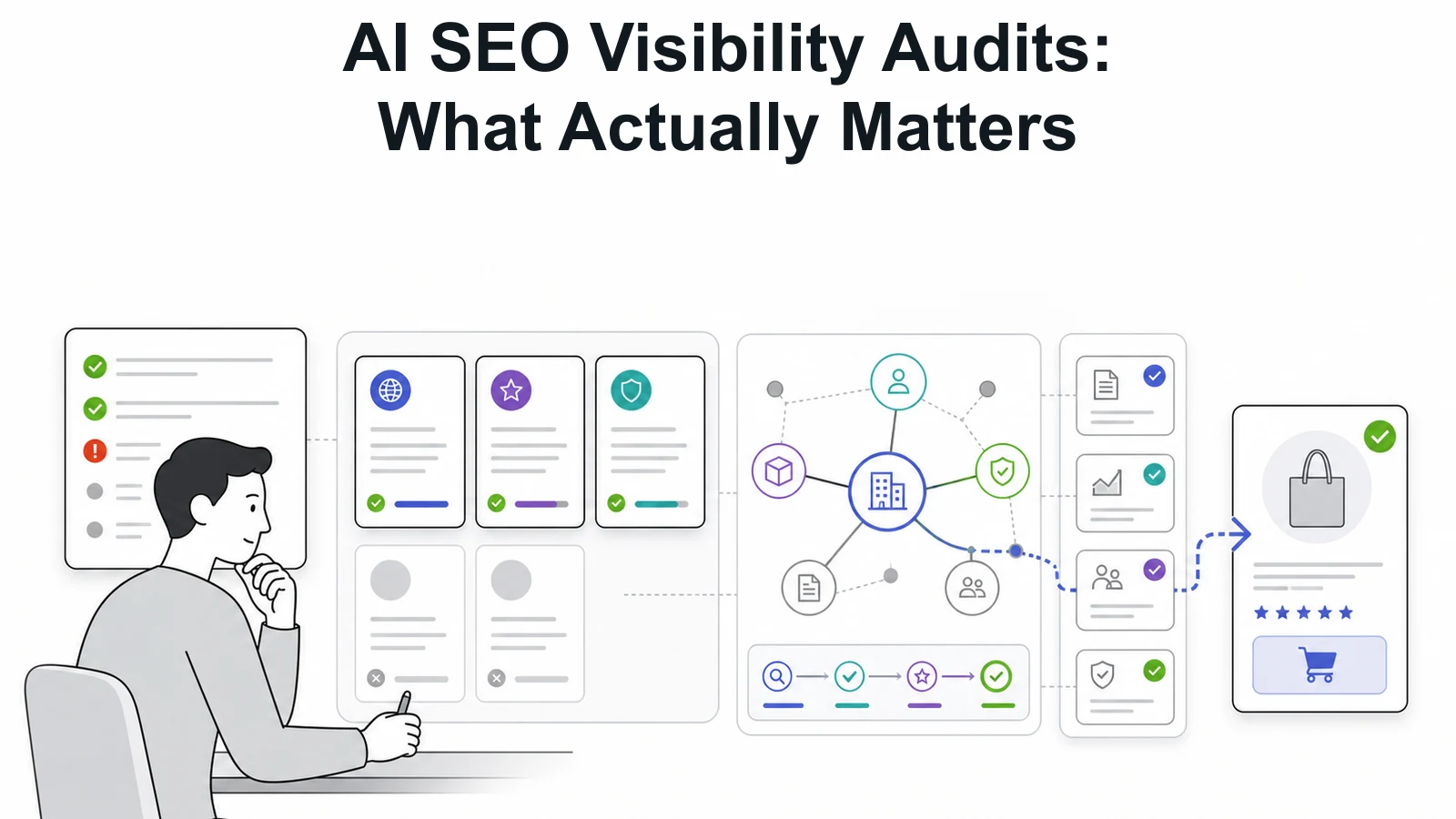
An AI SEO visibility audit should not be a screenshot collection of prompts. Screenshots can be useful evidence, but they are not the strategy or the success metric.
The real question is whether AI-assisted search and answer surfaces can understand, trust, cite, and connect the brand to the buying questions that matter.
Start with crawlable source material
AI visibility still depends on accessible, coherent source material. If important pages are thin, blocked, duplicated, stale, slow, or disconnected from the rest of the site, the brand gives answer systems less useful material to work with.
- Can key pages be crawled and indexed?
- Do service, product, category, comparison, and proof pages explain the same offer clearly?
- Are claims supported by evidence on pages that can be found?
- Are author, company, service, and case-study entities clear across the site?
Audit questions, not vanity prompts
A useful prompt set mirrors the buyer journey. It should include problem discovery, solution comparison, vendor shortlisting, implementation risk, pricing context, alternatives, and proof questions.
The audit should record whether the brand appears, which sources are used, what competitors or publishers are cited, and what page gaps explain the result.
Proof matters more than volume
Publishing more generic answers rarely solves AI visibility by itself. Buyers and answer systems need specific proof: examples, constraints, process detail, public case studies, source-backed claims, and clear fit criteria.
If competitors have clearer proof pages, stronger comparison coverage, or more quotable explanations, they may become easier sources even when the core service is similar.
Measure influence carefully
AI visibility can affect the buyer before a website click. That makes pure session reporting incomplete. Watch branded search movement, direct traffic quality, assisted conversions, sales-call language, lead source notes, and changes in high-intent landing page behavior.
The audit should make the brand a credible source for the questions that shape purchase decisions instead of chasing every AI mention.
Build the audit around buyer questions
AI SEO visibility becomes useful when it is tied to the questions that shape a buying decision. A random prompt set can make the audit look busy while missing the moments that matter. The prompt list should cover problem discovery, solution comparison, vendor evaluation, pricing concerns, implementation risk, alternatives, and proof.
For each question, record more than whether the brand appears. Record what answer was given, which sources were cited or echoed, what competitors or publishers showed up, what page would have been the right source, and what gap on the site explains the result. That turns prompt checks into a roadmap instead of a scoreboard.
The strongest prompts usually sound like a buyer trying to reduce risk. They ask who is a good fit, what to check before hiring, how two options compare, what can go wrong, and what evidence should be trusted. A site that answers those questions clearly is more useful to both buyers and answer systems.
Check whether the site is a usable source
AI visibility is limited when the site itself is hard to use as a source. Important pages need clear headings, direct answers, consistent naming, crawlable copy, source-backed claims, and enough context for a passage to make sense when quoted outside the page.
Thin service pages are a common blocker. If a page only says that a team does SEO, Google Ads, CRO, or AI visibility, it gives answer systems little to cite. The page should explain the use case, constraints, process, proof, fit criteria, and related questions. The same applies to case studies. A case study that only names a result without the situation, sequence, and caveats is weaker source material.
Technical access also matters. Canonicals, robots rules, rendering, internal links, structured data, and page quality can all affect whether important material is discoverable. The audit should not treat prompt output as separate from basic crawl and indexability.
Review entity clarity across the site
A brand is easier to understand when its entities are consistent. The company name, founder name, services, locations, industries, case studies, authors, and social profiles should tell the same story. If the site uses several names for the same service or spreads proof across disconnected pages, answer systems have to work harder to connect the signals.
Entity clarity does not require stuffing schema everywhere. It requires stable naming, clear relationships, and pages that reinforce each other. A service page should link to relevant proof. A case study should link back to the service. Author and company information should be visible enough to support trust. Comparison pages should make the category and alternatives explicit.
The audit should flag where the site is unclear, not only where the brand is absent from AI answers. Absence is the symptom. Weak source material, inconsistent entities, and missing proof are often the cause.
Turn visibility findings into content and proof work
AI SEO work can easily turn into prompt monitoring without implementation. A useful audit ends with page-level changes. Some pages may need a clearer answer near the top. Some may need supporting examples, comparison sections, FAQ coverage, or better internal links. Some may need proof that explains the actual operating work instead of broad claims.
Prioritize the fixes by buyer value. If a missing answer affects vendor shortlisting, pricing trust, service comparison, or risk evaluation, it deserves attention before a broad informational page. If a prompt has low business relevance, it can stay in the backlog.
The audit should also define how progress will be checked. Prompt visibility can be part of the review, but it should be paired with branded search, direct traffic quality, assisted conversions, sales-call language, and changes in high-intent page behavior. The useful outcome is better buyer influence, not a larger screenshot folder.
The most useful output is a page queue with reasons. Each page should have a buyer question, a missing source element, a proposed edit, and a way to check whether the change improved visibility or buyer movement. That keeps the audit close to implementation and gives content, SEO, and leadership the same priority list for action now.
That queue should be revisited after edits ship. Some answer surfaces may react slowly or inconsistently, so the review should look for directional movement across several signals rather than one prompt screenshot. The durable question is whether the brand has become clearer, more quotable, and easier to connect to the buying problem.
.svg)
