
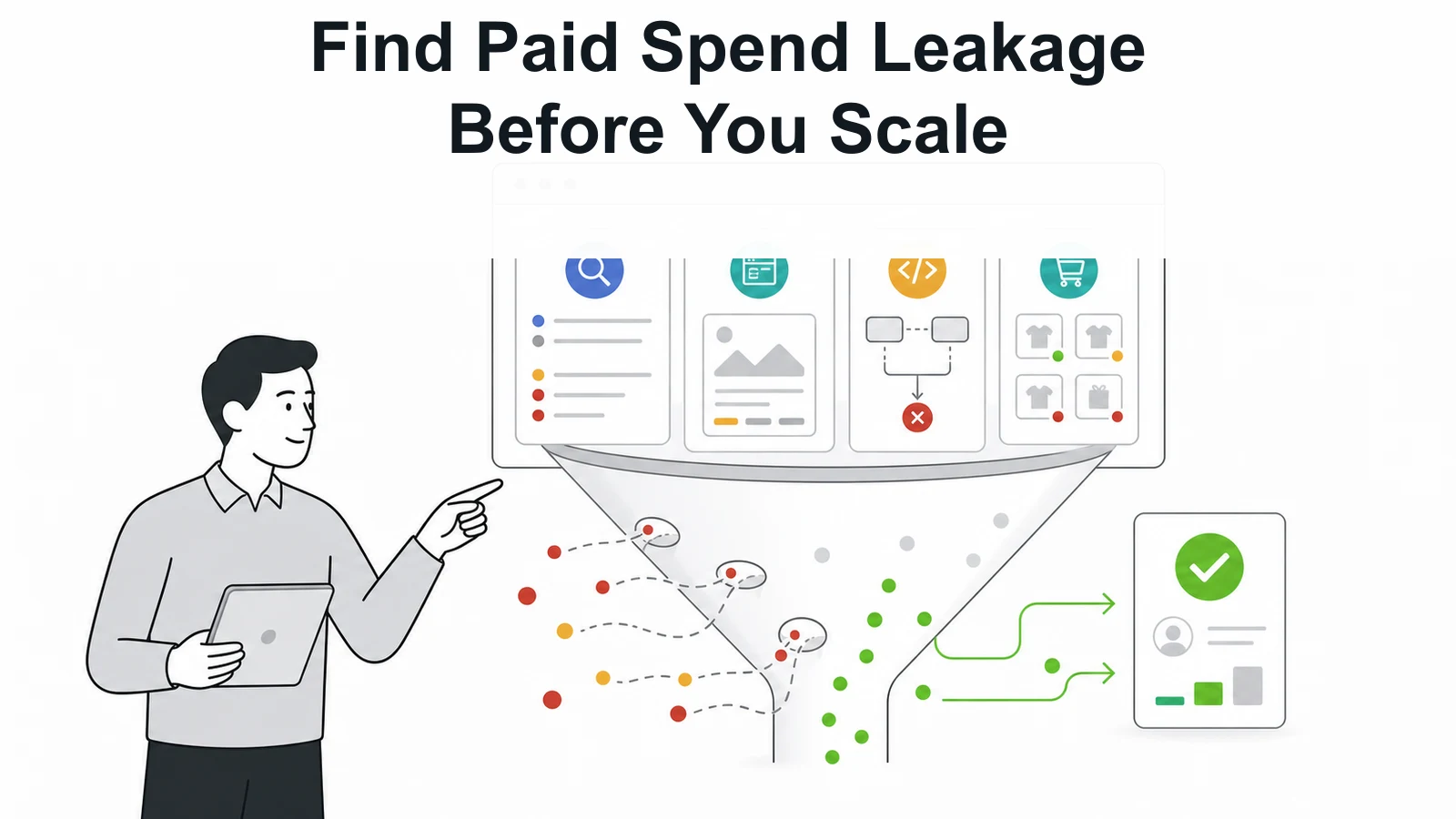
Paid spend leakage is budget that enters the ad platform but does not create useful commercial movement.
It can hide inside strong-looking averages. The account may still produce sales or leads, but a meaningful share of spend may be routed to weak intent, poor-fit users, low-margin products, duplicated audiences, or broken conversion signals.
Start with the intent path
The first check is whether spend reaches the right demand. In search, that means search terms, match types, negatives, product titles, feed attributes, and campaign segmentation. In social, that means creative promise, audience fit, and whether the click intent matches the landing page.
- Queries that are informational when the campaign expects buying intent.
- Competitor or support terms that do not convert into qualified revenue.
- Product groups that consume budget without margin or stock depth.
- Creative angles that attract clicks from people outside the real buyer set.
Then check the conversion path
A campaign can buy the right person and still leak value after the click. Slow pages, generic category pages, unclear offer logic, weak product detail pages, poor mobile checkout, and forms with too much friction can all turn expensive intent into low-quality performance.
Do not only compare conversion rate at the campaign level. Compare it by device, page type, query class, product margin, and new versus returning user where the data allows it.
Check measurement leakage
Spend decisions get worse when the tracking setup rewards the wrong action. A soft lead, page view, add-to-cart, unqualified call, duplicate purchase, or imported CRM stage can all distort bidding if it is treated like the main business outcome.
- Duplicate purchases or duplicated lead events.
- Primary conversions that are too soft for the current bidding goal.
- Offline conversion imports that miss rejected or low-quality leads.
- Consent, attribution, or CRM gaps that make one channel look cleaner than it is.
Turn findings into actions
A useful leakage review ends with budget movement, ownership, and a short testing order, not a long screenshot deck. Pause or isolate weak intent. Split high-margin products from low-margin products. Fix conversion actions. Move budget toward proven query, product, audience, and page combinations.
A leakage review should stop funding avoidable waste before asking the account to scale.
Read leakage by where the money goes
Spend leakage becomes easier to find when the account is read by destination. Where did the money go by campaign role, query class, product group, audience, placement, device, geography, and landing page? The answer usually shows several small leaks rather than one dramatic failure.
In Google Ads, search terms and product feed behavior deserve the first pass. Broad terms can attract research traffic when the campaign needs purchase intent. Shopping and Performance Max can route spend toward products that convert but cannot support the acquisition cost. Brand and non-brand traffic can blur together until the account looks more efficient than it really is.
In paid social, leakage often shows up through creative promise and post-click mismatch. A creative angle may earn cheap clicks from people who like the idea but do not match the real buyer. A landing page may continue the wrong promise. The platform can optimize toward engagement while the business waits for revenue that never follows.
Check the conversion signal before blaming the campaign
A campaign can look wasteful because the measurement layer is weak. It can also look strong for the same reason. Duplicate events, soft primary conversions, missing offline lead quality, imported revenue gaps, and mixed conversion actions can all move bidding in the wrong direction.
Review the conversion hierarchy before making big budget calls. Purchases, qualified leads, accepted sales opportunities, calls, add-to-cart events, form starts, and page views should not all carry the same meaning. If the platform is told that a soft action is the main outcome, it will look for more of that action.
For lead generation, the critical question is whether the ad platform sees the difference between a form fill and a useful sales conversation. For e-commerce, the question is whether revenue quality, refunds, margin, and new customer status are visible enough to guide spend.
Inspect the page that receives the click
Spend leakage can sit after the click. A high-intent query that lands on a generic page can underperform. A product page with unclear shipping, weak images, missing variants, or poor mobile usability can waste good traffic. A service page that asks for a call before explaining fit can lose buyers who needed one more layer of proof.
The review should connect campaign intent to page job. If the search term is comparison-led, the page should help compare. If the ad promises a specific product use case, the page should continue that use case. If the audience is cold, the page may need proof and fit criteria before a direct conversion ask.
This is why leakage analysis should include landing page conversion by traffic class. A page can perform well for returning users and poorly for non-brand acquisition. A blended conversion rate hides that difference.
Turn the leakage review into budget rules
A leakage audit should end with rules the account can use. Add negatives where query intent is consistently wrong. Separate brand, remarketing, and acquisition views. Split high-margin and low-margin products. Create campaign roles instead of forcing every campaign into the same ROAS target.
The team should also decide what evidence would justify more spend. That may be a clean search term mix, a minimum contribution margin, an improved landing page conversion rate, a stronger new customer share, or a CRM quality threshold. Budget should move when the account proves it can carry the next tier, not because the month is halfway over and spend is behind pace.
Keep a short leakage log after the first cleanup. If the same query type, product group, or page keeps wasting spend, the issue may be structural. That is the moment to change campaign architecture, feed rules, offer routing, or landing page strategy instead of adding another one-off exclusion. Repeated leakage deserves a system fix, owned clearly by one person.
The log should show what was changed and what happened afterward. If a negative keyword, product split, landing page edit, or conversion cleanup improves quality, keep that rule visible for the next budget review. If the fix does not move the business signal, mark it as a weaker hypothesis and look for the next leak in the path.
.svg)
