
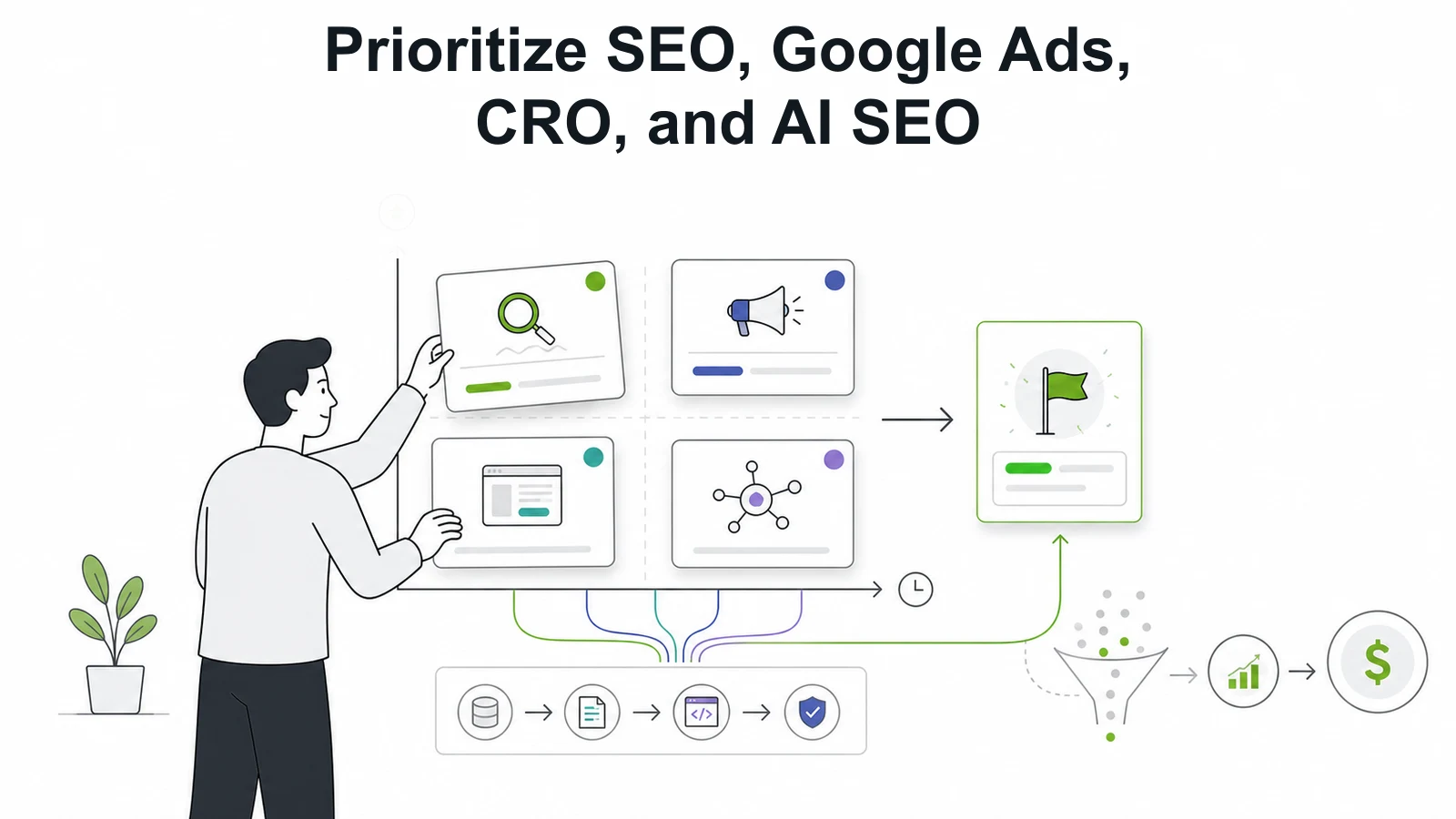
SEO, Google Ads, CRO, and AI SEO can all be valid growth work. They should not all be treated as equal next steps.
The right priority depends on the current bottleneck. If the tracking is unreliable, optimization work becomes guesswork. If high-intent traffic exists but does not convert, CRO may beat more acquisition. If demand exists but is not captured, SEO or Google Ads may move first.
Start with the constraint
Do not start with the channel you prefer. Start with the place where business value is currently blocked.
- Demand problem: the right buyers are not finding the offer often enough.
- Conversion problem: the right buyers arrive but do not take the next step.
- Measurement problem: the team cannot tell useful demand from noise.
- Visibility problem: the brand is missing from search, comparison, and AI-assisted research paths.
- Economics problem: revenue exists but margin or payback cannot support scale.
When each lane should lead
Google Ads should usually lead when high-intent demand exists and the team needs faster feedback. SEO should lead when demand is durable, paid media is expensive, and the site has gaps in category, service, comparison, or proof coverage.
CRO should lead when meaningful traffic already exists and the page journey is the obvious leak. AI SEO should lead when buyers increasingly research through answer-led paths and the brand lacks quotable, crawlable, proof-rich source material.
Score the next sprint
A simple scorecard is enough. Rate each option by business impact, confidence, speed to evidence, dependency risk, and owner availability. The highest score does not always win if a dependency blocks it.
- Impact: what business number can this move?
- Confidence: what evidence supports the move?
- Speed: how quickly can the team learn?
- Dependency: what has to be fixed first?
- Owner: who can actually execute it this month?
Keep the sequence short
The plan should name the next one or two moves, not every possible initiative. A focused sprint with a clear success measure beats a broad roadmap that nobody has capacity to execute.
Once the first bottleneck moves, rescore the system. Prioritization is an operating habit, not a one-time deck.
Decide from the current constraint
Prioritization gets easier when the team stops asking which channel is generally best. SEO, Google Ads, CRO, and AI SEO can all be useful. The right first move depends on the constraint that is currently limiting commercial progress.
If the business needs faster demand feedback and high-intent search demand exists, Google Ads may be the right learning engine. If paid acquisition is expensive and search demand is durable, SEO may build the asset base the business has been missing. If traffic is already meaningful and conversion is weak, CRO may move revenue faster than adding more visitors. If buyers are researching through answer-led surfaces and comparison queries, AI SEO may protect influence before the click.
The constraint should be written in plain language. The site does not have enough qualified demand. The site has demand but cannot convert it. The dashboard cannot tell signal from noise. The brand is absent from evaluation paths. The economics do not support more acquisition. A clear constraint prevents the roadmap from becoming a wish list.
Use a scoring pass without pretending it is exact
A simple scorecard can help, as long as the team treats it as a decision aid rather than a mathematical truth. Score each lane by likely business impact, confidence in the evidence, speed to learning, dependency risk, and available ownership. The scores should force a conversation about tradeoffs.
For example, SEO may have high long-term impact but low speed if technical cleanup and content production capacity are weak. Google Ads may have fast evidence but poor economics if margin is unclear. CRO may have high confidence if checkout or form friction is obvious. AI SEO may be important if the brand is already being compared by buyers, but it may depend on proof pages and entity clarity first.
The scorecard should also include a dependency line. If tracking is broken, all channel decisions become weaker. If margin is unknown, paid scale decisions become risky. If the website cannot clearly explain the offer, both SEO and CRO are constrained by the same positioning issue.
Examples of sensible first moves
If an e-commerce store has strong product demand, messy Shopping traffic, and uncertain margin, the first sprint may be tracking and product economics, followed by feed and campaign cleanup. SEO can wait until the store knows which categories deserve more demand.
If a service business has rising organic traffic, weak lead quality, and generic service pages, the first sprint may be commercial page improvement and internal linking from existing content. Publishing more articles may increase traffic while keeping the revenue problem untouched.
If paid search is already profitable and the site has thin comparison coverage, the first sprint may combine SEO and AI SEO around buyer questions. The goal would be to support evaluation, show proof, and reduce reliance on paid traffic for every high-intent visit.
Keep the plan short enough to execute
A useful priority plan usually covers one main sprint and one secondary dependency. More than that becomes a roadmap that looks responsible and behaves like avoidance.
Write the next move, the reason it leads, the evidence that supports it, the owner, the decision metric, and the next review date. If the sprint is Google Ads, name the campaign role and metric. If it is SEO, name the page group and search intent. If it is CRO, name the page and conversion action. If it is AI SEO, name the buyer questions and pages that need to become better sources.
Review the priority after the sprint. If the bottleneck moved, choose the next one. If it did not, decide whether the diagnosis was wrong, the implementation was weak, or the measurement was not able to see the change.
This makes prioritization easier to defend. The team can see why one lane leads, what was delayed, and what evidence would change the order next month.
It also protects focus. SEO, ads, CRO, and AI visibility all create plausible work, so the backlog will always look full. The plan should name the work that is deliberately waiting. That pause list is not neglect; it is the price of giving the current constraint enough attention to learn something useful.
.svg)
