
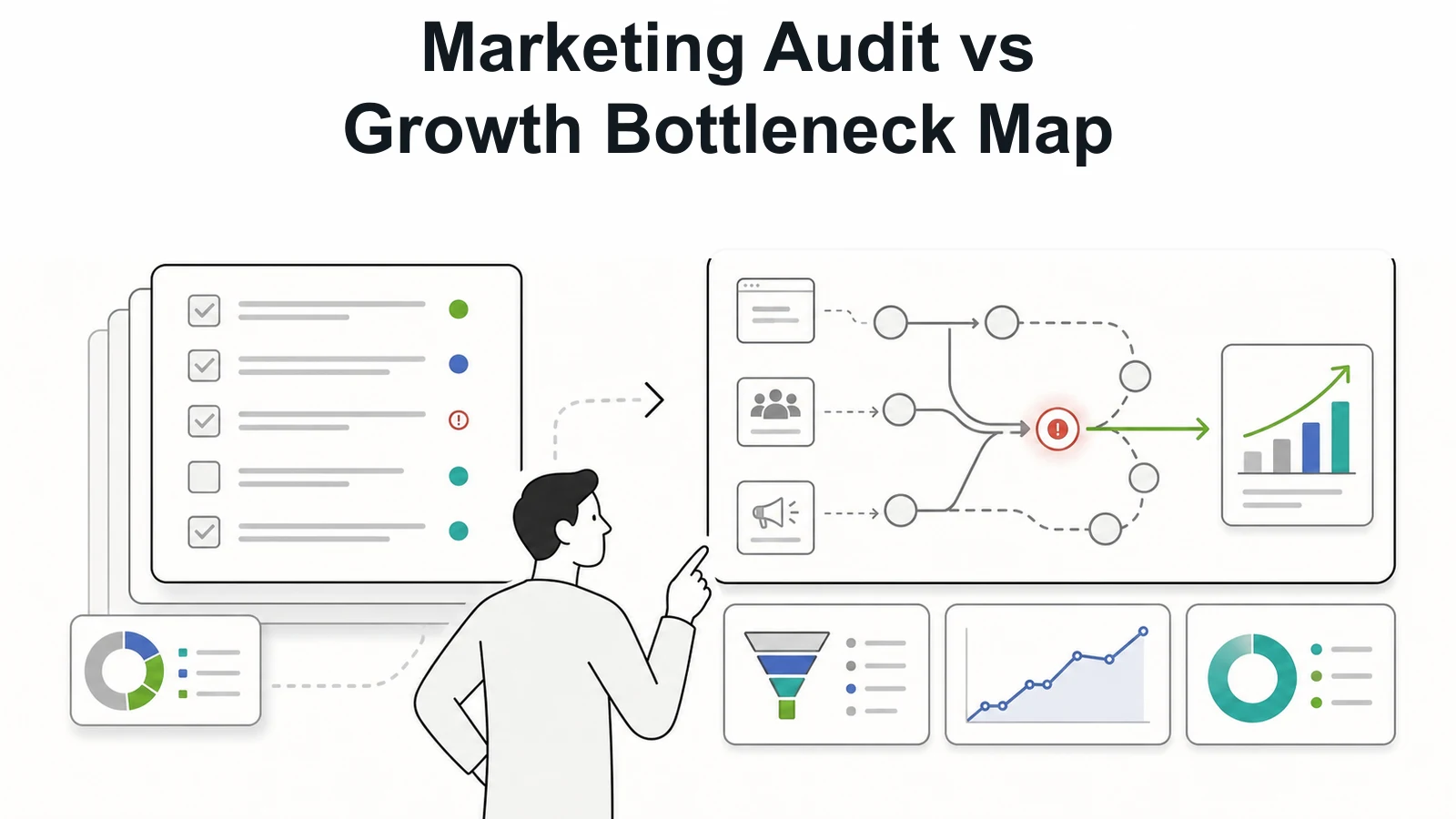
A marketing audit is useful when you need a clean view of what is broken inside a channel or system. A Free Growth Map is useful when the bigger question is what to fix first.
Without that separation, teams often collect more findings than they can act on. The map should turn those findings into a sequence tied to revenue, margin, lead quality, or implementation capacity.
What a marketing audit should answer
A good audit checks the current state. It should show where tracking is unreliable, where paid spend leaks, where SEO demand is underused, where landing pages create friction, and where reporting hides the real commercial signal.
The output is usually a list of issues, risks, and recommendations. That is valuable when the owner already knows the priority and needs better evidence inside one area.
- Use it when one channel has a clear owner and a clear problem.
- Use it when the team needs technical depth before changing the plan.
- Use it when a vendor, internal team, or campaign setup needs an independent check.
What a Free Growth Map should answer
A Free Growth Map starts with the business constraint, then works backward. It asks whether the next dollar is blocked by demand capture, conversion quality, tracking, offer clarity, sales follow-up, margin, or execution bandwidth.
The output should be a short action sequence. It should explain what to fix first, what to postpone, what evidence supports the decision, and what would change the priority later.
- Use it when SEO, Google Ads, CRO, and AI visibility all look important.
- Use it when traffic is growing but revenue is not moving with it.
- Use it when the team needs a sharper operating plan instead of another long issue list.
The main failure mode
The common failure is treating every finding as equal. A slow page, weak search term, missing conversion action, and unclear offer can all be true. They do not all deserve the same week of work.
The map forces tradeoffs. If tracking cannot tell qualified revenue from noise, scaling paid media is premature. If paid search already captures the best demand but landing pages underperform, CRO may beat another keyword expansion. If organic traffic is broad and low intent, more content can make the reporting look better while sales stays flat.
A useful decision rule
Run a marketing audit when the question is, what is wrong here? Build a Free Growth Map when the question is, what should we do next?
The strongest workflow uses both. Audit the evidence, then map the sequence. That keeps the plan grounded without letting the team drown in disconnected recommendations.
How to choose the right format
The choice usually depends on the decision sitting in front of the team. If the team already knows that Google Ads, SEO, analytics, or conversion rate is the working area, a channel audit can go deep enough to be useful. It can inspect setup, find weak signals, and explain why the current system is underperforming.
If the team is still arguing about which lane deserves the next month, a Free Growth Map is the stronger first step. It keeps the discussion above channel preference. The question becomes where revenue is stuck and what evidence would move it, rather than which team has the louder backlog.
This matters for e-commerce and service businesses in different ways. An e-commerce team may see paid media efficiency fall and assume the ad account needs restructuring. The actual constraint may be product margin, discounting, stock depth, tracking, or category page conversion. A service business may see organic traffic rise and assume SEO is working. The actual constraint may be lead quality, weak proof, unclear positioning, or slow sales follow-up.
What the audit should produce
A useful marketing audit should produce evidence that someone can act on. It should show the current setup, the likely business impact, the confidence level, and the practical fix. A list of findings without weight creates more internal debate. A list with impact, effort, and risk gives the owner a way to decide.
For tracking, that means the audit should separate missing data, duplicate data, soft conversions, and attribution limits. For paid media, it should separate spend leakage from necessary exploration. For SEO, it should separate technical blockers, intent mismatch, weak internal linking, and content that attracts the wrong audience. For CRO, it should separate obvious friction from ideas that need a proper test.
The audit does not need to solve the whole growth system. It needs to make the current area easier to understand. The best version gives the responsible person fewer places to hide and fewer low-value actions to chase.
What the map should produce
A Free Growth Map should turn multiple inputs into a short sequence. It can use audit findings, analytics, CRM notes, campaign data, search demand, page performance, and sales context. The output should be a practical order of operations, not a polished inventory of every possible improvement.
The map should name the constraint, explain why that constraint is more important than the others right now, and state what should happen next. If tracking is too weak, the first move may be measurement repair. If demand is already arriving and not converting, the first move may be landing page or offer work. If paid demand capture is strong but total growth is flat, the next move may be margin, customer mix, or non-brand acquisition analysis.
The map should also say what to pause. That is often the most useful part. It may tell the team to delay a content sprint, hold a budget increase, avoid a full redesign, or stop adding new reports until the primary conversion signal is fixed.
A good operating rhythm
The clean workflow is audit first where the system needs detail, then map the priority. A paid media audit can explain where spend leaks. An SEO audit can explain why revenue pages are not earning useful demand. A tracking audit can explain why the dashboard cannot support budget decisions. The Free Growth Map then decides which finding becomes the next operating priority.
That rhythm keeps the team from confusing effort with progress. It also makes the next meeting shorter. Instead of debating ten findings from ten directions, the team can ask whether the chosen bottleneck is still the constraint, whether the evidence changed, and whether the next sprint moved the business number it was meant to move.
The final deliverable should be short enough to run from. A good map can fit in one operating document: constraint, evidence, first action, owner, measurement, pause list, and review date. If the output needs a long explanation before anyone can act, it is probably still an audit pile rather than a decision map.
.svg)
