
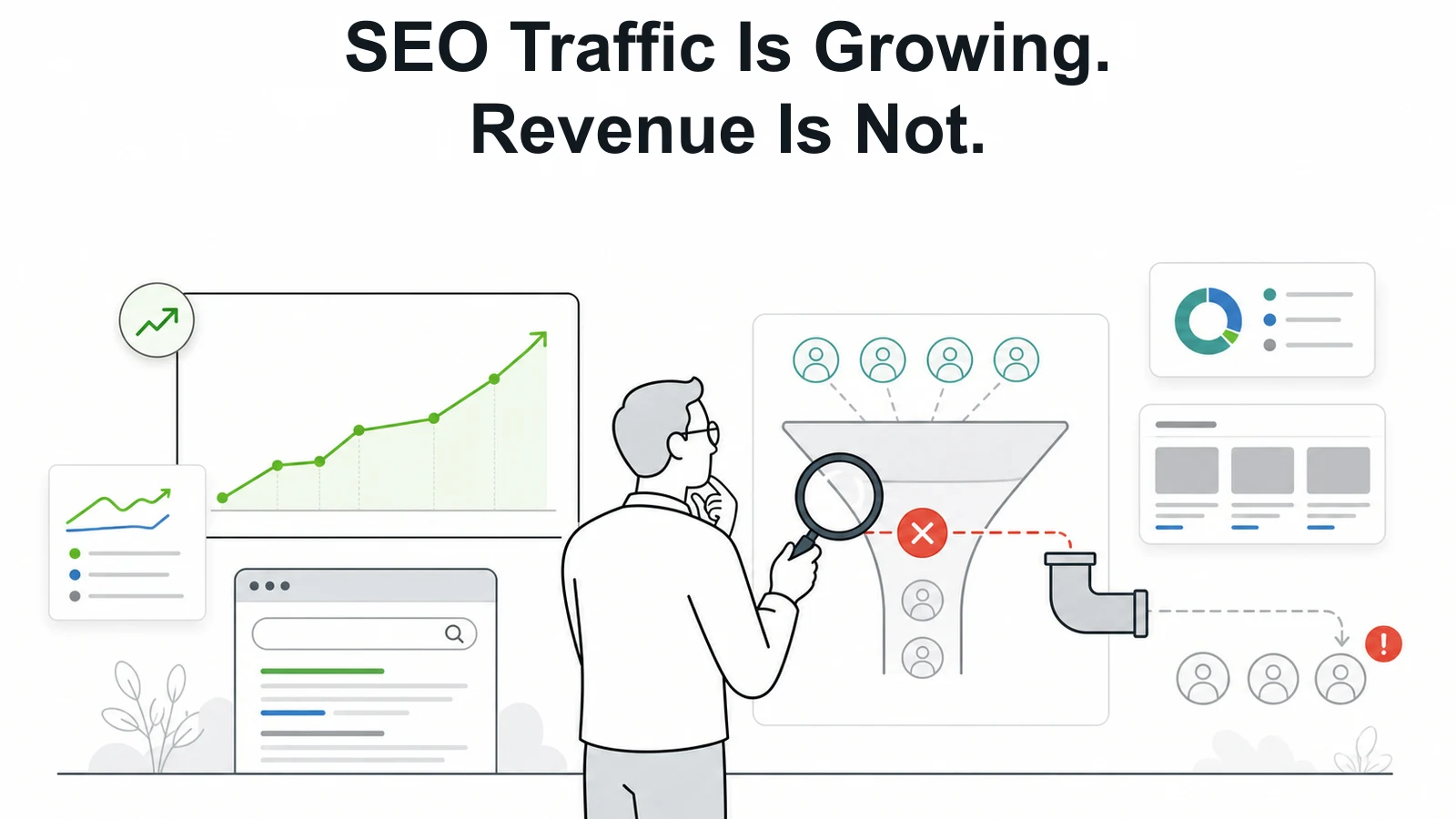
Growing organic traffic is not the same as growing revenue.
The uncomfortable version is when search visibility improves, dashboards look better, and sales still does not feel the change. That usually means the traffic is real, but the commercial path around it is weak or misread.
Check the intent mix
Start by separating informational, comparison, category, product, service, and branded traffic. A traffic lift from broad articles can be useful, but it will not behave like high-intent category, product, or service demand.
If the increase is mostly low-intent, revenue may lag until the site has a path from education to evaluation and purchase.
- Which pages gained traffic?
- Which queries gained impressions and clicks?
- Do those pages have a natural next commercial step?
- Do they attract the buyer, or only the researcher?
Check the landing page job
A page may rank for a useful query but fail the job after the click. The offer may be vague, the product fit may be unclear, the proof may be too far down the page, or the call to action may ask for too much too early.
Look at the pages that gained traffic and ask what action a qualified visitor should take next. If that answer is not obvious on the page, the SEO gain is not yet a revenue gain, even if rankings improved.
Check attribution and sales quality
Revenue can also be undercounted. Organic search often assists branded search, direct visits, paid retargeting, and sales conversations. If CRM source fields, lead quality stages, or assisted conversion views are messy, SEO may look weaker than it is.
At the same time, do not use attribution uncertainty as an excuse. If organic traffic is rising, the team should still be able to show directional movement in qualified enquiries, product revenue, assisted pipeline, or useful sales conversations.
What to do next
Fix the revenue path before publishing more of the same content. Strengthen internal links into money pages. Add proof and comparison content where buyers evaluate options. Improve category and product pages. Tighten forms, calls, and CRM tracking.
More traffic helps only when the site knows what to do with the visitors it already earns.
Start with the pages that changed
The fastest way to understand the gap is to separate the pages that gained traffic from the pages that can create revenue. If the increase came from blog posts, glossary pages, or broad informational queries, the business may have gained visibility without gaining buyer intent.
That is not automatically bad. Educational pages can build assisted demand, improve internal linking, and help buyers understand the problem. They become weak when they sit as isolated traffic assets. If the page does not point to the relevant product, service, comparison, category, or proof page, the visitor has to design the journey alone.
Review the top growth pages one by one. Ask what job each page performs for a buyer, what next page it should lead to, and whether that next step is visible above the point where most users leave.
Separate ranking progress from commercial progress
SEO reports often blend ranking gains, impression gains, traffic gains, and business gains into one story. The numbers can all improve while revenue stays flat because each one answers a different question.
Impressions show that Google is testing or showing the site more often. Clicks show that users chose the result. Sessions show that the site received traffic. Qualified enquiries, sales, assisted pipeline, and revenue show whether that traffic found a path into the business. A useful review keeps those layers separate.
When the traffic lift is real but revenue does not move, the next check is usually intent, path, or measurement. The query may be too early. The page may be too weak. The conversion event may be missing. The CRM may not capture the source well enough. Treat each possibility as a testable path instead of assuming SEO either worked or failed.
Look for weak internal links and missing proof
Many sites earn informational traffic and then leave money pages underlinked. A useful article may mention the problem, explain the context, and stop before connecting the reader to the buying path.
Internal links should not be decorative. They should help the reader move from learning to evaluating. A page about organic traffic and revenue should connect to SEO audits, growth maps, tracking checks, relevant case studies, and commercial pages that explain how the problem gets fixed.
Proof also needs to sit closer to the decision. If a visitor reaches a service page after reading an article, the page should quickly show who the service is for, what constraints are usually found, how the work is sequenced, and what evidence supports the approach. Without that, traffic can increase while trust stays too low for action.
Use the next 30 days to repair the path
A practical 30-day response starts with the highest-traffic growth pages. Add or improve internal links to relevant commercial pages. Clarify the next step on pages where the buyer intent is stronger. Update CTAs so they match the stage of the reader. A broad educational article may need a diagnostic next step, while a comparison page can ask for a more direct conversation.
Then review the money pages. If category, product, service, or comparison pages are thin, the site may have traffic without enough conversion assets. Strengthen the pages that should turn search demand into revenue before publishing another batch of low-intent posts.
Finally, repair reporting. Track assisted conversions where possible, review lead quality in the CRM, and compare branded search movement after organic visibility grows. That comparison shows whether SEO is creating weak traffic, untracked influence, or demand that the site is failing to convert.
A simple page group report can help. Group pages by education, comparison, category, product, service, proof, and conversion. Then compare traffic growth, next-page movement, conversion actions, and assisted value. The pattern usually shows whether SEO needs better content, better internal routing, or better commercial pages before more publishing work starts again in earnest.
Keep the repair list narrow. Choose the pages that gained meaningful traffic, the pages that should create revenue, and the links or proof blocks that connect them. If the first repair pass improves movement from education to evaluation, the site can earn more from existing traffic before the content calendar expands again.
.svg)
