
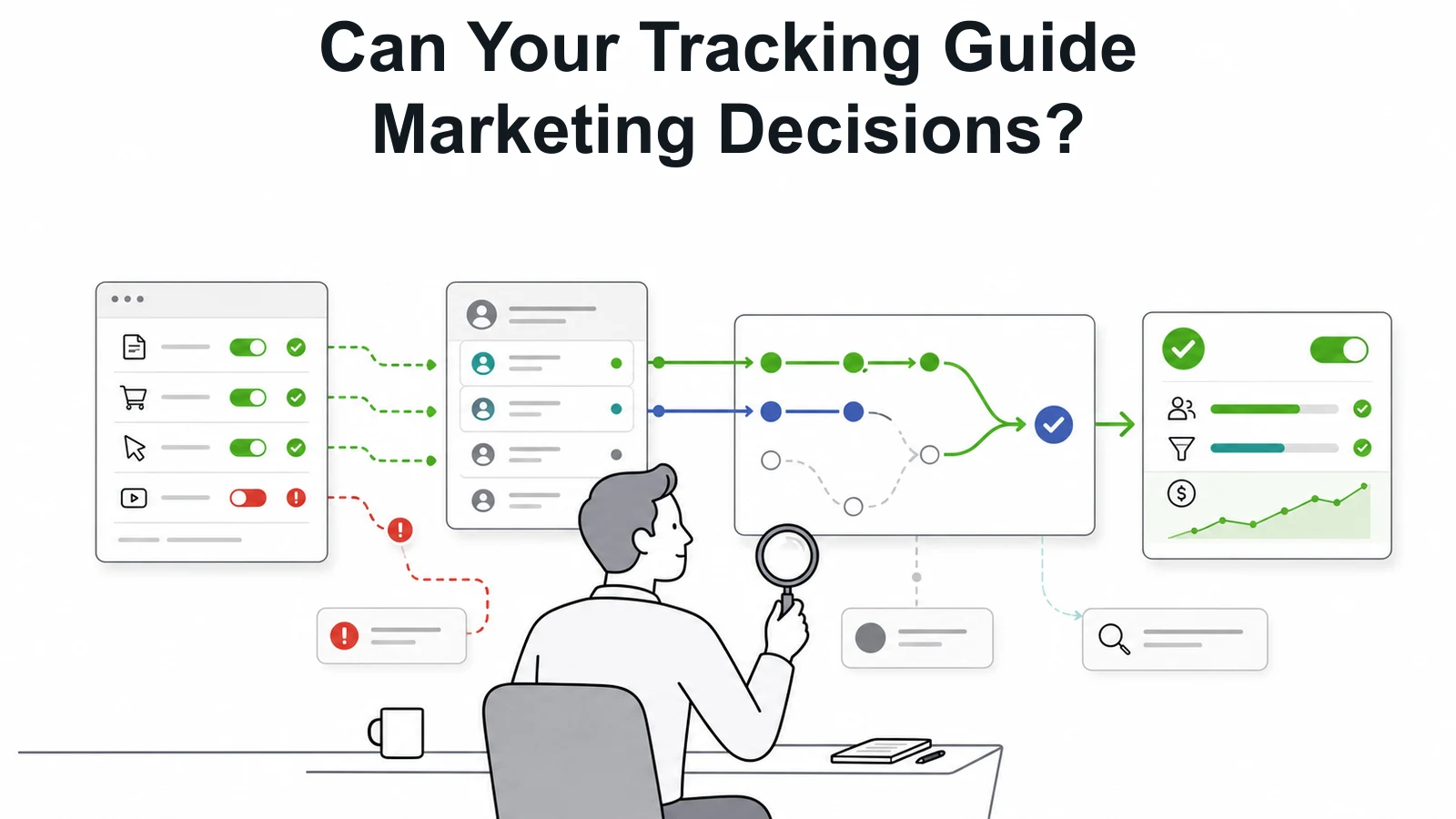
Tracking does not need to be perfect before a team makes decisions. It does need to be honest about what it can and cannot tell you.
The question is whether the data is good enough for the decision being made. Budget shifts, bidding, SEO priorities, CRO work, and sales follow-up all need different levels of confidence.
Check the source of truth
Start by naming the system that decides whether marketing created useful business value. For e-commerce, that may be the commerce platform plus margin data. For lead generation, it may be the CRM stage and revenue view.
If every tool tells a different story and nobody knows which one wins, the team will optimize toward the cleanest dashboard instead of the best business outcome.
Check event quality
A conversion event should represent a real step toward revenue. If the main event is too soft, duplicated, missing on key pages, or mixed with unqualified actions, it cannot guide budget safely.
- Are purchases, leads, calls, and forms firing once per real action?
- Are primary and secondary conversions separated?
- Are test submissions, spam, refunds, and internal traffic handled?
- Are offline or CRM outcomes imported with enough quality detail?
Check decision fit
Different decisions require different tracking quality. A rough directional view may be enough to spot a broken landing page. A large paid media budget increase needs stronger conversion, margin, and attribution confidence.
Before a major decision, ask what would have to be true for the data to be misleading. That question usually exposes the weak point.
Use confidence labels
Do not force uncertain data to sound precise. Label views as reliable, directional, or suspect. Then match the action size to the confidence level.
Reliable data can guide budget movement. Directional data can guide tests. Suspect data should trigger repair before it controls bidding or strategy.
Match tracking quality to decision size
A tracking setup can be useful for one decision and too weak for another. A rough directional view may be enough to notice that mobile conversion is lower than desktop. It may not be enough to shift a large budget into automated bidding or judge whether a channel is profitable.
Start by naming the decision. Are you choosing which campaign gets more budget, whether SEO is producing qualified demand, whether a landing page should be redesigned, whether an agency is doing useful work, or whether the business can scale paid media? Each decision needs a different level of confidence.
For small tests, directional data can be acceptable if the risk is low and the learning is useful. For budget increases, bidding changes, channel cuts, and hiring decisions, the data should be much stronger. The larger the action, the more the team should understand what the tracking can miss.
Build a clean conversion hierarchy
A good tracking setup separates primary business outcomes from supporting actions. Purchases, qualified leads, sales-accepted opportunities, and booked calls may be primary depending on the business. Add-to-cart, form starts, page views, downloads, and email signups may be useful supporting signals, but they should not silently control the main optimization logic.
Review every conversion action by three questions. Does it fire once per real action? Does it represent value close enough to revenue? Does it send the ad platform or reporting team a clean signal? If the answer is weak, mark the event as secondary, repair it, or remove it from bidding until it is trustworthy.
For lead generation, the CRM stage matters. A form submission can be cheap and still useless. If the sales team rejects most leads from a campaign, that quality signal needs to reach reporting. For e-commerce, revenue quality matters. Refunds, discounts, low-margin products, and returning customer behavior can all change the meaning of a conversion.
Check whether systems agree enough
Analytics, ad platforms, the CMS, the commerce platform, call tracking, and the CRM will rarely match perfectly. Perfect agreement is unrealistic; the team needs to understand the difference well enough to avoid bad decisions.
If Google Ads shows more conversions than the commerce platform, check duplicate tags, attribution windows, modeled conversions, and imported events. If GA4 undercounts compared with the backend, check consent, browser restrictions, tag firing, and checkout domains. If the CRM disagrees with marketing reports, check source fields, lifecycle stage timing, duplicate leads, and manual edits.
Write down which system wins for each decision. The commerce platform may win for order revenue. The CRM may win for lead quality. GA4 may help with page behavior. Google Ads may help with campaign mechanics. Once the source of truth is named, reporting conversations become more useful.
Use confidence labels in reporting
A dashboard should not present every number with the same confidence. Label views as reliable, directional, or suspect. Reliable numbers can guide larger decisions. Directional numbers can guide tests. Suspect numbers should trigger repair before they shape strategy.
This small habit changes the conversation. Instead of debating whether a number is perfect, the team can decide whether it is good enough for the action being considered. A directional landing page signal may justify a CRO test. A suspect purchase event should not justify a bidding strategy change.
The best tracking setups are not the most complex. They are the ones that make decisions safer. If the team knows what the data proves, what it suggests, and what it cannot see, marketing can move faster without pretending the dashboard is more precise than it is.
End each reporting review with the decisions the data can support. If the answer is only a small test, keep the action small. If the data is reliable enough for budget movement, document the guardrail and move. If the data is suspect, the next task is repair, not another interpretation of the same broken number. That discipline keeps tracking from becoming theatre and keeps meetings attached to action. It also makes reporting calmer because uncertainty is named instead of hidden inside another dashboard debate or another attribution argument about whose number wins for the month. The decision should still move.
The final check is ownership. Every suspect signal should have a named owner and a repair path. Without that, teams keep discussing the same broken metric for months. Tracking becomes useful when the report says what can be decided today, what can only be tested, and what must be fixed before it earns influence.
.svg)
