
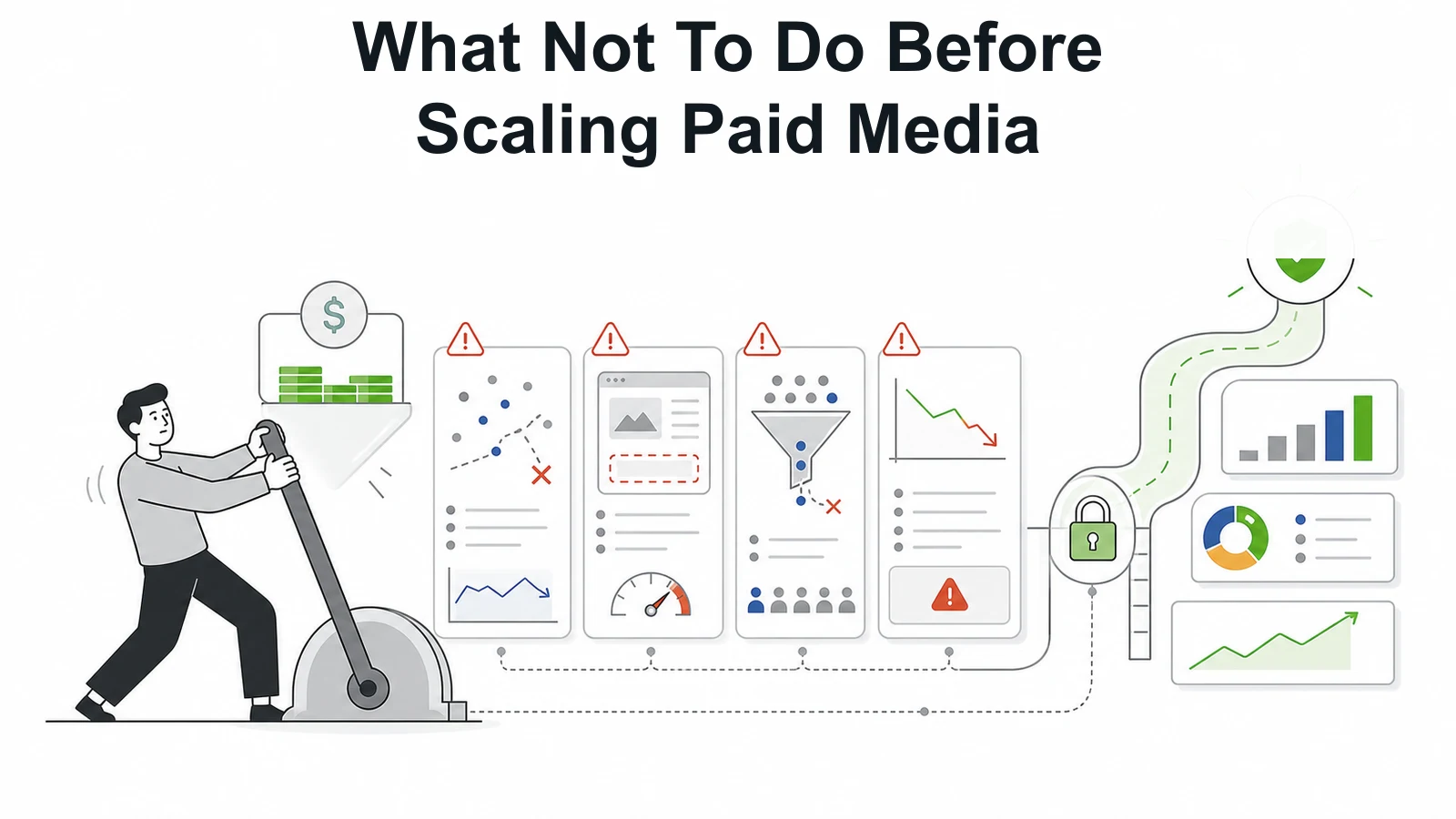
Scaling paid media too early usually makes existing problems more expensive.
Before raising budgets, the team should know which demand is profitable, which conversion signals are trustworthy, which pages can hold traffic, and which campaigns are only harvesting demand that already existed.
Do not scale before tracking is decision-ready
If the account is optimizing toward duplicate purchases, soft leads, unqualified calls, or incomplete offline data, higher spend will teach the system the wrong lesson faster.
Fix the primary conversion hierarchy first. Separate useful business outcomes from supporting events. Make sure imported revenue or lead quality does not reward noise.
Do not scale before margin is visible
Revenue volume can hide weak economics. Before increasing spend, confirm which products, services, regions, or customer groups can actually support the acquisition cost.
For e-commerce, discounts, returns, shipping, payment fees, stock depth, and product-level margin can change the answer. For lead generation, sales acceptance and close quality matter more than raw form volume.
Do not scale a messy account structure
Budget increases should not reward avoidable leakage. Review search terms, negatives, match types, product feed quality, campaign roles, audience overlap, geography, device performance, and brand versus non-brand split before the account receives more room.
Do not scale pages that cannot carry intent
Paid traffic exposes landing page weakness quickly. If the page does not match the promise, explain the offer, handle objections, show proof, and make the next action clear, more spend will mostly buy more friction.
Scale after the constraint is named
The safest pre-scale question is simple: what exactly are we scaling? If the answer is unclear, the next step is not more budget. It is a tighter map of the constraint, the economics, and the first test that can prove the system is ready.
Do not scale before the account role is clear
A paid media account needs clear campaign roles before it receives more money. Brand defense, non-brand acquisition, remarketing, product testing, demand creation, and retention support should not be judged by one blended target. Each role should have its own expectation and budget logic.
If the account role is unclear, scaling usually funds whatever the platform can find most easily. That may be returning customers, branded queries, low-margin products, broad audiences, or soft conversion actions. The spend can rise while the business learns very little.
Before scaling, write the role of each campaign or campaign group. What demand is it supposed to reach? What conversion or revenue quality should it create? What would make the team reduce budget? If those answers are missing, the next step is account clarity, not a larger daily budget.
Do not scale before landing pages can hold the intent
Paid traffic is less forgiving than organic traffic because every weak click has a visible cost. If the landing page does not match the query, product, audience, or creative promise, more spend turns the mismatch into a larger bill.
Check the pages that will receive the next budget increase. A product page should answer the questions that block purchase: fit, variants, shipping, returns, reviews, price, proof, and availability. A service page should explain the problem, the process, who it is for, proof, and the next step. A collection page should help a buyer choose, not only list products.
Mobile deserves its own review. Many accounts look acceptable in aggregate while mobile carries a large share of waste. Speed, layout, sticky elements, checkout friction, form usability, and payment options can all decide whether the next spend tier works.
Do not scale without a stopping rule
Scaling should have a pre-agreed stop rule. Without one, teams often keep spending because the test has not had enough time, the platform needs more data, the month is not over, or someone wants to wait for the next reporting cycle.
A stopping rule can be simple. If search term quality falls below a threshold, pause expansion. If contribution margin drops under the guardrail, reduce budget. If lead quality stays weak after enough volume, change the conversion action or audience. If MER worsens beyond the agreed range, stop the increase and diagnose.
The point is not to avoid risk. Paid media growth always carries risk. The point is to define the risk before the account is under pressure, so the team does not negotiate with bad data in the middle of the test.
Do not scale before creative quality is understood
Creative can hide spend leakage because the platform sees engagement before the business sees revenue. A hook may attract curiosity from people who like the angle but have no realistic buying intent. A product demo may create clicks without answering the objections that block purchase. A service ad may sound sharp while sending the wrong type of lead.
Before scaling, review creative by promise, audience, landing page match, and downstream quality. Keep the concepts that attract buyers who continue through the funnel. Pause or isolate concepts that mostly create cheap traffic, low-quality leads, or product interest that cannot convert profitably. Creative deserves the same quality review as keywords, audiences, and landing pages before the next spend increase is approved by the team responsible for growth this quarter and the next budget cycle, with clear ownership and a review date agreed upfront.
Scale in increments tied to evidence
Budget increases should follow evidence, not optimism. Move in steps large enough to learn and small enough to recover. After each step, check campaign role, search terms or audience quality, conversion value, margin, new customer share, MER, and landing page behavior.
If the account holds quality, the next increase can be justified. If the account starts buying weaker demand, the team has learned where the current boundary sits. That learning is valuable because it prevents the business from treating a temporary efficiency number as a stable scaling signal.
The cleanest paid media scale plans are boring in the right way. They know the economics, control the signal, improve the page path, define the stopping rules, and let the account earn more budget with evidence.
After each increment, record the decision in plain language. Which spend was raised, which signal held, which signal weakened, and what happens next? That note keeps the team from retelling the test differently later. It also makes future scaling calmer because every increase has a memory of the evidence that justified it and the conditions that would reverse it before losses become normalized inside the monthly plan and the next budget review cycle too.
.svg)
