
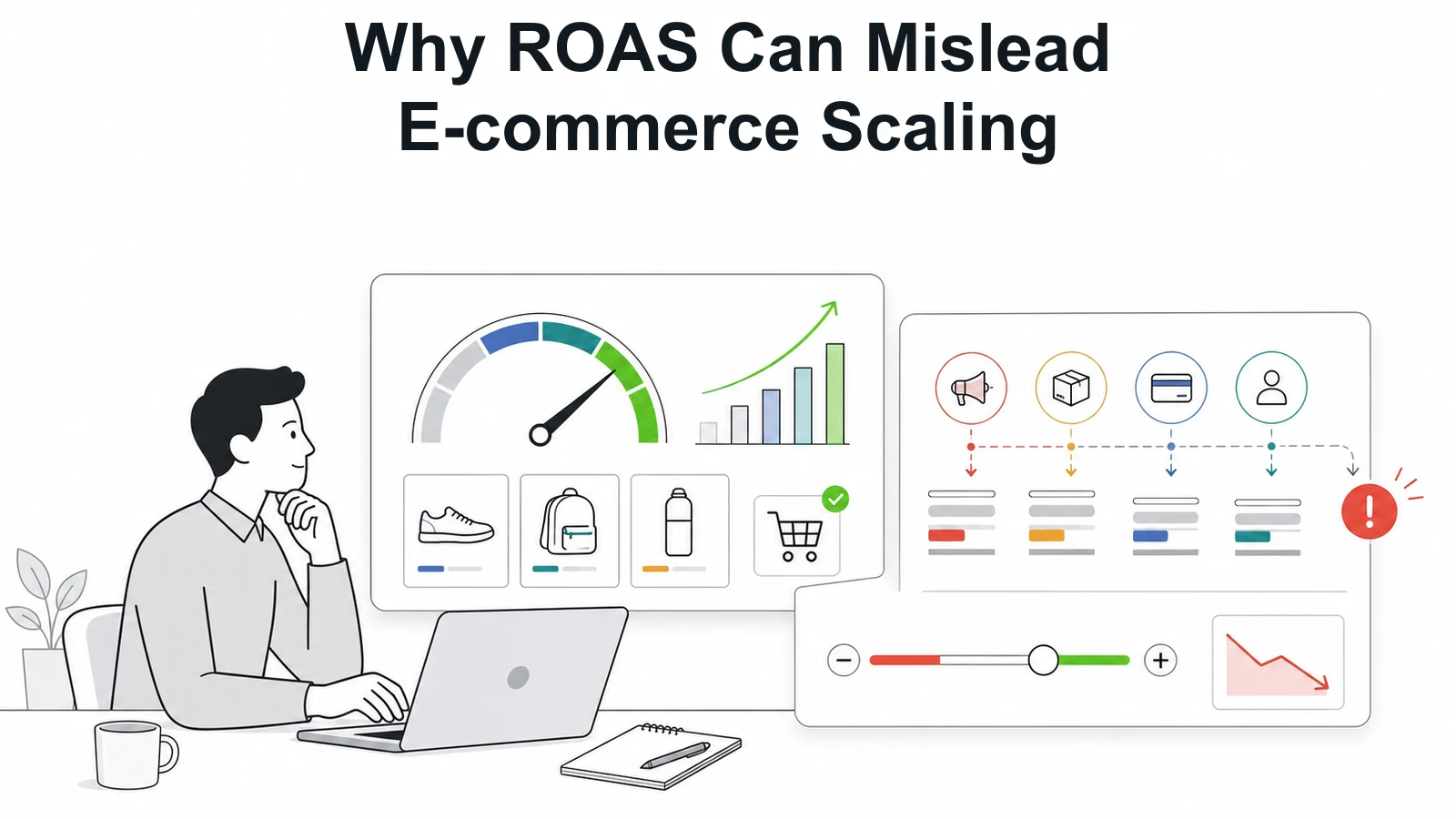
ROAS is useful inside the ad account. It is risky as the main scaling metric.
ROAS measures attributed revenue against ad spend, but that is only one layer of the scaling decision. It does not automatically show margin, incrementality, new customer quality, discount pressure, cash timing, or the sales that would have happened anyway.
Why high ROAS can still be weak growth
A campaign can report strong ROAS because it captures branded demand, retargets existing buyers, or sells a low-margin product that looks good in revenue terms. That does not mean the next budget increase will create profitable new demand.
This is especially common when campaigns mix prospecting, remarketing, shopping, brand, and loyalty traffic into one reporting view.
- Branded and returning-customer revenue can make acquisition look stronger than it is.
- Discounted orders can lift conversion rate while reducing contribution margin.
- Average ROAS can hide that the next spend tier is much less efficient.
Where ROAS helps
ROAS is still useful for spotting obvious account-level problems. It can show which campaign, product group, keyword set, or creative cluster is moving revenue relative to spend.
Use it as a diagnostic view. Do not let it become the only scale gate.
What to check before scaling
Before increasing budget, connect ROAS to the commercial model. The team should know what margin is left after cost of goods, shipping, payment fees, discounts, returns, agency or internal media cost, and any platform fees that matter to the decision.
Then separate new customer acquisition from demand harvesting. If the extra budget mostly buys existing demand, the reported ROAS can stay attractive while real growth stays thin.
- Contribution margin by product or category.
- New customer revenue versus returning customer revenue.
- MER and blended acquisition cost, not only platform ROAS.
- Search term, audience, and product feed leakage.
- Landing page conversion rate and average order value by campaign intent.
The better scaling question
Do not ask only whether ROAS is high enough. Ask whether the next spend increase is likely to create profitable revenue that would not have arrived anyway.
That question usually needs ROAS, MER, margin, customer mix, and channel context together. Any one metric alone is too easy to misread.
Separate campaign roles before reading ROAS
The first mistake is reading all ROAS as if every campaign has the same job. Brand search, remarketing, shopping, Performance Max, non-brand search, YouTube, and social prospecting can all sit inside one media plan while doing very different work. Some capture existing demand. Some create or qualify demand. Some defend shelf space. Some test whether a new product angle can earn attention.
When those roles are mixed, the account average can look cleaner than the business reality. A high-return brand campaign may make the paid channel look efficient while the acquisition campaigns struggle to create profitable new revenue. A strong retargeting view may mostly show that existing site visitors already had intent. A product campaign may look weak because it carries exploration that other campaigns later harvest.
Before scaling, the team should tag campaigns by role. Demand capture, demand creation, retention, remarketing, product testing, and brand defense should be read separately. ROAS is more useful after the job is named.
Connect ROAS to margin and cash
Revenue is only part of the scaling decision. Two campaigns can show the same ROAS and create very different business outcomes if product margin, discounting, refunds, payment fees, shipping, fulfillment cost, and stock depth are different.
A product with a higher order value can still be weaker if margin is thin or returns are heavy. A campaign can sell discounted items quickly and still reduce contribution profit. A strong ROAS can hide that the business is borrowing from margin to make the ad account look healthy.
The practical check is to build a simple contribution view beside platform reporting. It does not need to be a perfect finance model on day one. It should at least show which product groups can support more paid acquisition and which ones need a different target, a different campaign role, or less budget.
Watch the next spend tier
Scaling is decided at the margin. The current ROAS tells you what happened at the current spend level. It does not prove that the next budget tier will behave the same way.
As budgets rise, the account often moves into broader queries, weaker audiences, less proven product groups, higher auction pressure, or less qualified placements. That can be acceptable if the business is intentionally buying new customers or testing new demand. It becomes a problem when the team expects the same average return and plans inventory, cash, or hiring around it.
A safer scale plan uses increments. Raise budget in controlled steps, watch marginal return, separate new customer revenue from returning customer revenue, and check whether MER moves in the same direction as platform ROAS. If MER weakens while platform ROAS stays attractive, the platform may be taking credit for demand the business already had.
Use ROAS as a diagnostic, then decide with economics
ROAS earns its place when it helps explain account mechanics. It can show that one product group is underpriced, one search theme is too broad, one campaign is capturing brand demand, or one bidding strategy is rewarding the wrong conversion.
The scaling decision needs a wider view. Margin sets the floor. MER shows whether total media spend is moving total revenue efficiently. New customer share shows whether the account is expanding the customer base. Product-level contribution shows whether the sales are worth buying. ROAS then helps the team find the campaign-level cause.
A good scale meeting should therefore start outside the ad platform and move inward. Confirm the economics, check blended movement, then open the campaign view. That order prevents the account from winning the argument simply because it has the cleanest dashboard. It also helps finance, marketing, and operations talk about the same decision instead of defending separate reports, especially when inventory, cash, and acquisition targets all depend on the answer. The final yes should come from the business model first, with the platform view used to explain how to operate the account.
For stores with mixed catalogs, the meeting should also separate product groups. A blanket ROAS target can punish a higher-margin category that deserves more acquisition budget and protect a lower-margin category that only looks efficient because demand is already warm. Scaling is clearer when each product group has its own role, margin view, and next-spend assumption.
.svg)
